


Major brokerages, including Barclays PLC, BNP Paribas SA and Deutsche Bank AG, expect a 25-basis-point US Federal Reserve rate cut next month following Fed Chair Jerome Powell’s shift in tone at the Jackson Hole symposium toward rising risks in the labor market.
“This unusual situation suggests that downside risks to employment are rising,” Powell told international economists and policymakers at the Fed’s annual conference in Wyoming on Friday, adding that such risks could materialize quickly in the form of layoffs and a spike in unemployment.
In notes released on Friday after Powell’s speech, Barclays pulled forward its previously expected September next year cut to a cut next month.
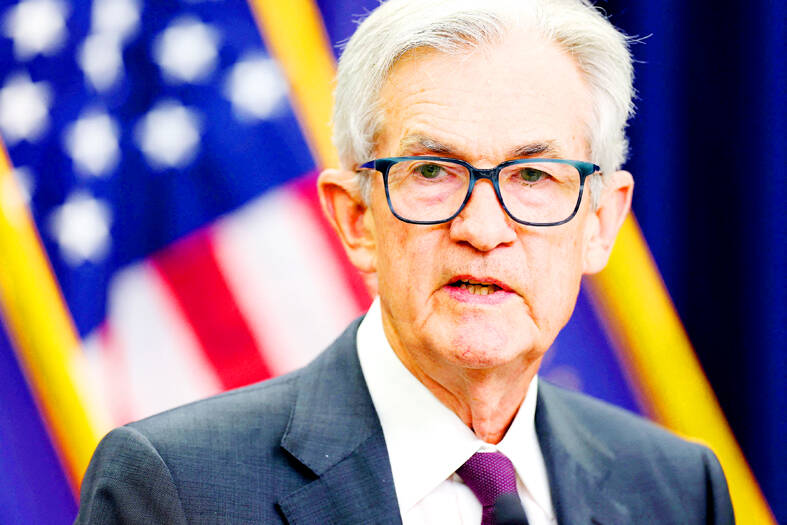
Photo: Reuters
His speech introduced “an easing bias” and raised the bar for not cutting, the the London-based bank said.
“Powell made [it] clear that the Fed intends to deliver a ‘fine-tuning’ rate cut in September unless the data dictates otherwise,” BNP economists led by Calvin Tse (謝文華) wrote in a note.
They reversed the brokerage’s long-standing call for the Fed to stay on hold, forecasting cuts next month and in December.
Meanwhile, Macquarie Capital Ltd and Deutsche Bank revised their expectations of a cut next month and in December, respectively, to a 25-basis-point cut each in those two months.
Bank of America Corp, which expects no rate cuts this year, said “barring further deterioration of the labor market, we think that the Fed would risk a policy error if it were to cut rates,” and pointed to signs of a rebound in economic activity and persistent inflation pressures.
Morgan Stanley also does not expect a cut next month yet, but said such a move is likely if incoming labor and inflation data confirm further softening.
Markets are now pricing in an 87 percent chance of a quarter-point rate cut at the Federal Open Market Committee (FOMC) policy meeting next month, the CME FedWatch Tool said, up from 75 percent before Powell’s speech.
The rate-setting FOMC is scheduled to meet again on Sept. 16 and 17.
Meanwhile, Goldman Sachs Group Inc and JPMorgan Chase & Co reaffirmed their expectations for a cut next month, aligning with the broader market view that softening data might warrant policy easing.

The EU and US are nearing an agreement to coordinate on producing and securing critical minerals, part of a push to break reliance on Chinese supplies. The potential deal would create incentives, such as minimum prices, that could advantage non-Chinese suppliers, according to a draft of an “action plan” seen by Bloomberg. The EU and US would also cooperate on standards, investments and joint projects, as well as coordinate on any supply disruptions by countries like China. The two sides are additionally seeking other “like-minded partners” to join a multicountry accord to help create these new critical mineral supply chains, which feed into

For weeks now, the global tech industry has been waiting for a major artificial intelligence (AI) launch from DeepSeek (深度求索), seen as a benchmark for China’s progress in the fast-moving field. More than a year has passed since the start-up put Chinese AI on the map in early last year with a low-cost chatbot that performed at a similar level to US rivals. However, despite reports and rumors about its imminent release, DeepSeek’s next-generation “V4” model is nowhere in sight. Speculation is also swirling over the geopolitical implications of which computer chips were chosen to train and power the new

Elon Musk’s lieutenants have reached out to chip industry suppliers, including Applied Materials Inc, Tokyo Electron Ltd and Lam Research Corp, for his envisioned Terafab, early steps in an audacious and likely arduous attempt to break into the production of cutting-edge chips. Staff working for the joint venture between Tesla Inc and Space Exploration Technologies Corp (SpaceX) have sought price quotes and delivery times for an array of chipmaking gear, people familiar with the matter said. In past weeks, they’ve contacted makers of photomasks, substrates, etchers, depositors, cleaning devices, testers and other tools, according to the people, who asked not to

Japan approved ¥631.5 billion (US$3.97 billion) in additional subsidies to hasten Rapidus Corp’s entry into the high-stakes artificial intelligence (AI) chipmaking arena, ramping up support for a project widely regarded as a long shot. The capital is intended to bankroll Rapidus’ work for information technology firm Fujitsu Ltd, one of the initial customers that Tokyo hopes would get the signature endeavor off the ground. The new money raises the fees and investments that the government is injecting into the start-up to ¥2.6 trillion by the end of the current fiscal year to March next year, the Japanese Ministry of Economy, Trade and


 RSS
RSS