


KGI Financial Holdings (KGI) is redefining employee wellness by blending physical activity with purpose-driven engagement. Through its long-standing commitment to talent development, the China Development Foundation launched this year’s “Seeing Talent” summer camp, inviting scholarship recipients and national athletes to coach employees in a series of high-energy sports sessions. The initiative transforms philanthropy from passive giving into active, meaningful connection.
The foundation, known for programs like “Dumbo in Our Class” and the “Skills and Expertise Scholarship”, has consistently supported emerging talent in sports, the arts, and vocational education. To showcase the impact of these efforts, the foundation hosts the “Seeing Talent” camp annually. This year’s program featured lifestyle weightlifting, badminton, pickleball, and Latin dance—all taught by young athletes and scholarship recipients who brought their expertise and enthusiasm directly into the workplace.
Angelo J.Y. Koo, Chairman of China Development Foundation, a fitness enthusiast himself, expressed pride in seeing these young talents share their skills with employees. He emphasized the importance of physical activity in boosting productivity and overall well-being. The “Seeing Talent” initiative, he noted, offers employees a chance to recharge both mentally and physically, fostering a happier and more balanced work environment.
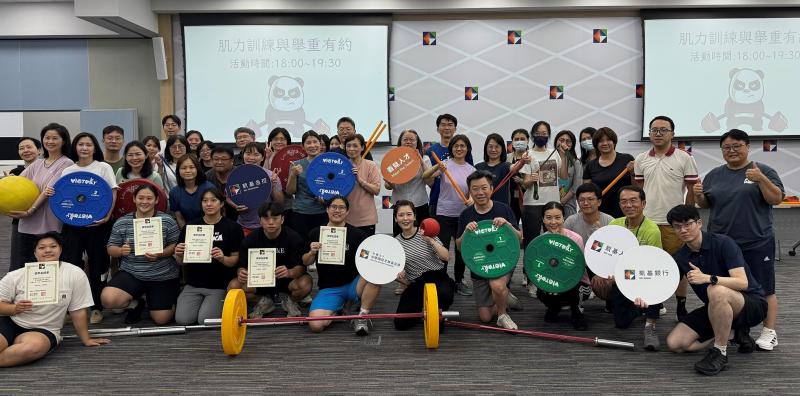
Photo courtesy of KGI Financial Holdings
Highlights included a lifestyle weightlifting class led by a national team athlete, teaching safe lifting techniques applicable both in the gym and daily life. Badminton sessions, guided by top-tier players Hsu Yun-Hsuan and Lee Chia-Hsin from National University of Kaohsiung, were filled with energy and laughter. A trending pickleball workshop, hosted by student athletes from Taipei’s Xihu Junior High School tennis team, gave employees a taste of badminton, tennis, and table tennis all in one. The Latin dance workout, led by national athlete Huang Shu-Han from National Taiwan Sport University, offered a vibrant way to burn calories and relieve stress.
Employees praised the young coaches for their energy and professionalism, noting that the sessions not only made fitness fun but also strengthened team bonds. Through the “Seeing Talent” camp, the China Development Foundation brings public service into everyday life—supporting young dreamers while empowering employees to become their most authentic allies. It’s a shared journey of inspiration and growth, fulfilling the foundation’s dual promise: Talent Development x Happy Workplace.

Netherlands-based semiconductor equipment supplier ASML Holding NV yesterday said that it is planning to hire an additional 1,000 people in Taiwan this year in response to growing demand from clients. ASML had previously planned to recruit 600 people this year, but that the plan has been adjusted upward, ASML vice president and ASML Taiwan general manager Grace Wang (汪佳慧) told reporters. ASML has a workforce of more than 4,500 in Taiwan, accounting for about 10 percent of its global total, Wang said. This year’s recruitment campaign would focus on adding people in the customer support, manufacturing and supply chain domains to assist ASML
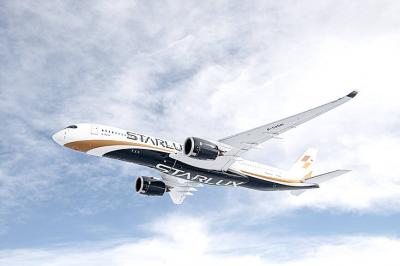
Starlux Airlines Co (星宇航空) today unveiled a long-haul network expansion plan at a shareholders’ meeting in Taipei, including direct flights to Barcelona, Spain, and Zurich, Switzerland, as well as a service connecting Taipei, Sydney and New Zealand. Starlux is to become the first Taiwanese carrier to offer non-stop services to the two European cities, while the inaugural oceanic route is expected to expand transit opportunities within the Australia-New Zealand market, Starlux said. Flight services to Chicago, Dallas, Washington and New York are under evaluation, the airline added. Prior to the shareholders’ meeting, the airline earlier this year announced that it would be

UNDER MICROSCOPE: Taiwan detained three people who allegedly conspired to buy servers in Taiwan and export them using fraudulent documentation, prosecutors said Nvidia Corp chief executive officer Jensen Huang (黃仁勳) on Saturday urged Super Micro Computer Inc to tighten up on compliance after Taiwan detained three people this week for allegedly making fraudulent declarations about artificial intelligence (AI) servers made by its US partner. The development marked the nation’s first crackdown on semiconductor smuggling, which grew after the US slapped restrictions on exports of high-end chips such as Nvidia AI accelerators to China. Nvidia is “rigorous” in explaining regulations to all of its partners, Huang told reporters after arriving in Taipei. “Ultimately Super Micro has to run their own company,” he said in response to
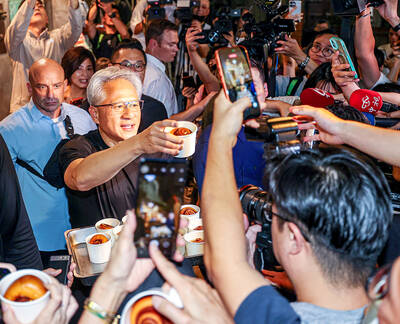
Nvidia Corp yesterday announced that CEO Jensen Huang (黃仁勳) would attend an employee meeting in Taipei tomorrow to celebrate the launch of the company’s Taiwan headquarters project. Huang would attend a gathering at the site of Nvidia’s planned headquarters in Beitou Shilin Technology Park (北投士林科技園區), the company said in a statement. After arriving in Taiwan on Saturday last week, Huang told reporters that he plans to meet with Quanta Computer Inc (廣達) chairman Barry Lam (林百里) and Taiwan Semiconductor Manufacturing Co (TSMC, 台積電) chairman C.C. Wei (魏哲家), and would attend the groundbreaking ceremony for Nvidia’s Taiwan headquarters tomorrow. Nvidia has not yet applied


 RSS
RSS