


Integrated Services Technology Inc (IST, 宜特科技), the world’s largest semiconductor reliability test provider, yesterday said its net profit dipped about 22 percent during the first half of this year, due to the absence of an asset disposal gain that it had recorded in the same period last year.
Net profits dropped to NT$238 million (US$8.09 million), compared with NT$306 million in the same period last year, with earnings per share falling from NT$4.13 a year earlier to NT$3.2, the company said.
However, IST’s operating income jumped 21.43 percent to NT$210.35 million, compared with NT$173.23 million a year earlier, which it attributed to contributions from services related to artificial intelligence (AI) and high-speed transmission applications.
Photo: CNA
Revenue expanded 10.04 percent year-on-year to NT$2.34 billion, while gross margin improved from 27.13 percent to 29.06 percent, driven by a favorable product portfolio and enhanced operational efficiency, it said.
IST expects revenue in the second half of this year to surpass the first half, citing growing demand for the company’s high-voltage, high-speed verification for AI applications and testing services for chips used in satellites.
IST is targeting double-digit percentage growth in revenue for the full year, it said.
The company booked a moderate foreign exchange loss for the first half of the year, amid the sharp appreciation of the New Taiwan dollar against the US dollar, but the risks remained manageable, IST said, adding that they used natural hedging strategies to minimize the impact.
IST did not disclose the amount of foreign exchange losses.
The company also said that it would tap into new material and reliability tests for the advanced packaging segment, copackaged optics, in collaboration with Enli Technology Co (光焱科技), as it aims to offer new-generation testing services for AI data centers.
Enli Technology focuses on supplying photonic integrated circuit testing equipment.
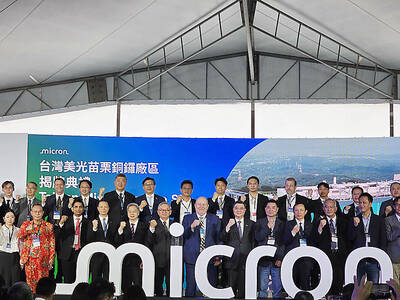
UNPRECEDENTED PACE: Micron Technology has announced plans to expand manufacturing capabilities with the acquisition of a new chip plant in Miaoli Micron Technology Inc unveiled a newly acquired chip plant in Miaoli County yesterday, as the company expands capacity to meet growing demand for advanced DRAM chips, including high-bandwidth memory chips amid the artificial intelligence boom. The plant in Miaoli County’s Tongluo Township (銅鑼), which Micron acquired from Powerchip Semiconductor Manufacturing Corp (力積電) for US$1.8 billion, is expected to make a sizeable capacity contribution to the company from fiscal 2028, the company said in a statement. It would be an extended production site of Micron’s large-scale manufacturing hub in Taichung, the company said. As the global semiconductor industry is racing to reach US$1 trillion

Singapore-based ride-hailing and delivery giant Grab Holdings Ltd has applied for regulatory approval to acquire the Taiwan operations of Germany-based Delivery Hero SE's Foodpanda in a deal valued at about US$600 million. Grab submitted the filing to the Fair Trade Commission on Friday last week, with the transaction subject to regulatory review and approval, the company said in a statement yesterday. Its independent governance structure would help foster a healthy and competitive market in Taiwan if the deal is approved, Grab said. Grab, which is listed on the NASDAQ, said in the filing that US-based Uber Technologies Inc holds about 13 percent of

Taiwan’s food delivery market could undergo a major shift if Singapore-based Grab Holdings Ltd completes its planned acquisition of Delivery Hero SE’s Foodpanda business in Taiwan, industry experts said. Grab on Monday last week announced it would acquire Foodpanda’s Taiwan operations for US$600 million. The deal is expected to be finalized in the second half of this year, with Grab aiming to complete user migration to its platform by the first half of next year. A duopoly between Uber Eats and Foodpanda dominates Taiwan’s delivery market, a structure that has remained intact since the Fair Trade Commission (FTC) blocked Uber Technologies Inc’s

Memory chip stocks extended their losses yesterday after Alphabet Inc’s Google publicized research that could allow more efficient use of the storage needed for artificial intelligence (AI) development. SK Hynix Inc and Samsung Electronics Co, South Korean leaders in the market, fell more than 6 percent and about 5 percent respectively in Seoul. In the US, Micron Technology Inc, Western Digital Corp and Sandisk Corp slid more than 2 percent in pre-market trading, after they all closed lower on Wednesday. Memory companies have been on a tear in recent months as the rapid development of AI infrastructure triggered a spike in chip


 RSS
RSS