


Prices of gasoline products at domestic fuel stations are this week to drop NT$0.2 per liter, while diesel prices are to remain unchanged from last week, CPC Corp, Taiwan (台灣中油) and Formosa Petrochemical Corp (台塑石化) said yesterday.
The price adjustments came even as international crude oil prices fluctuated in a narrow range last week, with the average prices higher than the previous week, amid a mixed bag of positive and negative factors, the companies said.
The factors included Saudi Arabia announcing price hikes for crude oil sold to Asia, Yemen’s Houthi rebels attacking cargo ships in Red Sea, the US Energy Information Administration lowering US crude oil production growth this year and markets worrying that the new round of US tariffs could hit the global economy, the companies added.
Front-month Brent crude oil futures — the international oil benchmark — last week gained 3.02 percent to settle at US$70.36 per barrel on the Intercontinental Exchange, while West Texas Intermediate crude oil futures — the US oil gauge — rose 2.16 percent to US$68.45 per barrel on the New York Mercantile Exchange.
CPC and Formosa adjusted gasoline prices downward after taking into account global oil market trends, the exchange rate for the New Taiwan dollar and intense competition in the domestic market, the companies said.
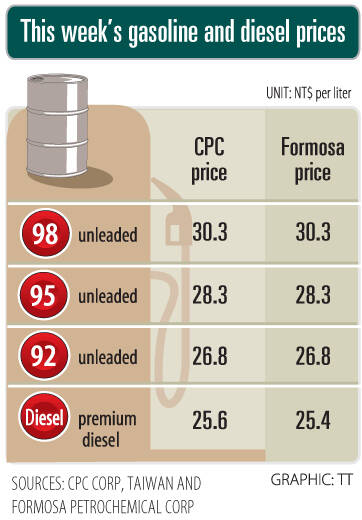
Effective today, gasoline prices at CPC and Formosa stations are to fall to NT$26.8, NT$28.3 and NT$30.3 per liter for 92, 95 and 98-octane unleaded gasoline respectively, while premium diesel is to stay at NT$25.6 per liter at CPC stations and NT$25.4 at Formosa pumps, they said.
The government yesterday approved applications by Alphabet Inc’s Google to invest NT$27.08 billion (US$859.98 million) in Taiwan, the Ministry of Economic Affairs said in a statement. The Department of Investment Review approved two investments proposed by Google, with much of the funds to be used for data processing and electronic information supply services, as well as inventory procurement businesses in the semiconductor field, the ministry said. It marks the second consecutive year that Google has applied to increase its investment in Taiwan. Google plans to infuse NT$25.34 billion into Charter Investments Ltd (特許投資顧問) through its Singapore-based subsidiary Fructan Holdings Singapore Pte Ltd, and

SECOND-RATE: Models distilled from US products do not perform the same as the original and undo measures that ensure the systems are neutral, the US’ cable said The US Department of State has ordered a global push to bring attention to what it said are widespread efforts by Chinese companies, including artificial intelligence (AI) start-up DeepSeek (深度求索), to steal intellectual property from US AI labs, according to a diplomatic cable. The cable, dated Friday and sent to diplomatic and consular posts around the world, instructs diplomatic staff to speak to their foreign counterparts about “concerns over adversaries’ extraction and distillation of US AI models.” Distillation is the process of training smaller AI models using output from larger, more expensive ones to lower the costs of training a powerful new

Micron Technology Inc is a driving force pushing the US Congress to pass legislation that would put new export restrictions on equipment its Chinese competitors use to make their chips, according to people familiar with the matter. A US House of Representatives panel yesterday was to vote on the “MATCH Act,” a bill designed to close gaps in restrictions on chipmaking equipment. It would also pressure foreign companies that sell equipment to Chinese chipmaking facilities to align with export curbs on US companies like Lam Research Corp and Applied Materials Inc. The bill targets facilities operated by China’s ChangXin Memory Technologies Inc

Singapore-based ride-hailing and delivery giant Grab Holdings’ planned acquisition of Foodpanda’s Taiwan operations has yet to enter the formal review stage, as regulators await supplementary documents, the Fair Trade Commission (FTC) said yesterday. Acting FTC Chairman Chen Chih-min (陳志民) told the legislature’s Economics Committee that although Grab submitted its application on March 27, the case has not been officially accepted because required materials remain incomplete. Once the filing is finalized, the FTC would launch a formal probe into the deal, focusing on issues such as cross-shareholding and potential restrictions on market competition, Chen told lawmakers. Grab last month announced that it would acquire


 RSS
RSS