


Formosa Smart Energy Tech Corp (台塑新智能科技) yesterday signed a memorandum of understanding with Poland's SKB Group in Taipei, hoping to build up its energy storage and electric transportation business in Europe, the company said today.
Under the deal, the Formosa Plastics Group (台塑集團) subsidiary would work with the Polish company on electric buses and vehicles, integrated energy storage systems, commercial and industrial energy storage, smart energy platforms, and a strategic investment alliance.
Formosa Smart Energy chairwoman Sandy Wang (王瑞瑜) and SKB CEO Bartlomiej Dobosz signed the agreement, witnessed by Polish officials and industry leaders.
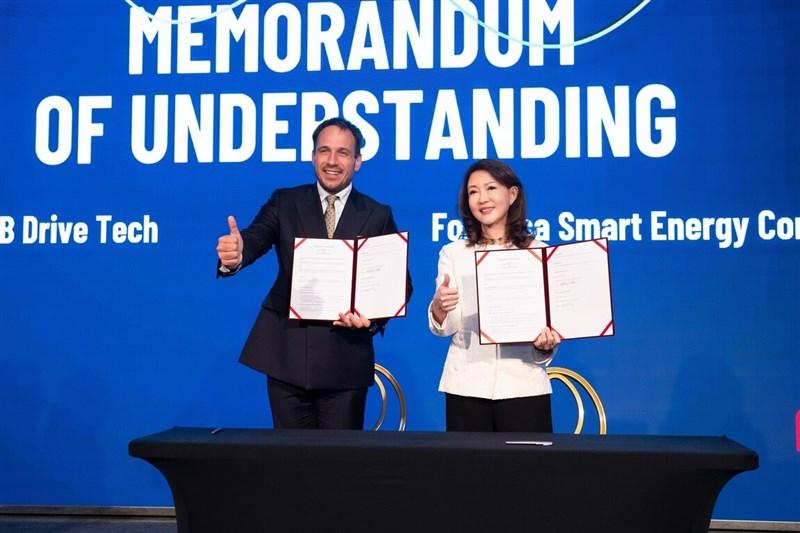
Photo courtesy of Formosa Smart Energy Tech Corp via CNA
Formosa Smart Energy would provide integrated solutions for battery packs, modules and energy storage systems, while leveraging SKB's expertise in electric bus systems, component development, renewable energy plant construction and public infrastructure projects, Wang said.
Together, the two companies aim to create a blueprint for energy storage infrastructure and electric transportation development in Europe, she said.
The prevalence of electric buses in Polish cities is about 5 to 7 percent, notably lower than the goal of 75 percent set by the Polish government for 2030, Formosa Smart Energy president Liu Hui-chi (劉慧啓) said.
As more than 60 percent of Poland's electricity is generated by burning coal, energy storage systems are needed alongside the rapid construction of renewable energy power plants, such as those producing solar and wind power, to ensure stable electricity generation, Liu said.
Formosa Smart Energy would help enhance peak load modulation through its energy storage solutions, he said.
The company also plans to expand into areas such as charging infrastructure and traffic systems to support a low-carbon transition in the Polish and broader European markets, Liu said.
SKB is a Polish conglomerate providing services in construction, steel structures, logistics and power transmission assemblies, its Web site states.
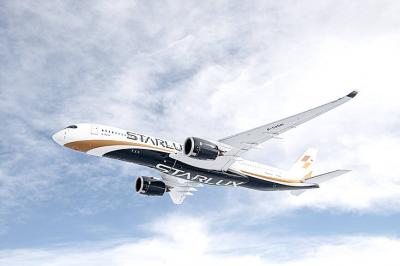
Starlux Airlines Co (星宇航空) today unveiled a long-haul network expansion plan at a shareholders’ meeting in Taipei, including direct flights to Barcelona, Spain, and Zurich, Switzerland, as well as a service connecting Taipei, Sydney and New Zealand. Starlux is to become the first Taiwanese carrier to offer non-stop services to the two European cities, while the inaugural oceanic route is expected to expand transit opportunities within the Australia-New Zealand market, Starlux said. Flight services to Chicago, Dallas, Washington and New York are under evaluation, the airline added. Prior to the shareholders’ meeting, the airline earlier this year announced that it would be

Netherlands-based semiconductor equipment supplier ASML Holding NV yesterday said that it is planning to hire an additional 1,000 people in Taiwan this year in response to growing demand from clients. ASML had previously planned to recruit 600 people this year, but that the plan has been adjusted upward, ASML vice president and ASML Taiwan general manager Grace Wang (汪佳慧) told reporters. ASML has a workforce of more than 4,500 in Taiwan, accounting for about 10 percent of its global total, Wang said. This year’s recruitment campaign would focus on adding people in the customer support, manufacturing and supply chain domains to assist ASML

UNDER MICROSCOPE: Taiwan detained three people who allegedly conspired to buy servers in Taiwan and export them using fraudulent documentation, prosecutors said Nvidia Corp chief executive officer Jensen Huang (黃仁勳) on Saturday urged Super Micro Computer Inc to tighten up on compliance after Taiwan detained three people this week for allegedly making fraudulent declarations about artificial intelligence (AI) servers made by its US partner. The development marked the nation’s first crackdown on semiconductor smuggling, which grew after the US slapped restrictions on exports of high-end chips such as Nvidia AI accelerators to China. Nvidia is “rigorous” in explaining regulations to all of its partners, Huang told reporters after arriving in Taipei. “Ultimately Super Micro has to run their own company,” he said in response to

Nvidia Corp yesterday announced that CEO Jensen Huang (黃仁勳) would attend an employee meeting in Taipei tomorrow to celebrate the launch of the company’s Taiwan headquarters project. Huang would attend a gathering at the site of Nvidia’s planned headquarters in Beitou Shilin Technology Park (北投士林科技園區), the company said in a statement. After arriving in Taiwan on Saturday last week, Huang told reporters that he plans to meet with Quanta Computer Inc (廣達) chairman Barry Lam (林百里) and Taiwan Semiconductor Manufacturing Co (TSMC, 台積電) chairman C.C. Wei (魏哲家), and would attend the groundbreaking ceremony for Nvidia’s Taiwan headquarters tomorrow. Nvidia has not yet applied


 RSS
RSS