


Apple Inc on Thursday reported its revenue hit US$124.3 billion in the year-end holiday quarter, but sales growth fell shy of market expectations as the iPhone faces stiff competition, particularly in China.
Apple logged US$36.3 billion in profit — a 7 percent increase from the previous year — in what chief executive Tim Cook called its “best quarter ever.”
Revenue growth of 4 percent from the previous year was powered by Apple’s service and digital content unit, with iPhone sales slipping in markets like China.

Photo: AFP
Overall iPhone sales in the quarter were US$69.1 billion, about a half-billion less than it took in for handsets in the same period a year earlier, according to an earnings release.
“Our record revenue and strong operating margins drove [earnings per share] to a new all-time record with double-digit growth,” Apple chief financial officer Kevan Parekh said. “We are also pleased that our installed base of active devices has reached a new all-time high across all products and geographic segments.”
In the quarter, Apple’s services segment — which includes Apple Music, iCloud, the App Store and Apple TV+ — reported revenue of US$26.3 billion, compared with US$23.1 billion in the same period a year earlier.
The Americas remained Apple’s largest market with US$56.2 billion in revenue, while Europe showed strong growth at US$33.9 billion. In China, Apple’s revenue registered US$18.5 billion, an 11 percent decrease from the previous year.
“On the Apple intelligence side, we have not rolled out in China,” Cook said on an earnings call. “We did see better results in the markets that we had rolled Apple Intelligence out in than markets we hadn’t; and, of course, it’s the most competitive market in the world.”
Cook said a software upgrade enabling the AI features in more European markets, as well as Japan and South Korea, will be rolling out in April.
Investors are eyeing demand for new iPhones with artificial intelligence (AI) features, especially after Apple stumbled with the technology.
Apple Intelligence is a new suite of software features for all devices that was announced at the company’s annual developers conference, where it also announced a partnership with ChatGPT maker OpenAI.
In the short-term, the new powers include AI-infused image editing, translation and small, creative touches in messaging, but not more ambitious breakthroughs promised by other AI players, such as OpenAI or Google.
Unlike tech peers such as Microsoft Corp, Google corporate parent Alphabet Inc and Facebook corporate parent Meta Platforms Inc, Apple has not been investing as heavily in AI, but that restraint could work to its advantage if Chinese start-up DeepSeek’s (深度求索) early breakthroughs in driving down AI costs gains momentum.

HORMUZ ISSUE: The US president said he expected crude prices to drop at the end of the war, which he called a ‘minor excursion’ that could continue ‘for a little while’ The United Arab Emirates (UAE) and Kuwait started reducing oil production, as the near-closure of the crucial Strait of Hormuz ripples through energy markets and affects global supply. Abu Dhabi National Oil Co (ADNOC) is “managing offshore production levels to address storage requirements,” the company said in a statement, without giving details. Kuwait Petroleum Corp said it was lowering production at its oil fields and refineries after “Iranian threats against safe passage of ships through the Strait of Hormuz.” The war in the Middle East has all but closed Hormuz, the narrow waterway linking the Persian Gulf to the open seas,

Apple Inc increased iPhone production in India by about 53 percent last year and now makes a quarter of its marquee devices there, reflecting the US company’s efforts to avoid tariffs on China. The company assembled about 55 million iPhones in India last year, up from 36 million a year earlier, people familiar with the matter said, asking not to be named because the numbers aren’t public. Apple makes about 220 million to 230 million iPhones a year globally, with India’s share of the total increasing rapidly. Apple has accelerated its expansion in the world’s most populous country in recent years, bolstered

HEADWINDS: The company said it expects its computer business, as well as consumer electronics and communications segments to see revenue declines due to seasonality Pegatron Corp (和碩) yesterday said it aims to grow its artificial intelligence (AI) server revenue more than 10-fold this year from last year, driven by orders from neocloud solutions clients and large cloud service providers. The electronics manufacturing service provider said AI server revenue growth would be driven primarily by the Nvidia Corp GB300 server platform. Server shipments are expected to increase each quarter this year, with the second half likely to outperform the first half, it said. The AI server market is expected to broaden this year as more inference applications emerge, which would drive demand for system-on-chip, application-specific integrated circuits
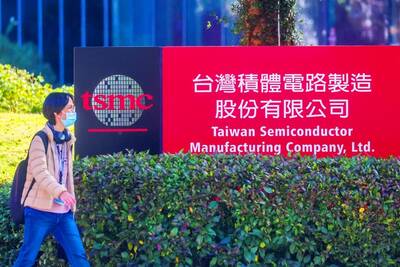
PROJECTION: TSMC said it expects strong growth this year, with revenue in US dollars projected to grow by about 30 percent, outperforming the industry Taiwan Semiconductor Manufacturing Co (TSMC, 台積電) yesterday reported consolidated sales last month reached NT$317.66 billion (US$9.98 billion), the highest ever for the month of February, driven by robust demand for chips built using the company’s advanced 3-nanometer (3nm) process. Last month’s figure was up 22.2 percent from a year earlier, but fell 20.8 percent from January, the world’s largest contract chipmaker said in a statement. For the first two months of the year, TSMC posted cumulative sales of NT$718.91 billion, up 29.9 percent from a year earlier. Analysts attributed the growth to sustained global demand for artificial intelligence (AI) products


 RSS
RSS