


US President Donald Trump has long ranted against wind energy — saying turbines are unsightly, dangerous to wildlife and too expensive — with him threatening to upend decades of industry progress just a few hours after resuming power.
“We’re not going to do the wind thing,” Trump said on Monday last week as he returned to the Oval Office for the first time in four years as commander-in-chief.
“Big, ugly windmills,” he said as he signed a series of executive orders that has brought the sector into crisis, adding that “they kill your birds, and they ruin your beautiful landscape.”
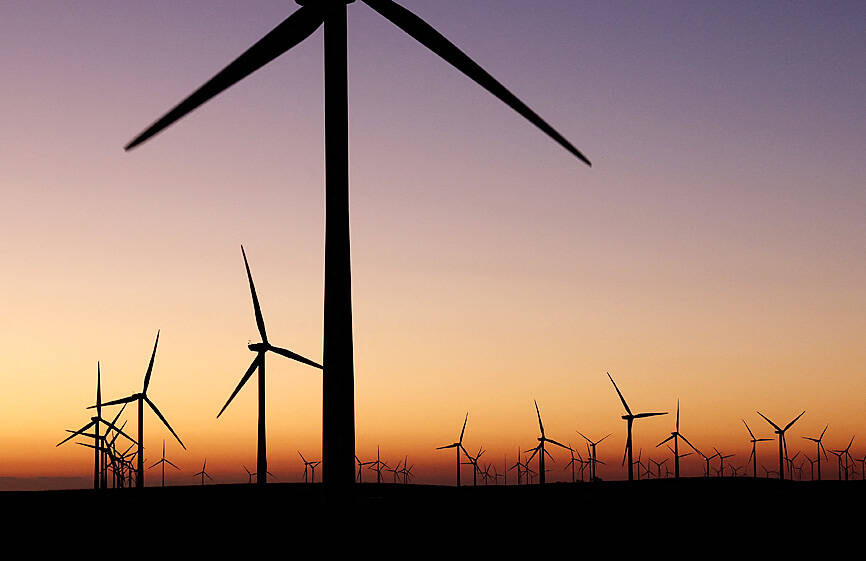
Photo: AFP
Among the measures was a temporary freeze on federal permitting and loans for all offshore and onshore wind projects.
American Clean Power Association (ACP) president Jason Grumet quickly slammed the move, saying it “increases bureaucratic barriers, undermining domestic energy development and harming American businesses and workers.”
After the announcements, wind-related stocks fell into the red.
“It’s had a real cooling effect on the sector,” Dartmouth University offshore wind specialist Elizabeth Wilson said.
Conflict-weary developers are already “backing away from some of these projects,” she said.
Although not as robust as in Europe, wind energy in 2023 accounted for about 10 percent of US electricity production — more than twice as much as solar.
Onshore wind power is also relatively inexpensive, experts say, with the price per megawatt-hour ranging from US$27 to US$73 last year, far less than nuclear or coal — although rates could fluctuate in the future.
Energy think tank Ember on Thursday warned that the US “risks being left behind in the clean industrial revolution,” as major economies such as China are increasingly “embracing wind as a source of cheap, clean electricity.”
It remains to be seen what the long-term effects of Trump’s actions would have on the sector, which has already faced struggles in the US in recent years due to rising costs from inflation and interest rates, along with mounting local opposition to projects.
Wilson said the offshore wind industry, still in its infancy in the US, is likely to be the hardest hit, as the majority of exploitable marine areas are in federal waters subject to Trump’s measures.
“Most of the onshore development happens on private lands where the federal government doesn’t really have any control,” she added.
Days before taking office, Trump wrote on his Truth Social media platform: “I don’t want even one [windmill] built during my administration.”
That pledge has seriously spooked the sector, which is worried he could permanently block subsidies or the environmental approvals needed for certain projects.
Such moves would likely be challenged in court and prompt political backlash.
“Ninety-nine percent of onshore wind power projects are on private lands, and the private landowners generally like these wind farms, and they get a lot of economic benefit from them,” Michigan Technological University professor emeritus Barry Solomon said.
The projects are also largely in Republican-led states, such as Texas, Oklahoma, Iowa, Kansas and the Dakotas, he added.
The ACP also warned that restricting wind development would “increase consumer energy bills.”
Despite the headwinds, some experts remain optimistic.
"Ultimately... the economics is driving the desire for wind and solar," University of Delaware professor Jeremy Firestone said.
With artificial intelligence, energy needs "are increasing a great deal. So there's going to be a lot of pressure to continue to build out wind turbines," he added.

The EU and US are nearing an agreement to coordinate on producing and securing critical minerals, part of a push to break reliance on Chinese supplies. The potential deal would create incentives, such as minimum prices, that could advantage non-Chinese suppliers, according to a draft of an “action plan” seen by Bloomberg. The EU and US would also cooperate on standards, investments and joint projects, as well as coordinate on any supply disruptions by countries like China. The two sides are additionally seeking other “like-minded partners” to join a multicountry accord to help create these new critical mineral supply chains, which feed into
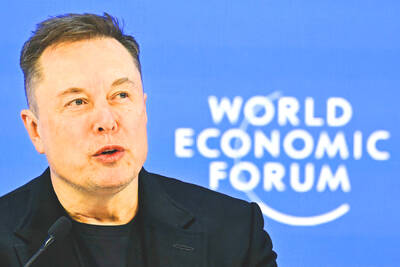
Elon Musk’s lieutenants have reached out to chip industry suppliers, including Applied Materials Inc, Tokyo Electron Ltd and Lam Research Corp, for his envisioned Terafab, early steps in an audacious and likely arduous attempt to break into the production of cutting-edge chips. Staff working for the joint venture between Tesla Inc and Space Exploration Technologies Corp (SpaceX) have sought price quotes and delivery times for an array of chipmaking gear, people familiar with the matter said. In past weeks, they’ve contacted makers of photomasks, substrates, etchers, depositors, cleaning devices, testers and other tools, according to the people, who asked not to

Japan approved ¥631.5 billion (US$3.97 billion) in additional subsidies to hasten Rapidus Corp’s entry into the high-stakes artificial intelligence (AI) chipmaking arena, ramping up support for a project widely regarded as a long shot. The capital is intended to bankroll Rapidus’ work for information technology firm Fujitsu Ltd, one of the initial customers that Tokyo hopes would get the signature endeavor off the ground. The new money raises the fees and investments that the government is injecting into the start-up to ¥2.6 trillion by the end of the current fiscal year to March next year, the Japanese Ministry of Economy, Trade and

The founder of Chinese property giant Evergrande Group (恆大集團) has pleaded guilty to charges of fraud and bribery, a court said yesterday, the latest blow for what was once the country’s leading developer. Evergrande’s rise was propelled by decades of rapid urbanization and rising living standards, but in 2020, its access to credit dramatically narrowed when the government introduced curbs on excessive borrowing and speculation. The company defaulted in 2021 after struggling to repay creditors. Founder Xu Jiayin (許家印), 67, known as Hui Ka Yan in Cantonese, was reportedly held by police in 2023, with Evergrande saying he had been subjected to


 RSS
RSS