


Semicon Taiwan, an annual international semiconductor exhibition, would bring leaders from the world’s top technology firms to Taipei this year, the event organizer said.
The CEO Summit is to feature nine global leaders from Taiwan Semiconductor Manufacturing Co (TSMC, 台積電), ASE Technology Holding Co (ASE, 日月光投控), Applied Materials Inc, Google, Samsung Electronics Co, SK Hynix Inc, Microsoft Corp, Interuniversity Microelectronic Centre and Marvell Technology Group Ltd, SEMI said in a news release last week.
The top executives would delve into how semiconductors are positioned as the driving force behind global technological innovation amid the artificial intelligence (AI) revolution, the organizer said.
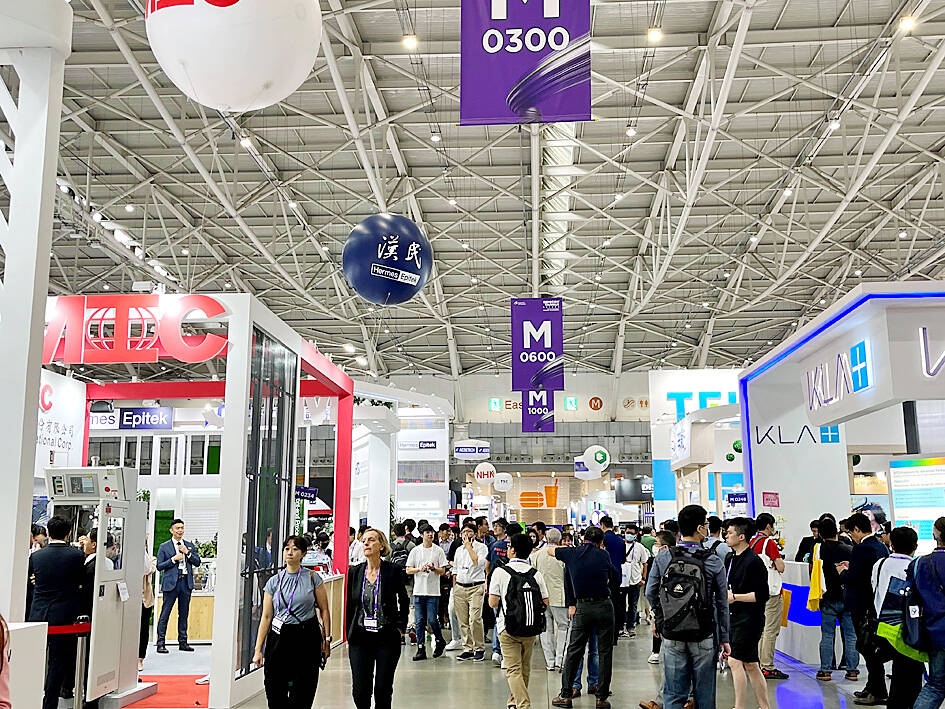
Photo: Grace Hung, Taipei Times
Among them, Samsung Electronics memory business head Lee Jung-bae and SK Hynix president Justin Kim are to deliver keynote speeches during the summit’s opening on Wednesday.
Lee would share his perspectives on the memory business in his keynote titled “Leaping Into the Future Through Memory Technology Innovation,” while Kim would discuss the AI memory trend, the organizer said.
This year’s event would also feature an AI Chip Fireside Chat, which would focus on semiconductor technology, cross-industry collaboration and future industry dynamics.
The discussions, which would be moderated by ASE chief operating officer Tien Wu (吳田玉) with TSMC, Samsung and Google executives participating, would include how semiconductors are driving global economic growth through AI, as well as the technical challenges and opportunities in chips, algorithms, memory, software, bandwidth, power consumption and system integration, it added.
The forums would feature more than 200 global semiconductor industry leaders, the organizer said.
The organizers expect the gathering to connect experts across various fields to explore how semiconductors would be the driving force behind global technological innovation in the era of AI.
Semicon Taiwan would feature 3,700 booths from more than 1,100 exhibitors from home and abroad, as well as more than 20 international forums, the organizer said.
Twelve countries, including Germany, the UK and the Czech Republic, plan to set up special pavilions at this year’s event, it said, adding that the American Institute in Taiwan (AIT) would also set up a US pavilion for the first time this year.
The annual event is to take place from Wednesday to Friday at the Taipei Nangang Exhibition Center’s halls 1 and 2. It is expected to attract more than 85,000 visitors, the organizer said.
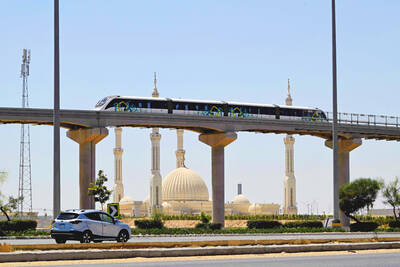
Cairo’s new monorail slices across the city skyline, running above the familiar chaos of blaring horns and aging buses’ exhaust fumes that mark rush hour below. The US$4.5 billion monorail, opened this month, is among Egypt’s most prominent new transport projects, part of a debt-funded infrastructure drive criticized for sapping state finances while bringing limited benefits to most of the country’s 109 million people. “It feels like you’re in a different country,” said Ramy Sayed, a restaurant manager, aboard a driverless Innovia 300 train. “No noise, no traffic, we’re not used to this.” The eastern line runs 56km from the bustling middle-class
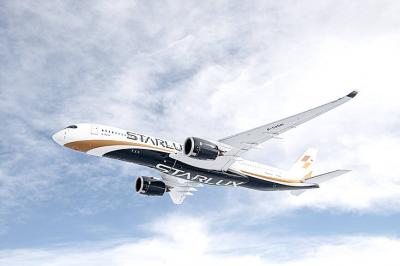
Starlux Airlines Co (星宇航空) today unveiled a long-haul network expansion plan at a shareholders’ meeting in Taipei, including direct flights to Barcelona, Spain, and Zurich, Switzerland, as well as a service connecting Taipei, Sydney and New Zealand. Starlux is to become the first Taiwanese carrier to offer non-stop services to the two European cities, while the inaugural oceanic route is expected to expand transit opportunities within the Australia-New Zealand market, Starlux said. Flight services to Chicago, Dallas, Washington and New York are under evaluation, the airline added. Prior to the shareholders’ meeting, the airline earlier this year announced that it would be

Netherlands-based semiconductor equipment supplier ASML Holding NV yesterday said that it is planning to hire an additional 1,000 people in Taiwan this year in response to growing demand from clients. ASML had previously planned to recruit 600 people this year, but that the plan has been adjusted upward, ASML vice president and ASML Taiwan general manager Grace Wang (汪佳慧) told reporters. ASML has a workforce of more than 4,500 in Taiwan, accounting for about 10 percent of its global total, Wang said. This year’s recruitment campaign would focus on adding people in the customer support, manufacturing and supply chain domains to assist ASML
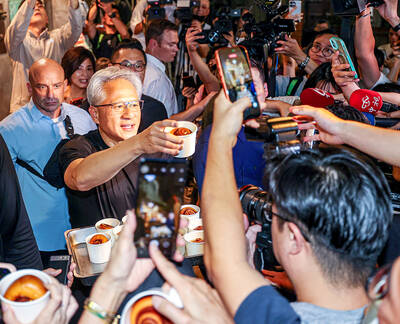
Nvidia Corp yesterday announced that CEO Jensen Huang (黃仁勳) would attend an employee meeting in Taipei tomorrow to celebrate the launch of the company’s Taiwan headquarters project. Huang would attend a gathering at the site of Nvidia’s planned headquarters in Beitou Shilin Technology Park (北投士林科技園區), the company said in a statement. After arriving in Taiwan on Saturday last week, Huang told reporters that he plans to meet with Quanta Computer Inc (廣達) chairman Barry Lam (林百里) and Taiwan Semiconductor Manufacturing Co (TSMC, 台積電) chairman C.C. Wei (魏哲家), and would attend the groundbreaking ceremony for Nvidia’s Taiwan headquarters tomorrow. Nvidia has not yet applied


 RSS
RSS