


Powerchip Semiconductor Manufacturing Corp (力積電) chairman Frank Huang (黃崇仁) met with French President Emmanuel Macron on Monday and proposed cooperation in artificial intelligence (AI) development, the company said in a statement yesterday.
Huang was invited to attend a round table on AI and Quantum investment opportunities presided over by Macron in Paris to discuss technology development trends, Powerchip said.
Huang, the only entrepreneur from East Asia invited by France to the forum, said that many US companies have worked with their Taiwanese counterparts in tech development and taken advantage of Taiwan’s well-developed information technology (IT) platform to support their global operations.
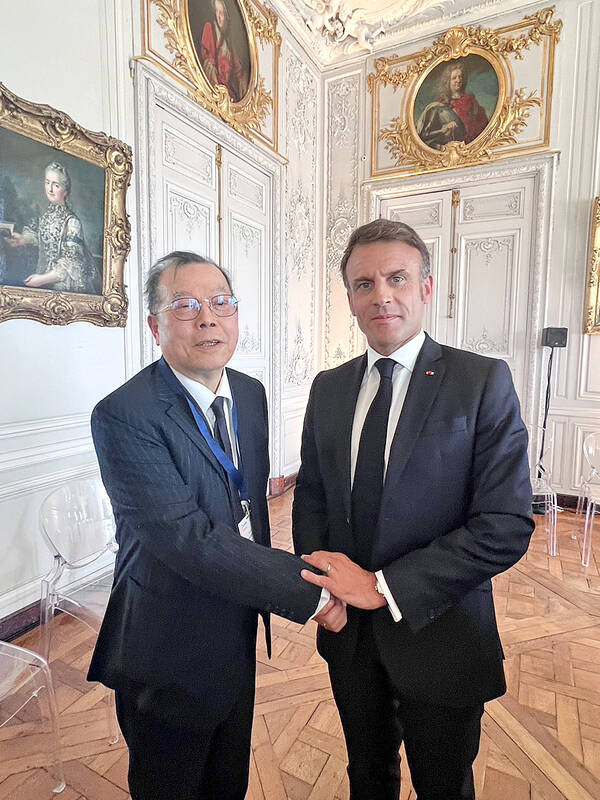
Photo courtesy of Powerchip Semiconductor Manufacturing Corp via CNA
They include IT service provider IBM Corp, software developer Microsoft Corp, search engine provider Google, consumer electronics giant Apple Inc, and AI chip designers Advanced Micro Devices Inc and Nvidia Corp, Powerchip said.
For example, Nvidia CEO Jensen Huang (黃仁勳) has repeatedly approached Taiwan’s semiconductor industry for help in supplying high-end chips as his firm develops more advanced AI graphics processing units, Huang said.
If France learned from the US in making good use of Taiwan’s well-developed technology platform and its tech companies’ experience, France and Taiwan mutually benefit from technology upgrades, cost controls and service improvements, he said.
France has built a robust foundation in fundamental technologies, but its cooperative ties with Taiwan are not as close as those of the US, Huang said.
France could use Taiwan’s advantages in the tech sector to become more of a force in emerging technologies, such as AI applications, he added.
Powerchip said the round table was also attended by representatives from US and European companies such as IBM, Dutch semiconductor equipment supplier ASML Holding NV and e-commerce behemoth Amazon.com Inc.
Representatives of sovereign wealth funds from Saudi Arabia and the United Arab Emirates were also present, it said.
The forum was part of the Choose France summit held at the Chateau de Versailles to drum up foreign investment in France.


The domestic unit of the Chinese-owned, Dutch-headquartered chipmaker Nexperia BV will soon be able to produce semiconductors locally within China, according to two company sources. Nexperia is at the center of a global tug-of-war over critical semiconductor technology, with a Dutch court in February ordering a probe into alleged mismanagement at the company. The geopolitical tussle has disrupted supply chains, with some carmakers reportedly forced to cut production due to chip shortages. Local production would allow Nexperia’s domestic arm, Nexperia Semiconductors (China) Ltd (安世半導體中國), to bypass restrictions in place since October on the supply of silicon wafers — etched with tiny components to
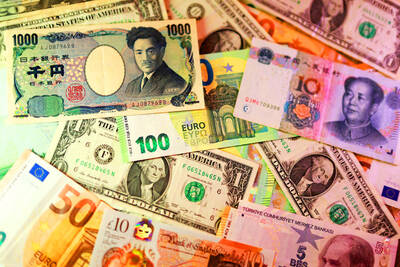
Taiwan’s foreign exchange reserves fell below the US$600 billion mark at the end of last month, with the central bank reporting a total of US$596.89 billion — a decline of US$8.6 billion from February — ending a three-month streak of increases. The central bank attributed the drop to a combination of factors such as outflows by foreign institutional investors, currency fluctuations and its own market interventions. “The large-scale outflows disrupted the balance of supply and demand in the foreign exchange market, prompting the central bank to intervene repeatedly by selling US dollars to stabilize the local currency,” Department of Foreign
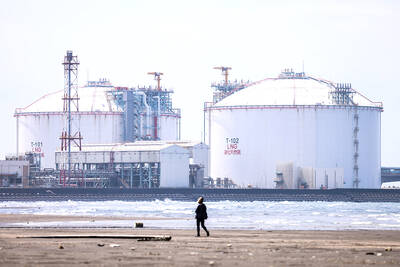
Taiwan is open to joining a global liquefied natural gas (LNG) program if one is created, but on the condition that countries provide delivery even in a scenario where there is a conflict with China, an energy department official said yesterday. While Taiwan’s priority is to have enough LNG at home, the nation is open to exploring potential strategic reserves in other countries such as Japan or South Korea, Energy Administration Deputy Director-General Chen Chung-hsien (陳崇憲) said. While the LNG market does not have a global reserve for emergencies like that of oil, the concept has been raised a few times —
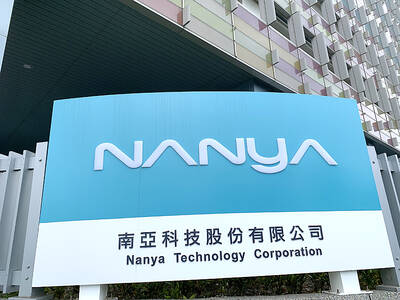
AI-FUELED DEMAND: The company has been benefiting from the skyrocketing prices for DRAM chips amid the AI frenzy, especially its core product — DDR4 DRAM chips DRAM chipmaker Nanya Technology Corp (南亞科技) yesterday reported that its revenue for the first quarter surged 582.91 percent to NT$49.09 billion (US$1.54 billion) from NT$7.19 billion a year earlier, as the supply crunch caused chip price spikes. Last quarter’s figure is the highest on record. On a quarterly basis, revenue jumped 63.14 percent from NT$30.09 billion, the company said. In January, Nanya Technology expected global DRAM supply scarcity to continue through the first half of 2028, thanks to strong demand for artificial intelligence (AI) applications. Market researcher TrendForce Corp (集邦科技) forecast prices of standard DRAM chips would rise between 58 percent and 63


 RSS
RSS