


Exports last month grew a tepid 4.3 percent year-on-year to US$37.48 billion, as shipments linked to artificial intelligence (AI) remained the lone bright spot, while all other product categories weakened amid a slow season, the Ministry of Finance said yesterday.
The figure suggested an uneven recovery and was disappointing compared with the ministry’s forecast of an increase of 8 to 11 percent, Department of Statistics Director-General Beatrice Tsai (蔡美娜) said.
“It is hard to capture the world’s business pulse as uncertainties linked to inflation, monetary policies and geopolitical tensions escalate,” Tsai said.
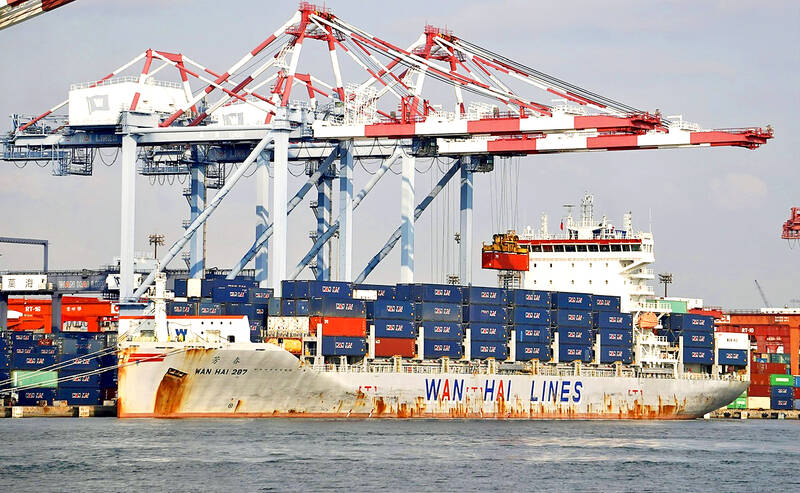
Photo: CNA
It is safe to say that the previous impressive rebounds were technical in nature and mainly due to lower comparison bases last year, she said.
Tsai said that shipments this month might expand 7 to 10 percent.
Exports to the US last month surged 81.6 percent to a historic high of US$10.16 billion, whereas exports to China decreased 11.3 percent to US$11.3 billion, the ministry’s report showed.
Tsai attributed it to US technology giants aggressively building up AI infrastructure and capacities, while Chinese firms increasingly depend on domestic suppliers amid the technology rivalry with the US.
Exports to Japan tumbled by a record 39.6 percent to US$1.93 billion, Tsai said.
Shipments to Europe slid 6.5 percent and a mild 2.8 percent to ASEAN markets, the report showed.
“The global economic recovery looked uneven and bumpy,” Tsai said.
Exports of information and communication technology products spiked 114.6 percent to US$11.74 billion, single-handedly driving 31.3 percent of the total volume, Tsai said.
Shipments of electronic components fell 17.7 percent to US$12.95 billion, with semiconductors shrinking a faster 18.8 percent due to unfavorable seasonality for consumer electronic gadgets, she said.
Although AI demand remained robust, sales of smartphones and PCs were lukewarm, Tsai said.
Likewise, exports of optical devices plunged 33.5 percent, machinery equipment shed 13 percent and transportation tools weakened 20 percent, ministry data showed.
Shipments of plastic, chemical, base metal and mineral products were equally bleak, retreating by 3.2 percent to 27.9 percent, the data showed.
By contrast, imports last month expanded by a faster 6.6 percent to US$31.02 billion, as local firms bought more input materials for exports and capital equipment for capacity expansion, Tsai said.
In particular, imports of semiconductor equipment grew 17.9 percent to US$2.39 billion, she said.
Last month’s trade figures gave Taiwan a trade surplus of US$6.46 billion, down 5.4 percent from a year earlier, the report showed.
Exports in the first four months expanded 10.6 percent to US$147.81 billion, while imports edged up 3.8 percent to US$122.39 billion, it said.
Taiwan’s foreign exchange reserves fell below the US$600 billion mark at the end of last month, with the central bank reporting a total of US$596.89 billion — a decline of US$8.6 billion from February — ending a three-month streak of increases. The central bank attributed the drop to a combination of factors such as outflows by foreign institutional investors, currency fluctuations and its own market interventions. “The large-scale outflows disrupted the balance of supply and demand in the foreign exchange market, prompting the central bank to intervene repeatedly by selling US dollars to stabilize the local currency,” Department of Foreign

ENERGY ISSUES: The TSIA urged the government to increase natural gas and helium reserves to reduce the impact of the Middle East war on semiconductor supply stability Chip testing and packaging service provider ASE Technology Holding Co (日月光投控) yesterday said it planned to invest more than NT$100 billion (US$3.15 billion) in building a new advanced chip testing facility in Kaohsiung to keep up with customer demand driven by the artificial intelligence (AI) boom. That would be included in the company’s capital expenditure budget next year, ASE said. There is also room to raise this year’s capital spending budget from a record-high US$7 billion estimated three months ago, it added. ASE would have six factories under construction this year, another record-breaking number, ASE chief operating officer Tien Wu

The EU and US are nearing an agreement to coordinate on producing and securing critical minerals, part of a push to break reliance on Chinese supplies. The potential deal would create incentives, such as minimum prices, that could advantage non-Chinese suppliers, according to a draft of an “action plan” seen by Bloomberg. The EU and US would also cooperate on standards, investments and joint projects, as well as coordinate on any supply disruptions by countries like China. The two sides are additionally seeking other “like-minded partners” to join a multicountry accord to help create these new critical mineral supply chains, which feed into

For weeks now, the global tech industry has been waiting for a major artificial intelligence (AI) launch from DeepSeek (深度求索), seen as a benchmark for China’s progress in the fast-moving field. More than a year has passed since the start-up put Chinese AI on the map in early last year with a low-cost chatbot that performed at a similar level to US rivals. However, despite reports and rumors about its imminent release, DeepSeek’s next-generation “V4” model is nowhere in sight. Speculation is also swirling over the geopolitical implications of which computer chips were chosen to train and power the new


 RSS
RSS