


AblePrint Technology Co (APT, 印能科技) yesterday said it expects strong revenue growth this year due to robust demand for advanced packaging for artificial intelligence (AI) and high-performance computing chips.
AI applications helped prop up APT’s revenue in the second half of last year thanks to rising demand for advanced chip packaging technologies, including chip-on-wafer-on-substrate, or CoWoS, fanout packaging and panel-level packaging, the Hsinchu-based firm said.
That compares with a slump in the first half of last year, when most semiconductor companies suffered from an inventory-driven correction, it said.
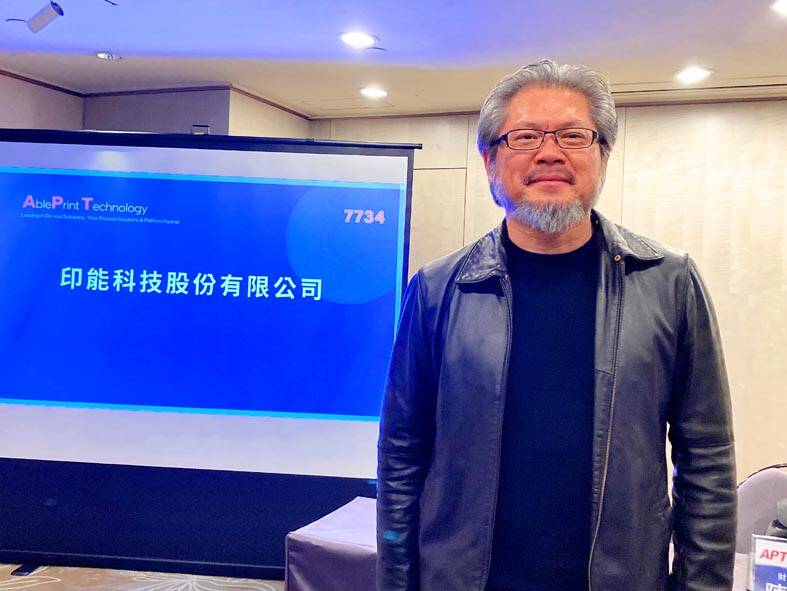
Photo: Grace Hung, Taipei Times
In the first two months of this year, revenue increased 88.13 percent year-on-year to NT$218 million (US$6.93 million), company data showed.
APT supplies burn-in ovens and related technologies to address major issues faced by customers in the manufacturing processes — from void eliminations to void-free soldering and package warpage suppression.
The company counts Taiwan Semiconductor Manufacturing Co (TSMC, 台積電) and the world’s leading chip packagers among its customers.
“As our customers are growing, we will be growing, too,” APT chairman Auger Horng (洪誌宏) told a media briefing in Taipei.
APT wants to “wow” investors with substantial revenue growth this year, Horng said, implying that growth could be as high as 50 percent from a year earlier.
The company has a good order visibility of six months this year, he said.
China and North America are the two markets with the greatest growth potential, he added.
APT reported a 30 percent annual decline in revenue last year to NT$1.19 billion.
Taiwan, China, Japan, South Korea and Malaysia accounted for 70 percent of the company’s revenue last year, it said.
Net profit last year plummeted 29 percent to NT$549 million from NT$776 million a year earlier.
Gross margin improved to 66.3 percent from 65.8 percent.
In light of the growing AI business, APT plans to set up a sales office in the US, as customers are building new chip packaging factories in the US and Mexico, the company said.
North America leads global demand for AI chips, it said.
APT is to start trading on the Emerging Stock Board today at NT$489 per share.

MAJOR BENEFICIARY: The company benefits from TSMC’s advanced packaging scarcity, given robust demand for Nvidia AI chips, analysts said ASE Technology Holding Co (ASE, 日月光投控), the world’s biggest chip packaging and testing service provider, yesterday said it is raising its equipment capital expenditure budget by 10 percent this year to expand leading-edge and advanced packing and testing capacity amid strong artificial intelligence (AI) and high-performance computing chip demand. This is on top of the 40 to 50 percent annual increase in its capital spending budget to more than the US$1.7 billion to announced in February. About half of the equipment capital expenditure would be spent on leading-edge and advanced packaging and testing technology, the company said. ASE is considered by analysts

TRANSFORMATION: Taiwan is now home to the largest Google hardware research and development center outside of the US, thanks to the nation’s economic policies President Tsai Ing-wen (蔡英文) yesterday attended an event marking the opening of Google’s second hardware research and development (R&D) office in Taiwan, which was held at New Taipei City’s Banciao District (板橋). This signals Taiwan’s transformation into the world’s largest Google hardware research and development center outside of the US, validating the nation’s economic policy in the past eight years, she said. The “five plus two” innovative industries policy, “six core strategic industries” initiative and infrastructure projects have grown the national industry and established resilient supply chains that withstood the COVID-19 pandemic, Tsai said. Taiwan has improved investment conditions of the domestic economy

Huawei Technologies Co’s (華為) latest smartphones carry a version of the advanced made-in-China processor it revealed last year, results from an independent analysis showed. This underscored the Chinese company’s ability to sustain production of the controversial chip. The Pura 70 series unveiled last week sports the Kirin 9010 processor, research firm TechInsights found during a teardown of the device. This is a newer version of the Kirin 9000s, made by Semiconductor Manufacturing International Corp (SMIC, 中芯) for the Mate 60 Pro, which had alarmed officials in Washington who thought a 7-nanometer chip was beyond China’s capabilities. Huawei has enjoyed a resurgence since

purpose: Tesla’s CEO sought to meet senior Chinese officials to discuss the rollout of its ‘full self-driving’ software in China and approval to transfer data they had collected Tesla Inc CEO Elon Musk arrived in Beijing yesterday on an unannounced visit, where he is expected to meet senior officials to discuss the rollout of "full self-driving" (FSD) software and permission to transfer data overseas, according to a person with knowledge of the matter. Chinese state media reported that he met Premier Li Qiang (李強) in Beijing, during which Li told Musk that Tesla's development in China could be regarded as a successful example of US-China economic and trade cooperation. Musk confirmed his meeting with the premier yesterday with a post on social media platform X. "Honored to meet with Premier Li


 RSS
RSS