


Asian shares were mixed yesterday, with most regional markets closed for holidays, while US futures edged lower after the S&P 500 ended last week above 5,000.
Australia’s S&P/ASX 200 slipped 0.4 percent to 7,614.90 and the SENSEX in India shed 0.7 percent to 71,129.07.
Thailand’s SET gained less than 0.1 percent and in Jakarta, the benchmark gained 0.8 percent ahead of an election to be held tomorrow.
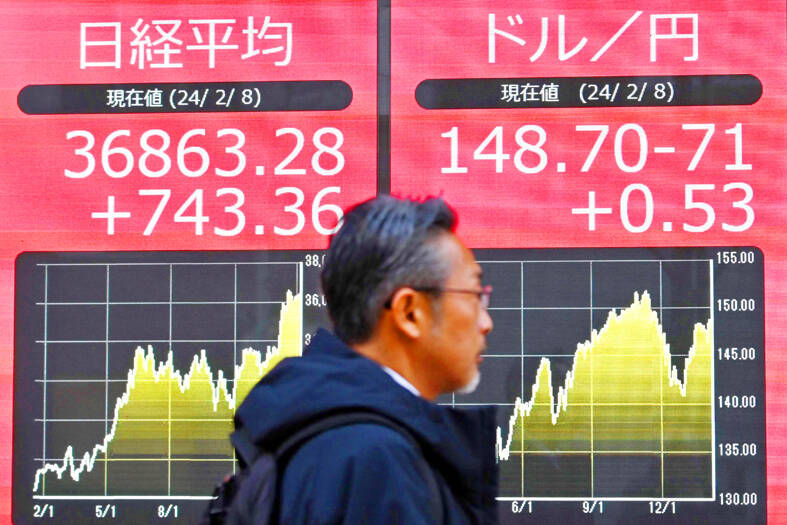
Photo: AFP
With Chinese markets closed for the week for the Lunar New Year holiday, there was a dearth of market moving news. Tokyo’s markets were also shut yesterday, for the National Foundation Day holiday, while Taipei, Hong Kong, Seoul, Singapore and Kuala Lumpur were all closed for the Lunar New Year holiday.
Europe’s main stock markets rose at the start of trading yesterday, as investors awaited key economic data releases due this week with the annual earnings seasons nearing an end.
This week is to bring an important update from the US on consumer inflation expectations. Japan is due on Thursday to announce its GDP growth for the final quarter of last year.
The US price data might not have a major impact on monetary policy, “However, the good news is that US inflation probably decreased at the beginning of the year, reinforcing expectations that the Federal Reserve may consider interest rate cuts in the coming months,” SPI Asset Management managing partner Stephen Innes said in a commentary.
On Friday, the S&P 500 rose 0.6 percent, finishing above 5,000 for the first time, at 5,026.61. It was the 10th record in less than a month for the index, which closed its 14th winning week in the last 15 to continue a romp that began around Halloween.
Profits have mostly been better than expected for the big companies in the S&P 500 this reporting season, which is roughly two-thirds finished.
That has burnished optimism on Wall Street, but contrarians say it may have gone too far and carried stocks to too-expensive heights.
In other trading yesterday, US benchmark crude oil lost US$0.33 to US$76.51 per barrel in electronic trading on the New York Mercantile Exchange. It gained US$0.62 on Friday.
Brent crude, the international standard, lost US$0.33 to US$81.86 per barrel.
The US dollar fell to ¥149.13 from ¥149.28. The euro rose to US$1.0797 from US$1.0784.
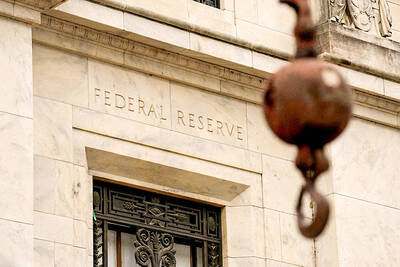
DAMAGE REPORT: Global central banks are assessing war-driven inflation risks as the law of unintended consequences careens around the world, spiking oil prices Central banks from Washington to London and from Jakarta to Taipei are about to make their first assessments of economic damage after more than two weeks of conflict between the US and Iran. Decisions this week encompassing every member of the G7 and eight of the world’s 10 most-traded currency jurisdictions are likely to confirm to investors that the specter of a new inflation shock is already worrying enough to prompt heightened caution. The US Federal Reserve is widely expected to do exactly what everyone anticipated weeks ahead of its March 17-18 policy gathering: hold rates steady. The narrative surrounding that
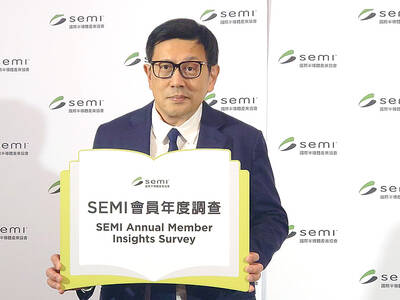
PRICE HIKES: The war in the Middle East would not significantly disrupt supply in the short term, but semiconductor companies are facing price surges for materials Taiwan’s semiconductor companies are not facing imminent supply disruptions of essential chemicals or raw materials due to the war in the Middle East, but surges in material costs loom large, industry association SEMI Taiwan said yesterday. The association’s comments came amid growing concerns that supplies of helium and other key raw materials used in semiconductor production could become a choke point after Qatar shut down its liquefied natural gas (LNG) production and helium output earlier this month due to the conflict. Qatar is the second-largest LNG supplier in the world and accounts for about 33 percent of global helium output. Helium is
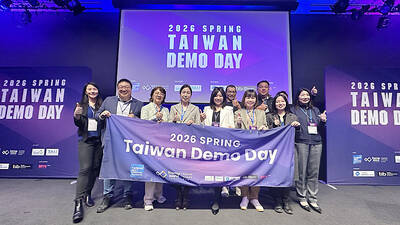
About 1,000 participants, including more than 200 venture capitalists, joined the Taiwan Demo Day in Silicon Valley on Saturday, the largest iteration to date of the event held ahead of Nvidia Corp’s annual GPU Technology Conference which runs from today to Thursday. Taiwan Demo Day, co-organized by the Taiwan Next Foundation and the Startup Island Taiwan Silicon Valley Hub, took place at the Computer History Museum in California, showcasing 12 teams focused on physical artificial intelligence (AI) and agentic AI technologies. Katie Hsieh (謝凱婷), founder of the Taiwan Next Foundation, said the event highlighted the strength of the Taiwan-US start-up ecosystem, with
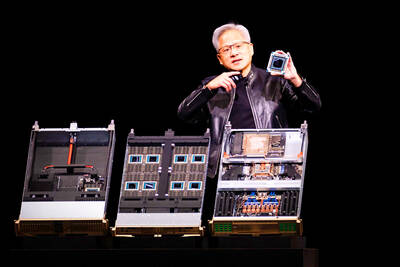
DOMESTIC COMPONENT: Huang identified several Taiwanese partners to be a key part of Nvidia’s Vera Rubin supply chain, including Asustek, Hon Hai and Wistron Nvidia Corp chief executive officer Jensen Huang (黃仁勳), addressing crowds at the company’s biggest annual event, unveiled a variety of new products while predicting that its flagship artificial intelligence (AI) processors would help generate US$1 trillion in sales through next year. During a two-and-a-half-hour keynote address, Huang announced plans to push deeper into central processing units (CPUs) — Intel Corp’s home turf — and introduced semiconductors made with technology acquired from start-up Groq Inc. The company even said it was developing chips for data centers in outer space. At the heart of Huang’s speech was the message that demand for computing power


 RSS
RSS