

Industrial production last month dipped for an 18th consecutive month due to weak demand for chips and electronic components, the Ministry of Economic Affairs said yesterday.
The industrial production index contracted 2.48 percent year-on-year to 92.19 last month, meeting the ministry’s expectations of between 89.28 and 93.28, it said.
The manufacturing production index, which contributed 95.41 percent to the industrial production index, fell 2.18 percent to 92.38 last month, also marking an 18th straight month of decline, the ministry said.
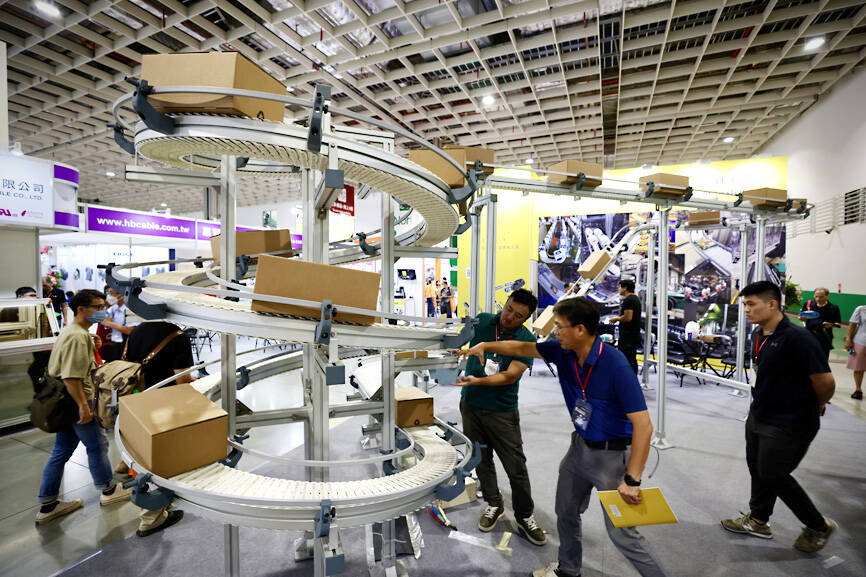
Photo: Ritchie B. Tongo, EPA-EFE
The 18-month decline in both the industrial production index and the manufacturing production index was the longest period of weakness in Taiwan's history, it said.
In the first 11 months of this year, the industrial production index was down 13.22 percent from a year earlier, while the manufacturing production index fell 13.65 percent, ministry data showed.
This month, the ministry’s survey showed that the manufacturing production index would be in the range of 90.27 to 94.27, indicating an annual increase of 0.3 percent in the best-case scenario.
With rising demand for artificial intelligence (AI)-enabled smartphones and PCs, coupled with the effect of a low comparison base this year, there would be a good chance of the manufacturing production index remaining in positive territory next month and in the first quarter of next year, the ministry said.
“This year, demand for server and AI applications was mostly driven by enterprises. Next year, AI demand should multiply when the function is introduced to smartphones and PCs, which are larger markets than servers. As a result, the consumption of chips would increase,” Department of Statistics Deputy Director-General Huang Wei-jie (黃偉傑) said by telephone yesterday.
However, “unstable outbound demand is a major factor weighing on Taiwan’s manufacturing production. We have not seen clear signs indicating a strong recovery in the global economy next year,” Huang said. “Supply chain inventory has not returned to normal levels yet, although it has been slimming down this year.”
The production of electronic components, which mainly comprise semiconductors and flat panels, shrank 2.48 percent last month, but the production of computers and optical components advanced 14.01 percent, ministry data showed.
It was the only segment that reported year-on-year expansion, aided by robust demand for servers and AI applications, the ministry said.
Demand for camera lenses made by Largan Precision Co (大立光) and its local peers also increased, the ministry said.
The production of base metals and steel dropped 3.68 percent last month as steel mills cut production to cope with weak end-market demand, while the petrochemicals sector also saw production contract 0.81 percent due to sluggish demand, as customers were still digesting inventory, it said.
Machinery equipment production sank 12.09 percent as economic weakness weighed on firms’ capital spending, while the production of automotive-related products dipped by 1.04 percent, it said.

Luxury powerhouses including Hermes and Cartier are suffering steeper slumps in China, in a sign that a spending pullback by the country’s wealthy consumers is hitting even the most resilient brands. Sales at the brands in mainland China fell as much as double-digits in August and last month compared to the same period a year ago, two research firms surveyed by Bloomberg that track industry data said. The drop is significant as Hermes International SCA and Cie Financiere Richemont SA’s Cartier had been relatively unaffected in the country as a broader slowdown in luxury consumption took hold in June, the firms’

STOCK, CASH: Quarterly profit-sharing bonuses would supplement payments under the Incentive Pay Plan, offering ‘transparency’ and ‘predictability,’ an executive said Micron Memory Taiwan Co (台灣美光) yesterday unveiled a new profit-sharing program and structural wage hikes as part of its efforts to build a predictable and transparent compensation framework in response to feedback from unions. The memorychip maker, a subsidiary of US-based Micron Technology Inc, announced the major compensation structural overhaul during an online news conference following a milestone agreement with the union representing more than 10,000 workers at its Taichung facility. Under the new framework, quarterly profit-sharing bonuses would supplement payments under the Incentive Pay Plan (IPP), the company said. The IPP formula has also been substantially enhanced, it said. “Profit-sharing mechanisms are common

Micron Memory Taiwan and a union representing workers at its Taichung operations today said they had signed a labor-management agreement covering multiple issues, prompting both sides to withdraw from mediation scheduled for tomorrow. The joint statement did not disclose the terms of the agreement, saying the company and the union would separately communicate details to affected employees in the coming days. Idaho-based Micron, the world's third-largest memory chipmaker, employs about 15,000 people in Taiwan, a key manufacturing base where it produces DRAM and high-bandwidth memory chips used in artificial intelligence (AI) servers. Any disruption to Micron's Taiwan operations could affect already strained global
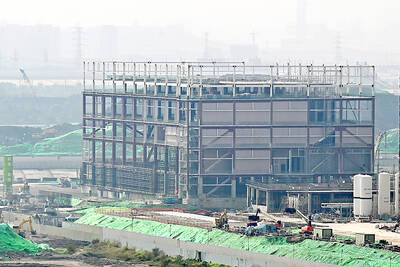
Taiwan Semiconductor Manufacturing Co (TSMC, 台積電) is suspending some construction work after an accident at one of its building sites in southern Taiwan led to the deaths of four workers. The incident took place on Tuesday during steel structure construction at TSMC’s Fab 22 in Kaohsiung, the company said. Workers fell from a height while performing steel structure hoisting and installation, a report from the Central News Agency said. A cause might be aged bolts, it said, citing a preliminary assessment by the Southern Taiwan Science Park Bureau. The bureau said that work would only resume after Shang Hao Machinery Co (上昊機械),


 RSS
RSS