

Luxury powerhouses including Hermes and Cartier are suffering steeper slumps in China, in a sign that a spending pullback by the country’s wealthy consumers is hitting even the most resilient brands.
Sales at the brands in mainland China fell as much as double-digits in August and last month compared to the same period a year ago, two research firms surveyed by Bloomberg that track industry data said. The drop is significant as Hermes International SCA and Cie Financiere Richemont SA’s Cartier had been relatively unaffected in the country as a broader slowdown in luxury consumption took hold in June, the firms’ data show.
Mainland sales for the 25 largest luxury labels including Louis Vuitton and Gucci have also contracted further, plunging by double-digits in August and last month, the firms said.
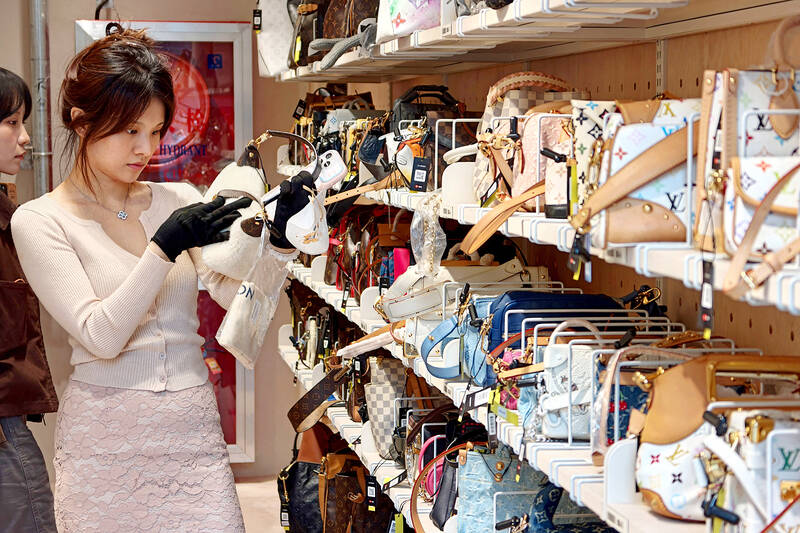
Photo: AFP
Business remained weak during China’s National Day holiday, a seven-day break early this month dubbed the golden week, even as consumers spent more on travel, according to people familiar with the matter who asked not to be identified because they are not authorized to speak publicly. Some executives at major luxury houses now fear the slump could become more widespread and persist until next year, the people said.
Concerns are mounting as Beijing’s widening scrutiny of offshore wealth and a cooling artificial intelligence stock rally rattle private fortunes, testing the long-held belief that the luxury industry’s wealthiest clients are largely recession-proof. Global brands had long banked on these top-tier spenders as China’s middle-class retreated during a prolonged property-market slump and wider economic slowdown. Now, they are facing the possibility of their key customers and aspirational shoppers spending less at the same time.
“The recurring message from our annual Asia consumer and luxury trip over the past three years was that conditions were difficult, but that ‘next year would be better,’” HSBC Holdings PLC analyst Anne-Laure Bismuth said in a note this month. “This time, however, meetings in Hong Kong, Xiamen and Shanghai provided no timeline or evidence of a recovery in Chinese luxury consumption.”
Hermes and Cartier did not respond to requests for comment.
Resilient demand from other parts of Greater China, including Hong Kong and Macau, has helped offset some of the declines in the mainland for high-end jewelry brands such as Cartier, research firm JL Warren said. Still, the weakness in one of the luxury group’s largest markets has weighed on their earnings.
Hermes on Thursday reported flat sales in Asia-Pacific for the third quarter. Revenue in the region excluding Japan fell short of analyst expectations for 1.55 percent growth.
The performance in the region — which includes China and accounts for about 42 percent of Hermes’ total revenue — is a sign that the Birkin bag maker is not immune to the spending curbs affecting Chinese shoppers.
China’s macroeconomic environment remains challenging, compounded by sluggish financial markets and ongoing tax-related campaigns, Hermes chief financial officer Eric Du Halgouet said during a post-earnings briefing.
LVMH Moet Hennessy Louis Vuitton SE’s third-quarter results showed a double-digit drop in domestic China sales amid a trademark controversy involving its largest brand Louis Vuitton. Purchases by Chinese shoppers overseas also fell by a mid-single-digit percentage. The weakness contributed to a 5 percent revenue slump in Asia excluding Japan, the group’s only region to post a negative performance.
Gucci sales fell 6 percent in the third quarter, worse than analysts’ expectations, hurt by weak consumption in China. That has contributed to parent Kering SA’s quarterly decline.
Amid the broader economic downturn, Chinese consumers have become more selective about discretionary spending, prioritizing travel, dining and other experiences over highly visible luxury purchases. Even among those still willing to spend, tastes have shifted. Many younger shoppers are gravitating away from prominent logos and status-driven purchases in favor of understated products that emphasize craftsmanship and quality, fueling the rise of so-called “quiet luxury.”
Retail sales growth in August slowed further to 0.4 percent before improving last month. Big-ticket items including jewelry and cars performed the worst, plunging as much as 21 percent in business receipts in the two months.
Comparisons are likely to become less challenging next year after a steep downturn this year, potentially helping major luxury groups return to reported growth, Shanghai-based consultancy Foresight Performance Partners co-founder Jacques Roizen said. However, any improvement in headline numbers is unlikely to signal a meaningful recovery in demand, he said.
“Beneath those comparisons is a structural problem,” Roizen said. “Much of the aspirational middle-class has moved away from luxury, while wealthier consumers have become more cautious. The underlying pressures are unlikely to change quickly.”

STOCK, CASH: Quarterly profit-sharing bonuses would supplement payments under the Incentive Pay Plan, offering ‘transparency’ and ‘predictability,’ an executive said Micron Memory Taiwan Co (台灣美光) yesterday unveiled a new profit-sharing program and structural wage hikes as part of its efforts to build a predictable and transparent compensation framework in response to feedback from unions. The memorychip maker, a subsidiary of US-based Micron Technology Inc, announced the major compensation structural overhaul during an online news conference following a milestone agreement with the union representing more than 10,000 workers at its Taichung facility. Under the new framework, quarterly profit-sharing bonuses would supplement payments under the Incentive Pay Plan (IPP), the company said. The IPP formula has also been substantially enhanced, it said. “Profit-sharing mechanisms are common

Micron Memory Taiwan and a union representing workers at its Taichung operations today said they had signed a labor-management agreement covering multiple issues, prompting both sides to withdraw from mediation scheduled for tomorrow. The joint statement did not disclose the terms of the agreement, saying the company and the union would separately communicate details to affected employees in the coming days. Idaho-based Micron, the world's third-largest memory chipmaker, employs about 15,000 people in Taiwan, a key manufacturing base where it produces DRAM and high-bandwidth memory chips used in artificial intelligence (AI) servers. Any disruption to Micron's Taiwan operations could affect already strained global
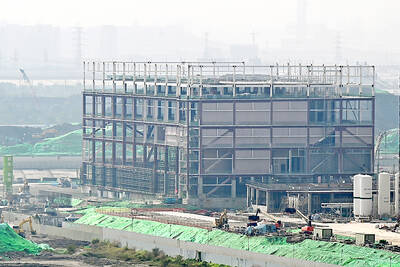
Taiwan Semiconductor Manufacturing Co (TSMC, 台積電) is suspending some construction work after an accident at one of its building sites in southern Taiwan led to the deaths of four workers. The incident took place on Tuesday during steel structure construction at TSMC’s Fab 22 in Kaohsiung, the company said. Workers fell from a height while performing steel structure hoisting and installation, a report from the Central News Agency said. A cause might be aged bolts, it said, citing a preliminary assessment by the Southern Taiwan Science Park Bureau. The bureau said that work would only resume after Shang Hao Machinery Co (上昊機械),

AGREEMENT REACHED: The joint statement did not disclose the details of the deal, which comes a day before the Taoyuan union is to hold a strike Micron Memory Taiwan Co (台灣美光) and a union representing workers at its Taichung operations yesterday said that they had signed a labor-management agreement covering multiple issues, prompting both sides to withdraw from mediation scheduled for today. The joint statement did not disclose the terms of the agreement, saying the company and the union would separately communicate details to affected employees in the coming days. Idaho-based Micron, the world’s third-largest memory maker, employs about 15,000 people in Taiwan, a key manufacturing base where it produces DRAM and high-bandwidth memory chips used in artificial intelligence (AI) servers. Any disruption to Micron’s Taiwan operations could affect


 RSS