


The central bank yesterday left its policy rate intact for the third straight quarter, saying that inflationary pressure has moderated and a policy pause would help support the economy amid lingering global uncertainty.
Governor Yang Chin-long (楊金龍) made known the decision after the quarterly board meeting and hinted at potential rate cuts next year if the consumer price index (CPI) returns to the 2 percent target and the US Federal Reserve turns its monetary policy stance around.
The Fed held its policy rate steady overnight, with Fed Chair Jerome Powell telling a news conference that a recession is not necessary for rate cuts. The Fed’s dot plot, which shows Fed directors’ estimates for interest rates over the long run, signals a reduction of 75 basis points next year.
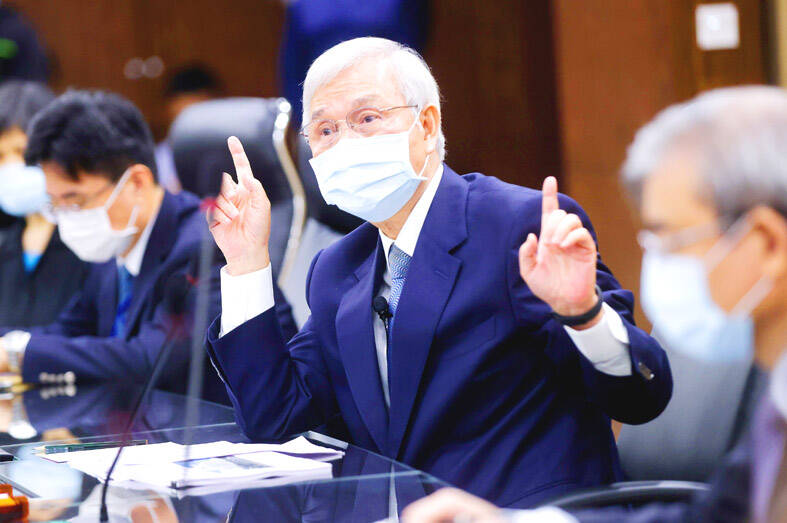
Photo: I-Hwa Cheng, Bloomberg
“Taiwan’s economy is too small and open to stay above external influences and chart its own monetary policy path,” Yang told reporters.
Capital movements beat interventions in dominating foreign exchange markets and currency directions, the governor said, adding that the Fed’s dovish rhetoric lifted bourses across the world and currencies gained value against the greenback.
Taiwan’s monetary tightening is also approaching an end, although the central bank would likely maintain its current stance in the first half of next year, Yang said.
He quoted Powell as saying that the COVID-19 pandemic taught global central banks a hard lesson on “unpredictability” as the Fed governor last month reiterated that interest rates would “stay high for longer.”
Yang painted Taiwan’s 2.9 percent CPI increase last month as weather-driven and that inflation would ease to 1.89 percent next year.
At the same time, the nation’s economy would come under continued challenges from geopolitical tensions and economic slowdown from the US and China, which account for more than 50 percent of Taiwan’s exports, the governor said.
The negative output gap is expected to deepen from 0.5 percent this year to 0.84 percent next year, meriting a policy pause despite an ongoing recovery, Yang said.
The central bank is looking at GDP growth of 3.12 percent next year, from a 1.4 percent this year. Central bank officials attributed the uptick mainly to a low base.
Board directors shared similar observations and arrived at the conclusion unanimously, he added.
The central bank did not introduce fresh measures to tighten property or land transactions, saying that previous waves of lending restrictions have achieved the effect of slowing price hikes, he said.
However, the property market remains on the central bank’s radar and it would move to regulate whenever it sees fit, he said.
The property market breathed a sigh of relief at the central bank’s rate pause, which fell in line with market expectation, Great Home Realty Co (大家房屋) said.
Property speculators have largely fled the market, leaving people with real demand to underpin transactions, Great Home chief researcher Mandy Lang (郎美囡) said.
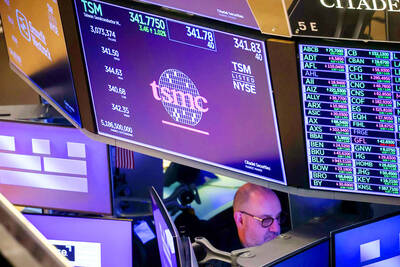
STRONG INTEREST: Analysts have pointed to optimism in TSMC’s growth prospects in the artificial intelligence era as the cause of the rising number of shareholders The number of people holding shares of chipmaker Taiwan Semiconductor Manufacturing Co (TSMC, 台積電) hit a new high last week despite a decline in its stock price, the Taiwan Depository and Clearing Corp (TDCC, 台灣集保) said. The number of TSMC shareholders rose to 2.46 million as of Friday, up 75,536 from a week earlier, TDCC data showed. The stock price fell 1.34 percent during the same week to close at NT$1,840 (US$57.55). The decline in TSMC’s share price resulted from volatility in global tech stocks, driven by rising international crude oil prices as the war against Iran continues. Dealers said
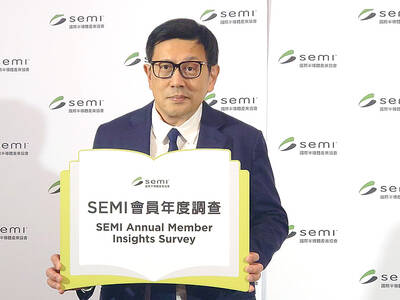
PRICE HIKES: The war in the Middle East would not significantly disrupt supply in the short term, but semiconductor companies are facing price surges for materials Taiwan’s semiconductor companies are not facing imminent supply disruptions of essential chemicals or raw materials due to the war in the Middle East, but surges in material costs loom large, industry association SEMI Taiwan said yesterday. The association’s comments came amid growing concerns that supplies of helium and other key raw materials used in semiconductor production could become a choke point after Qatar shut down its liquefied natural gas (LNG) production and helium output earlier this month due to the conflict. Qatar is the second-largest LNG supplier in the world and accounts for about 33 percent of global helium output. Helium is

China is clamping down on fertilizer exports to protect its domestic market, industry sources said, putting an additional strain on global markets that were already grappling with shortages caused by the US-Israeli war on Iran. China is among the largest fertilizer exporters — shipping more than US$13 billion of it last year — and it has a history of controlling exports to keep prices low for farmers. Shipments through the war-blocked Strait of Hormuz account for about one-third of the sea-borne supply. This month, Beijing banned exports of nitrogen-potassium fertilizer blends and certain phosphate varieties, sources said. The ban, which has not

AMAZING ABUNDANCE: Elon Musk has announced plans for a new facility in Texas which would manufacture chips for Tesla and SpaceX to use in robotics and AI Elon Musk said his Terafab project — a grand plan to eventually manufacture his own chips for robotics, artificial intelligence (AI) and space data centers — would be built in Austin and jointly run by Tesla Inc and Space Exploration Technologies Corp (SpaceX). Musk, the chief executive officer of the two companies, said he would start off with an “advanced technology fab” in Austin that would have all of the equipment necessary to make chips of any kind. The project would call for one day supporting 1 terawatt (TW) of computing power per year, the amount Musk expects the companies to


 RSS
RSS