

Hon Hai Precision Industry Co (鴻海精密), the world’s largest contract electronics manufacturer, yesterday forecast revenue this quarter would grow significantly, driven by seasonal demand for smartphones.
The major iPhone assembler told investors that growth momentum this quarter would extend from last quarter, when revenue increased 18 percent to NT$1.54 trillion (US$47.63 billion) from the previous quarter.
Revenue this quarter would fall on an annual basis as demand for information and communications technology products weakens across the board under an unfavorable macroeconomic environment, it said.
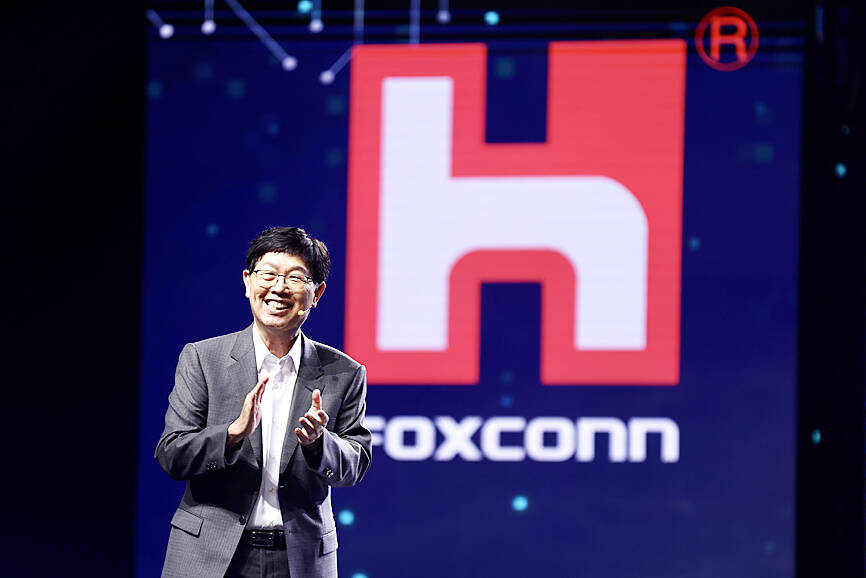
Photo: Ritchie B. Tongo, EPA-EFE
“Although we still expect a decline in revenue year-on-year this quarter, we believe our performance in the fourth quarter would beat our earlier expectations,” Hon Hai chairman Young Liu (劉揚偉) said.
Hon Hai said that revenue this year would fall from last year’s level, as expected, but gross margin would be higher than last year’s 6.04 percent.
Gross margin in the first three quarters rose to 6.37 percent from 6.2 percent during the same period last year, due to a better product mix, it said.
Hon Hai said its operations in China remain normal despite an investigation by local authorities into tax and land use issues.
However, the company said it is cautious about the industry’s outlook next year amid geopolitical conflicts, central banks’ monetary policies and high inflation, adding that growth in the global economy might slow next year.
“We have a relatively conservative and neutral view about next year,” Liu said. “We expect the [electronics] market to grow 5 percent next year, but that 5 percent growth could easily be offset by geopolitical factors.”
Artificial intelligence-enabled servers are the bright spot next year, and that segment would experience robust growth due to strong demand from cloud service providers, Liu said.
Demand for general servers is also showing signs of a revival, as inventory adjustments wind down, he said.
Regarding the company’s electric vehicle (EV) business, Liu said that Hon Hai started generating revenue from Model T buses and Model C sedans, and is in talks with 14 potential customers to assemble their vehicles.
Recent auto workers’ strikes in the US would drive up manufacturing costs and put pressure on automakers to outsource production, he said.
At the same time, EV makers have cut prices to attract consumers, he added.
Hon Hai’s net profit last quarter surged 31 percent to NT$43.13 billion from NT$33 billion in the second quarter, due to elevated margin performance. That meant annual growth of 11 percent from NT$38.76 billion.
Earnings per share climbed to NT$3.11, compared with NT$2.38 in the second quarter and NT$2.8 in the third quarter last year.
Gross margin rose to 6.6 percent, the highest level in about six years, from 6.41 percent in the prior quarter and 6.16 percent a year ago, attributable to improved product portfolios and favorable foreign exchange rates.
In the first three quarters of this year, net profit totaled NT$88.95 billion, down 12.4 percent year-on-year, or earnings per share of NT$6.42, compared with NT$7.32 a year earlier.
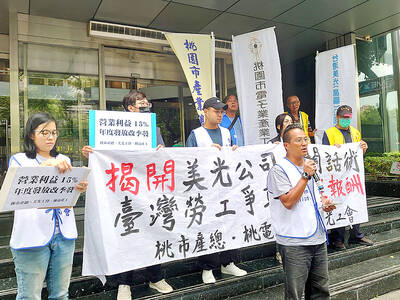
UNION DETERMINATION: Rejecting an offer for a one-time payout as an attempt to influence opinion, the union said a strike at the memory chip manufacturer is possible The Micron Taiwan workers’ union yesterday rejected a one-time payout unveiled by US-based Micron Technology Inc last week, saying it wants a long-term mechanism under which employees would share 15 percent of the company’s operating profits. While the union and the company are still in talks over the dispute, the reward package was proposed unilaterally by the employer without reaching an agreement with the union, union head Jerry Lin (林哲瑞) told reporters. Lin said he suspected the company was seeking to influence public opinion with the move. On Friday last week, Micron announced a reward package under which employees in Taiwan would receive
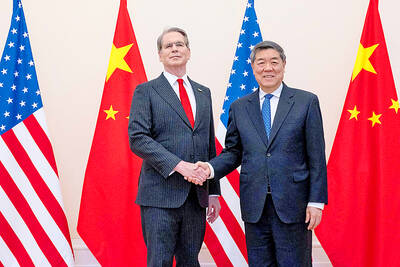
MINIMAL EXPECTATIONS: Analysts think that the two sides are likely to aim for ‘status quo’-level agreements, maintaining civility, without major trade breakthroughs US Secretary of the Treasury Scott Bessent and Chinese Vice Premier He Lifeng (何立峰) were set to meet yesterday to try to set up potential agreements on artificial intelligence (AI), tariffs and critical minerals for a summit in Washington this week between US President Donald Trump and Chinese President Xi Jinping (習近平). The meetings at JPMorgan Chase & Co’s headquarters in Manhattan, which included US Trade Representative Jamieson Greer, were due to start at about 10:30am on Sunday morning and were expected to run all day. Key topics would be the status of a US-China trade truce that is set to expire
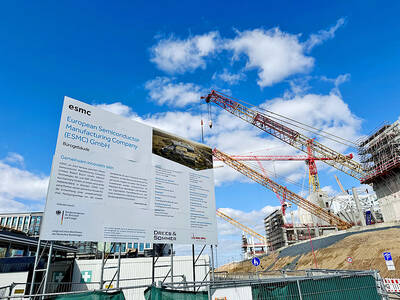
BUILDER’s RITES: The topping out ceremony is held when a project being built has its highest point laid out, a sure sign that TSMC’s European project is making solid progress A “topping out” ceremony was held on Monday at a plant under construction in Germany by Taiwan Semiconductor Manufacturing Co (TSMC, 台積電), indicating that the fab is progressing as planned and within budget, the head of a joint-venture company in charge of the project said. A topping out ceremony is the construction milestone of laying the final beam or structural piece at the highest point of a building, and it honors the construction crew, architects and engineers. European Semiconductor Manufacturing Co (ESMC) president Christian Koitzsch said that about 2,000 workers from 106 countries are working around the clock at the site in
APPEAL: Any agreement to produce advanced memory such as HBM or DRAM could run into opposition from Seoul as those technologies are sensitive, sources said South Korea’s SK Hynix Inc is in talks with Intel Corp about a deal that would see it manufacture memory chips on US soil for the first time, three people familiar with the discussions said. Under one potential scenario, SK Hynix would lease part of Intel’s long-planned chipmaking facility in Ohio, they said. Under another scenario, it could form a venture with Intel and major cloud firms that are keen to lock in memory supplies, two of the people said. A deal would relieve pressure on Intel, which has been struggling, and mark a big win for US President Donald


 RSS
RSS