


Salma Faheem has not spoken to her husband, Mohammed, since June. That is when he dropped her and their three children off in his home village of Dalma in Pakistan’s northwestern Khyber Pakhtunkhwa Province because he could no longer afford for them to live with him in the southern city of Karachi.
Instead of living in one room in an urban slum with water on tap and a gas-powered cooker, Salma has to walk an hour every day to fetch water and she must cook her family’s meals on a wood-fired stove.
“I hate it here,” she said by telephone. “I loved it in Karachi.”
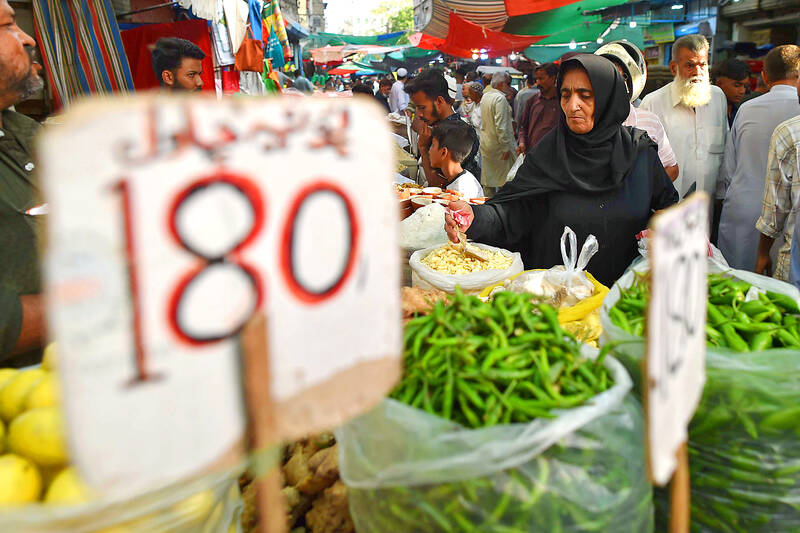
Photo: EPA-EFE
Her husband is not happy either, but said he feels he had no choice.
Cash-strapped Pakistan’s US$350 billion economy is in meltdown with low growth, a weak currency and spiraling prices.
The pain is being felt most keenly by those living on low incomes in cities. Some have decided that the only answer is to leave or to send their families back to their home villages, where they can live more cheaply thanks to family networks and assets.
Faheem, 33, said that the 35,000 rupees (US$126.26) he earns a month as a furniture handler and loader could no longer stretch to cover food, rent and tuition.
“In the village, the house is ours so it is rent-free,” he said. However, “I loved having them around. I miss my children.”
Like other developing countries, Pakistan is heavily reliant on imports of oil, gas and other commodities, and has been hit hard by the COVID-19 pandemic, the global slowdown that followed the war in Ukraine and floods last year that submerged one-third of the country.
High fuel and energy prices have pushed inflation to 31.4 percent year-on-year last month, up from 27.4 percent in August, and there is little the new caretaker government, which took over in August, can do to rein in prices.
A US$3 billion loan program, approved by the IMF in July last year, averted a sovereign debt default, but reforms linked to the bailout, including an easing of import restrictions and a demand that energy and fuel subsidies be removed, have thrown oil on the inflation fire. The economic crisis is exacerbated by rising political tensions ahead of a national election scheduled for January.
With no relief in sight, some people in the nation of about 240 million are cutting costs the only way they can: by moving home to their villages.
“The decision to return to our hometown was not an easy one,” said Waseem Anwar, who in May moved with his wife and five children to the small dusty town of Chowk Marlay — about four hours from Lahore.
His wages as a water filter and sanitary fittings installer could no longer cover rent, utilities, medical expenses and tuition in the city.
“Although the work opportunities here are not as plentiful, the reduction in my overhead expenses to about half ... has provided great relief,” said Anwar, who now works as a plumber.
There is no immediate data available on the total number of people who have moved back to villages in the past few months, but researchers cite substantial anecdotal evidence based on dozens of conversations with so-called reverse migrants and their relatives.
One reason that hard figures are difficult to come by is because this year’s census operation meant the labor force survey, normally carried out every two years by the Pakistan Bureau of Statistics, has been delayed indefinitely, said Bilal Gilani, executive director of research firm Gallup Pakistan.
“The labor force survey is the main data source for migration and reverse migration,” Gilani said, adding that other surveys provided evidence of some population movements.
“Many of our surveys suggest that cutting costs is a major way by which people are surviving this flood of inflation as other forms of mitigation, such as doing more hours or a second job, are also not available,” he said. “Avoiding rent in [the] city by sending families back to rural areas or avoiding food costs by returning to villages where there is own-grown wheat, and meat and milk through owned livestock provides a cover.”
While the government has said it expects inflation to ease eventually, it warned that prices would remain high next month due to an upward adjustment in energy tariffs and a major increase in fuel prices.
The South Asian nation’s power sector has been plagued by high rates of power theft and distribution losses, resulting in accumulating debts across the production chain.
A Pakistani Ministry of Finance official, speaking on condition of anonymity as they were not authorized to speak to the media, said that the government had rolled out a range of targeted social safety net programs aimed at income support, food assistance and healthcare.
For example, the Benazir Income Support Program, with a budget of 471 billion rupees for the current financial year, disburses payments to more than 9 million families.
Other schemes help enroll millions of children from low-income homes into schools and provide healthcare and cash transfers to prevent child stunting, which affects 40 percent of children younger than five.
“We are fully committed to ensuring that the most vulnerable segments of our society are protected during these trying times,” the official said by phone from the capital, Islamabad.
Policy experts say the government should support poor households by lowering taxes, such as sales levies, in the short term and introducing a targeted subsidy system, which could help narrow the fiscal deficit.
“If even a part of the untargeted subsidy to energy [among others] can be targeted, it would make a big difference,” said Haris Gazdar, director at the Karachi-based Collective for Social Science Research.
Gazdar said that while the recent trend of reverse migration would not have major economic effects immediately, because workers would likely return to cities once the economy picked up, it could lead to “longer lasting” problems with, for example, many children being taken out of schools.
He urged Pakistan to learn from countries like the US, where social security benefits kick in when someone becomes jobless, and neighboring India, where citizens can enroll for work, such as building roads, digging wells or creating other rural infrastructure, and receive a minimum wage for at least 100 days each year.
“These are responsive systems, which we do not yet have and would need to work towards,” Gazdar said.

Vincent Wei led fellow Singaporean farmers around an empty Malaysian plot, laying out plans for a greenhouse and rows of leafy vegetables. What he pitched was not just space for crops, but a lifeline for growers struggling to make ends meet in a city-state with high prices and little vacant land. The future agriculture hub is part of a joint special economic zone launched last year by the two neighbors, expected to cost US$123 million and produce 10,000 tonnes of fresh produce annually. It is attracting Singaporean farmers with promises of cheaper land, labor and energy just over the border.

US actor Matthew McConaughey has filed recordings of his image and voice with US patent authorities to protect them from unauthorized usage by artificial intelligence (AI) platforms, a representative said earlier this week. Several video clips and audio recordings were registered by the commercial arm of the Just Keep Livin’ Foundation, a non-profit created by the Oscar-winning actor and his wife, Camila, according to the US Patent and Trademark Office database. Many artists are increasingly concerned about the uncontrolled use of their image via generative AI since the rollout of ChatGPT and other AI-powered tools. Several US states have adopted

A proposed billionaires’ tax in California has ignited a political uproar in Silicon Valley, with tech titans threatening to leave the state while California Governor Gavin Newsom of the Democratic Party maneuvers to defeat a levy that he fears would lead to an exodus of wealth. A technology mecca, California has more billionaires than any other US state — a few hundred, by some estimates. About half its personal income tax revenue, a financial backbone in the nearly US$350 billion budget, comes from the top 1 percent of earners. A large healthcare union is attempting to place a proposal before

KEEPING UP: The acquisition of a cleanroom in Taiwan would enable Micron to increase production in a market where demand continues to outpace supply, a Micron official said Micron Technology Inc has signed a letter of intent to buy a fabrication site in Taiwan from Powerchip Semiconductor Manufacturing Corp (力積電) for US$1.8 billion to expand its production of memory chips. Micron would take control of the P5 site in Miaoli County’s Tongluo Township (銅鑼) and plans to ramp up DRAM production in phases after the transaction closes in the second quarter, the company said in a statement on Saturday. The acquisition includes an existing 12 inch fab cleanroom of 27,871m2 and would further position Micron to address growing global demand for memory solutions, the company said. Micron expects the transaction to


 RSS
RSS