


The Bank of Israel yesterday said it would sell up to US$30 billion of foreign currency in the open market, in the central bank’s first-ever sale of foreign exchange, to maintain stability during Israel’s war with Palestinian militants in Gaza.
The move appeared to quickly calm the market as the shekel recovered from steep early losses.
“The bank will operate in the market during the coming period in order to moderate volatility in the shekel exchange rate and to provide the necessary liquidity for the continued proper functioning of the markets,” it said in a statement.
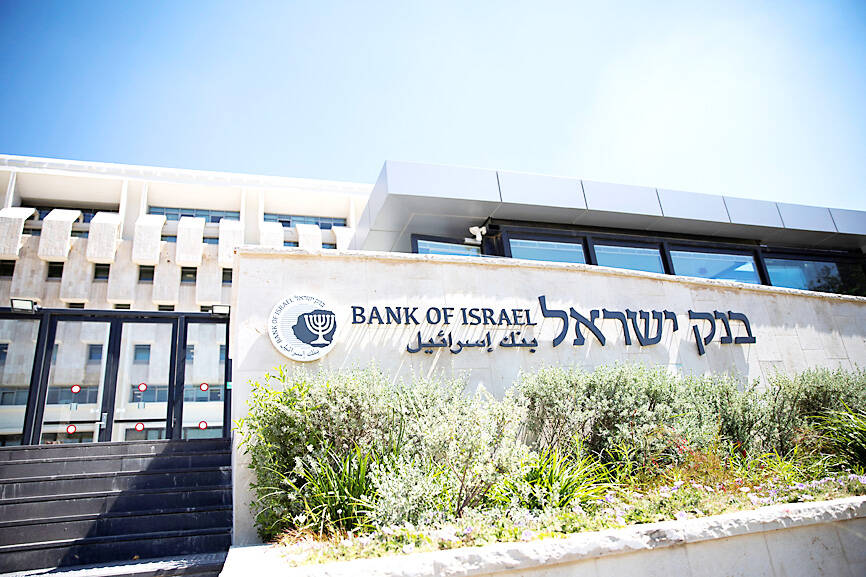
Photo: Reuters
The central bank said it would also provide liquidity through SWAP mechanisms in the market, of up to US$15 billion.
CONTINUED MONITORING
“The Bank of Israel will continue monitoring developments, tracking all the markets, and acting with the tools available to it as necessary,” it said.
Ahead of the announcement, the shekel had weakened by more than 2 percent to a more than seven-and-a-half-year low of 3.92 shekels per US dollar. The shekel now stands at 3.86.
The shekel was already weak, down 10 percent versus the greenback so far this year, largely due to the Israeli government’s judicial overhaul plan that has sharply curtailed foreign investment.
Israeli stock and bond prices slid 7 percent and many businesses were closed on Sunday, a day after Hamas militants from Gaza killed 700 Israelis and abducted dozens more in the deadliest incursion into Israeli territory since Egypt and Syria’s attacks in the Yom Kippur War more than 50 years ago.
FOREX RESERVES
Israel has amassed forex reserves of more than US$200 billion, much of it from buying forex since 2008 to try and keep the shekel from strengthening too much and harming exporters as foreign inflows to the country’s tech sector soared.
The last time the bank intervened was in January last year.

AI SERVER DEMAND: ‘Overall industry demand continues to outpace supply and we are expanding capacity to meet it,’ the company’s chief executive officer said Hon Hai Precision Industry Co (鴻海精密) yesterday reported that net profit last quarter rose 27 percent from the same quarter last year on the back of demand for cloud services and high-performance computing products. Net profit surged to NT$44.36 billion (US$1.48 billion) from NT$35.04 billion a year earlier. On a quarterly basis, net profit grew 5 percent from NT$42.1 billion. Earnings per share expanded to NT$3.19 from NT$2.53 a year earlier and NT$3.03 in the first quarter. However, a sharp appreciation of the New Taiwan dollar since early May has weighed on the company’s performance, Hon Hai chief financial officer David Huang (黃德才)

The Taiwan Automation Intelligence and Robot Show, which is to be held from Wednesday to Saturday at the Taipei Nangang Exhibition Center, would showcase the latest in artificial intelligence (AI)-driven robotics and automation technologies, the organizer said yesterday. The event would highlight applications in smart manufacturing, as well as information and communications technology, the Taiwan Automation Intelligence and Robotics Association said. More than 1,000 companies are to display innovations in semiconductors, electromechanics, industrial automation and intelligent manufacturing, it said in a news release. Visitors can explore automated guided vehicles, 3D machine vision systems and AI-powered applications at the show, along
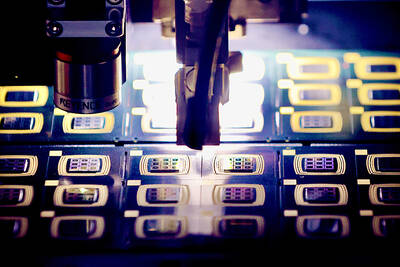
FORECAST: The greater computing power needed for emerging AI applications has driven higher demand for advanced semiconductors worldwide, TSMC said The government-supported Industrial Technology Research Institute (ITRI) has raised its forecast for this year’s growth in the output value of Taiwan’s semiconductor industry to above 22 percent on strong global demand for artificial intelligence (AI) applications. In its latest IEK Current Quarterly Model report, the institute said the local semiconductor industry would have output of NT$6.5 trillion (US$216.6 billion) this year, up 22.2 percent from a year earlier, an upward revision from a 19.1 percent increase estimate made in May. The strong showing of the local semiconductor industry largely reflected the stronger-than-expected performance of the integrated circuit (IC) manufacturing segment,

NVIDIA FACTOR: Shipments of AI servers powered by GB300 chips would undergo pilot runs this quarter, with small shipments possibly starting next quarter, it said Quanta Computer Inc (廣達), which supplies artificial intelligence (AI) servers powered by Nvidia Corp chips, yesterday said that AI servers are on track to account for 70 percent of its total server revenue this year, thanks to improved yield rates and a better learning curve for Nvidia’s GB300 chip-based servers. AI servers accounted for more than 60 percent of its total server revenue in the first half of this year, Quanta chief financial officer Elton Yang (楊俊烈) told an online conference. The company’s latest production learning curve of the AI servers powered by Nvidia’s GB200 chips has improved after overcoming key component


 RSS
RSS