


The global economy and inflation have so far proved surprisingly resilient to a barrage of interest-rate increases, prompting top central bankers on Wednesday to promise more of the same.
Appearing together in Sintra, Portugal, US Federal Reserve Chairman Jerome Powell, European Central Bank (ECB) President Christine Lagarde and Bank of England (BOE) Governor Andrew Bailey all said they had a way to go in reining in too-high inflation.
“Although policy is restrictive, it may not be restrictive enough and it has not been restrictive for long enough,” Powell said at an ECB-hosted panel discussion that also included Bank of Japan (BOJ) Governor Kazuo Ueda.
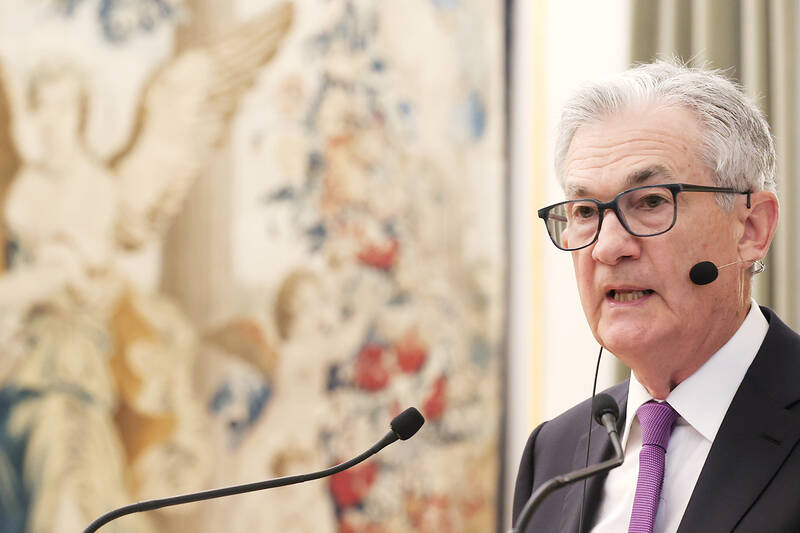
Photo: EPA-EFE
Noting that most Fed policymakers expect to raise rates at least two more times this year, Powell left the door open to the US central bank increasing borrowing costs at two consecutive meetings after it took a break from tightening at a gathering earlier this month.
Lagarde, for her part, suggested that an ECB rate increase next month was a virtual certainty, though she was less committal on what policymakers would do at their subsequent meeting in September.
Meanwhile, Bailey vowed to do what was necessary to bring inflation back to 2 percent after the BOE surprised investors by boosting rates a half percentage point this month.
Ueda was the odd one out, emphasizing that Japan’s rates are on hold because underlying inflation remains below 2 percent. Even so, he outlined the potential for a change if the BOJ becomes more confident that 2 percent price gains would materialize next year.
Last year, the Fed, ECB and BOE embarked on their most aggressive credit tightening in decades in a bid to bring inflation back down to their 2 percent targets.
Despite fears that it would trigger a global recession, the world economy has so far held up.
However, underlying inflation has also been persistent.
Powell said it would not be until 2025 that the core inflation measure falls to 2 percent, and voiced concern that the longer inflation stays high, the greater the risk that it would become entrenched in the economy.
“The passage of time is not our friend here,” he said.
He and Bailey zeroed in on the tightness of their respective job markets, portraying it as a source of strength for the economy, but also as a fuel for inflation.
Powell acknowledged that a recession was possible because of the Fed’s actions, though that is not his base case.
Others on the panel were equally cautious.
While the BOE is not forecasting a recession, “we have to watch it very carefully,” Bailey said.
In the end, the central bankers made clear that their No. 1 aim was taming inflation — even if that meant that their economies would have to suffer through tough times as a result.
Separately, Sweden’s central bank yeserday raised its key interest rate to its highest level in 15 years, as inflation remains too high.
The Riksbank raised the rate by 0.25 percentage points to 3.75 percent.
“The Riksbank’s policy rate increases are having an effect, but for inflation to return to the target of 2 percent within a reasonable period of time, monetary policy needs to be tightened further,” the central bank said in a statement.

The domestic unit of the Chinese-owned, Dutch-headquartered chipmaker Nexperia BV will soon be able to produce semiconductors locally within China, according to two company sources. Nexperia is at the center of a global tug-of-war over critical semiconductor technology, with a Dutch court in February ordering a probe into alleged mismanagement at the company. The geopolitical tussle has disrupted supply chains, with some carmakers reportedly forced to cut production due to chip shortages. Local production would allow Nexperia’s domestic arm, Nexperia Semiconductors (China) Ltd (安世半導體中國), to bypass restrictions in place since October on the supply of silicon wafers — etched with tiny components to

Singapore-based ride-hailing and delivery giant Grab Holdings Ltd has applied for regulatory approval to acquire the Taiwan operations of Germany-based Delivery Hero SE's Foodpanda in a deal valued at about US$600 million. Grab submitted the filing to the Fair Trade Commission on Friday last week, with the transaction subject to regulatory review and approval, the company said in a statement yesterday. Its independent governance structure would help foster a healthy and competitive market in Taiwan if the deal is approved, Grab said. Grab, which is listed on the NASDAQ, said in the filing that US-based Uber Technologies Inc holds about 13 percent of

Taiwan Semiconductor Manufacturing Co (TSMC, 台積電) yesterday received government approval to deploy its advanced 3-nanometer (3nm) process at its second fab currently under construction in Japan, the Ministry of Economic Affairs said in a news release. The ministry green-lit the plan for the facility in Kumamoto, which is scheduled to start installing equipment and come online in 2028 with a monthly production capacity of 15,000 12-inch wafers, the ministry said. The Department of Investment Review in June 2024 authorized a US$5.26 billion investment for the facility, slated to manufacture 6- to 12nm chips, significantly less advanced than 3nm process. At a meeting with

Taiwan’s food delivery market could undergo a major shift if Singapore-based Grab Holdings Ltd completes its planned acquisition of Delivery Hero SE’s Foodpanda business in Taiwan, industry experts said. Grab on Monday last week announced it would acquire Foodpanda’s Taiwan operations for US$600 million. The deal is expected to be finalized in the second half of this year, with Grab aiming to complete user migration to its platform by the first half of next year. A duopoly between Uber Eats and Foodpanda dominates Taiwan’s delivery market, a structure that has remained intact since the Fair Trade Commission (FTC) blocked Uber Technologies Inc’s


 RSS
RSS