


The US Department of Commerce on Monday restricted exports to entities that it says recruited Western pilots to train Chinese military personnel, as well as some that helped develop hypersonic weapons.
They were among 43 groups added to the department’s so-called Entity List, which covers national-security threats.
“It is imperative that we prevent China from acquiring US technologies and know-how to enable their military modernization programs,” US Assistant Secretary of Commerce for Export Enforcement Matthew Axelrod said in a statement.
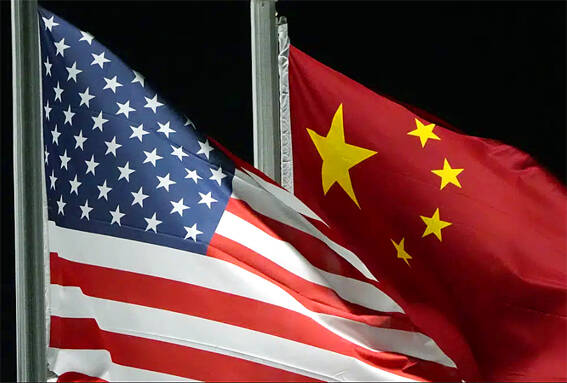
Photo: AP
Aviation Industry Corporation of China 612 Institute (中國航空工業集團612研究所) was among those added for seeking US items to help Beijing’s military modernization, with ties to activities including design and manufacturing of air-to-air missiles.
Shanghai Supercomputing Technology Co (上海超算科技) was added for supporting the operation of supercomputers in China, specifically by offering cloud-based supercomputing capabilities to support hypersonic research.
The US action over recruiting pilots follows reports last year, including in the Wall Street Journal in December, that China’s military had sought to enlist veteran Western pilots to improve its ability to fly planes from aircraft carriers, which could be useful in the event of a conflict with the US.
In addition to 31 Chinese entities, the department added five firms from the United Arab Emirates, four from Pakistan, three from South Africa, two from the UK, and one each from Kenya, Laos, Malaysia, Singapore and Thailand.
Entities were also added for contributing to Pakistan’s ballistic-missile program and other weapons.
The Entity List is a roster of people and organizations to which US companies cannot export technology without first securing a license, which requires a strong case for why an exception should be made.
The list has traditionally covered foreign scientists and shell companies, and it has been used to cut off sales to terrorist groups. In the past few years, the list has expanded to include more than 600 Chinese entities, including large companies such as computer server maker Inspur Group (浪潮集團) and chipmaker Semiconductor Manufacturing International Corp (中芯國際).


Taiwanese firms have increased investment in the Philippines in recent years as Manila’s ties with Washington deepen and global supply chains continue to shift away from China, an expert at the Chung-Hua Institution for Economic Research (CIER, 中華經濟研究院) said yesterday. The Philippines had not been among Taiwanese investors’ top choices in Southeast Asia, CIER Taiwan ASEAN Studies Center director Kristy Hsu (徐遵慈) said at a seminar in Taipei. However, Taiwan’s investment in the country has grown significantly since the COVID-19 pandemic, reaching US $257 million last year, a high in recent years, she said. Although Taiwan’s total investment in the Philippines still lags

Intel Corp regards Taiwan Semiconductor Manufacturing Co (TSMC, 台積電) as a longstanding partner, as the US chipmaker would continue outsourcing production of advanced chips to TSMC, Intel chief executive officer Lip-Bu Tan (陳立武) said yesterday. “I don’t look at people as competitors. I look at the collaboration... Nvidia is also, you know, a good friend,” Tan told a news conference following his keynote speech at the Computex trade show in Taipei. “It’s a very trusted partnership for us... We are a big, top customer for them, and we’re going to continue doing that,” he said, referring to TSMC, the world’s largest foundry

Hon Hai Precision Industry Co (鴻海精密) yesterday said it would work with US chipmaker Intel Corp to jointly develop and deploy next-generation artificial intelligence (AI) infrastructure and intelligent computing platforms in a move to capture booming demand for AI computing systems. Hon Hai, also known as Foxconn Technology Group (富士康), said in a statement that the partnership would combine its global manufacturing scale, system integration expertise and AI data center deployment capabilities with Intel’s strengths in processor architecture, silicon technologies and software ecosystem. The companies said they plan to work on equipment used in AI data centers, including server racks powered by

Artificial intelligence (AI) agents would supplant smartphones as the center of people’s digital lives, fundamentally reshaping personal devices and driving a major computing upgrade cycle, Qualcomm Inc CEO Cristiano Amon said yesterday. In his keynote speech for this year’s Computex trade show in Taipei, Amon said that the rise of "agentic AI" — AI systems capable of reasoning, planning and carrying out tasks autonomously — would transform how people interact with technology across phones, PCs, vehicles and wearable devices. Describing the technology as the next major evolution in computing, Amon said that "2026 is the year of agents.” For decades, smartphones have sat


 RSS
RSS