


The US Federal Reserve is widely expected to pause its campaign of interest rate increases on Wednesday to give policymakers more time to assess the economic affect of existing hikes and recent banking stresses.
However, members of the rate-setting US Federal Open Market Committee (FOMC) remain divided going into the meetings on Tuesday and Wednesday, with a minority still pushing for an 11th straight hike to fight inflation, which remains stubbornly above the Fed’s long-term target of 2 percent.
The Fed has raised its benchmark lending rate by 5 percentage points since March last year, lifting it to 5.00 to 5.25 percent.
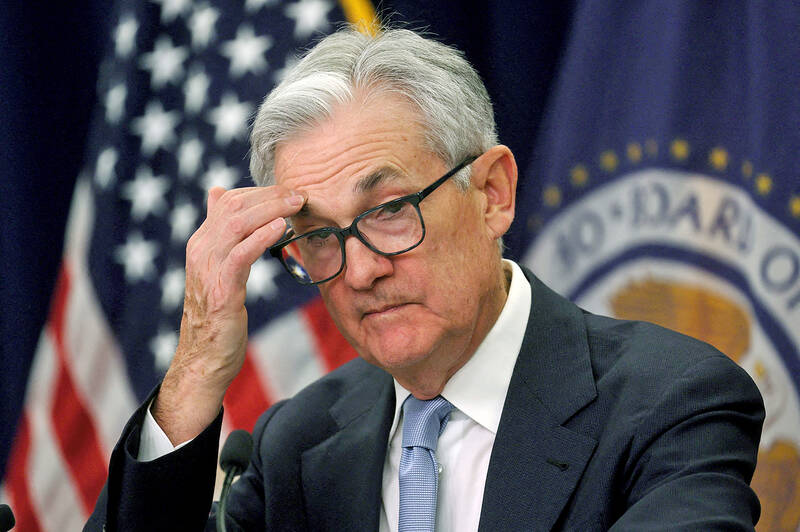
Photo: Reuters
“I think there is enough support within the community for that pause,” Ernst & Young senior economist Lydia Boussour said.
“But at the same time, the compromise will be that the FOMC will be keen on carrying on retaining that optionality, and really keeping the door open to further tightening,” she said.
Senior officials, including Fed Chairman Jerome Powell, have indicated that they might vote to hold the benchmark lending rate at the next meeting of the Fed’s rate-setting committee, while leaving the door open to an additional rate hike next month if necessary.
“Skipping a rate hike at a coming meeting would allow the committee to see more data before making decisions about the extent of additional policy firming,” Fed Board of Governors member Philip Jefferson said at the end of last month.
The data points to a mixed economic picture, with slowing growth, a tight labor market and inflation well above the Fed’s 2 percent target.
Jefferson, who was recently nominated for the vacant No. 2 spot at the Fed, said that “a decision to hold our policy rate constant at a coming meeting should not be interpreted to mean that we have reached the peak rate for this cycle.”
However, those pushing for a further hike, such as Fed Board of Governors member Christopher Waller, have indicated support for a more aggressive stance on inflation.
“I do not support stopping rate hikes unless we get clear evidence that inflation is moving down towards our 2 percent objective,” Waller said last month, adding that “whether we should hike or skip at the June meeting will depend on how the data come in.”
The division among members of the FOMC over the best path forward has led some traders on a journey, from predicting a pause to expecting a hike — and back again.
Futures traders, who as recently as the end of last month were predicting another hike, see a more-than 70 percent chance that the Fed would vote to hold rates on Wednesday.
Many analysts also see a pause as the most likely scenario.
“Chairman Powell is expected to corral the cats and get the Federal Open Market Committee to skip a rate hike in June, while leaving the door open to hike in July,” KPMG Economics chief economist Diane Swonk wrote in a recent note to clients.
While most major banks predict a pause, there are still some notable outliers who expect the Fed to hike rates by another quarter of a percentage point.
“We are maintaining our call for a 25bp [basis points] rate hike next week — though admittedly it is a close call,” Citigroup Inc economists wrote in an investor note.
If Powell does succeed in winning over a majority of FOMC members for a pause this month, analysts expect the Fed to signal its interest-rate announcement and updated summary of economic projections (SEP) that it expects another rate hike to complete the cycle.
“Among the key innovations for this meeting, we expect the statement will be hawkishly adjusted to note the potential for further tightening at ‘coming meetings,’” Deutsche Bank AG economists wrote in a note to clients.
The SEP would likely show that “appropriate policy may require an additional hike to achieve a sufficiently restrictive stance,” they added.
This would mean the Fed could leave the door open for an additional rate hike if needed, possibly as early as next month, analysts said.

The domestic unit of the Chinese-owned, Dutch-headquartered chipmaker Nexperia BV will soon be able to produce semiconductors locally within China, according to two company sources. Nexperia is at the center of a global tug-of-war over critical semiconductor technology, with a Dutch court in February ordering a probe into alleged mismanagement at the company. The geopolitical tussle has disrupted supply chains, with some carmakers reportedly forced to cut production due to chip shortages. Local production would allow Nexperia’s domestic arm, Nexperia Semiconductors (China) Ltd (安世半導體中國), to bypass restrictions in place since October on the supply of silicon wafers — etched with tiny components to

Singapore-based ride-hailing and delivery giant Grab Holdings Ltd has applied for regulatory approval to acquire the Taiwan operations of Germany-based Delivery Hero SE's Foodpanda in a deal valued at about US$600 million. Grab submitted the filing to the Fair Trade Commission on Friday last week, with the transaction subject to regulatory review and approval, the company said in a statement yesterday. Its independent governance structure would help foster a healthy and competitive market in Taiwan if the deal is approved, Grab said. Grab, which is listed on the NASDAQ, said in the filing that US-based Uber Technologies Inc holds about 13 percent of

Taiwan Semiconductor Manufacturing Co (TSMC, 台積電) yesterday received government approval to deploy its advanced 3-nanometer (3nm) process at its second fab currently under construction in Japan, the Ministry of Economic Affairs said in a news release. The ministry green-lit the plan for the facility in Kumamoto, which is scheduled to start installing equipment and come online in 2028 with a monthly production capacity of 15,000 12-inch wafers, the ministry said. The Department of Investment Review in June 2024 authorized a US$5.26 billion investment for the facility, slated to manufacture 6- to 12nm chips, significantly less advanced than 3nm process. At a meeting with

Taiwan is open to joining a global liquefied natural gas (LNG) program if one is created, but on the condition that countries provide delivery even in a scenario where there is a conflict with China, an energy department official said yesterday. While Taiwan’s priority is to have enough LNG at home, the nation is open to exploring potential strategic reserves in other countries such as Japan or South Korea, Energy Administration Deputy Director-General Chen Chung-hsien (陳崇憲) said. While the LNG market does not have a global reserve for emergencies like that of oil, the concept has been raised a few times —


 RSS
RSS