


In February 2021, Dominican baseball superstar Fernando Tatis Jr signed a monster deal with the San Diego Padres — US$340 million over 14 years.
However, up to US$30 million of that total is eventually to go to Big League Advantage (BLA), which financed Tatis in the early stages of his career, according to US media estimates.
The company and its investors stand to make at least 10 times their initial investment.

Photo: AFP
BLA is one of several start-ups offering individuals an opportunity to bankroll young athletes in exchange for a portion of their future earnings — a new and perfectly legal market that has some sports agents wringing their hands.
Investing in young athletes is nothing new. In the early 2000s, hundreds of promising soccer players ceded their rights to investment funds before the sport’s world governing body FIFA banned the practice in 2015.
Yet now, these opportunities are increasingly available to the average investor, and not just a handful of rich elites with high-powered financial advisers — thanks to new regulations that took effect in 2016.
“We started Finlete because we wanted to bridge the gap between athletes and their fans,” said Rob Connolly, cofounder of the California-based platform, which has the backing of media-telecom giant Comcast Corp.
Finlete is awaiting operations approval from the US Securities and Exchange Commission, in what would be a first for an investment firm open to all, no matter their wealth or earnings.
“Our goal is to have the share price at around US$25,” affording the investor a share of a blue-chip athlete’s future income, said Connolly, adding that he has several thousand people already on a wait list to buy in.
Shareholders would then be able to buy and sell on the platform.
Until now, this nascent investment industry has been largely linked to Major League Baseball (MLB), as its minor league system creates a market of thousands of young players who could eventually make it big.
However, Swiss company FANtium has launched with a focus on tennis, and Commonwealth, which initially specialized in shares of racehorses, is expanding its listings to include golfers.
Those players receive US$225,000 upfront to cover a three-year span, in exchange for 30 percent of their earnings over the same period — a percentage that dwindles to 10 percent in year six, when the contract expires.
The money is placed in a joint account controlled by the player and Commonwealth, “so that we have full visibility into what the money is being spent on,” Commonwealth cofounder and CEO Brian Doxtator said.
At Commonwealth, Finlete and most of their competitors, the athlete is not required to reimburse any of the initial investment if they do not make it to the professional ranks.
For the time being, for athlete investments, Commonwealth only accepts accredited investors, who fulfill a minimum wealth and income threshold.
Yet eventually, “we’ll be able to sell shares in athletes for 100 bucks” as is done for racehorses, Doxtator said.
However, one executive from a sports agency who asked not to be named, voiced skepticism about the benefits of such investments for the athletes.
“It’s become really a predatory practice,” they said. “It can be incredibly dangerous, because you can be giving away a significant financial upside long-term for sort of early short-term gains.”
The executive said he hoped to see more government regulation of the sector, with “more guardrails and safeguards.”
“But it’s still so early,” he said. “Only time will tell — I don’t think people fully understand the whole practice at large.”
Doxtator said he hopes to “completely eradicate predatory deals,” citing the example of an athlete being given US$50,000, and then owing 50 percent of his earnings to investors for 10 years.
“It’s just crazy,” he said.
Registering Commonwealth with the Securities and Exchange Commission would force transparency, especially on the financial parameters of the deals signed by the players, Doxtator said.
Connolly said he understands why some are hesitant to buy into his investment model, but added that some athletes do not have the “support system” needed to make it to the big leagues.
“A lot of these athletes have to quit their dream of being a professional athlete before they reach their full potential because of financial hardship,” Connolly said. “We believe we’re getting more [of them] the ability to achieve their dreams.”
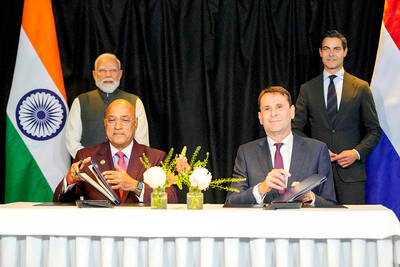
NEW MARKET: The partnership opens up India to the Dutch company, which already has a strong hold in the semiconductor market of South Korea, Taiwan and China ASML Holding NV entered into a partnership agreement with Tata Electronics Pvt Ltd aimed at ramping up India’s goal to develop domestic chip-manufacturing capabilities. The Dutch company’s technology would help power Tata Electronics’ planned 300 millimeter (mm) semiconductor foundry in Gujarat, according to a joint statement from the two companies on Saturday. The signing of a memorandum of understanding coincides with a visit by Indian Prime Minister Narendra Modi to the Netherlands, which is looking to deepen bilateral relations with New Delhi. ASML, whose top customers include Taiwan Semiconductor Manufacturing Co (台積電) and Samsung Electronics Co, makes lithography machines that can print

ROUGH RECORDS: Bonds in Japan, as well is in New Zealand, Australia and the US, are seeing the effects of a nervy market as stock exchanges across Asia edge down A deepening slump in Japanese government bonds added fuel to the selloff in global debt markets as rising oil prices stoked inflation fears and pushed yields to multi-decade highs. Japan’s 30-year yield yesterday surged as much as 20 basis points to the highest level since the tenor’s debut in 1999, before paring some of the move. Shorter-maturity Japanese debt was also under pressure, underscored by weak demand at a sale of five-year notes that offered a record-high coupon of 2 percent. Concerns over inflation and government spending rippling through markets including the US, Australia and New Zealand are being amplified in Japan,
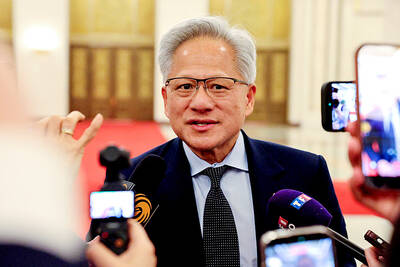
The US has cleared about 10 Chinese firms to buy Nvidia Corp’s second-most powerful artificial intelligence (AI) chip, the H200, but not a single delivery has been made so far, three people familiar with the matter said, leaving a major technology deal in limbo as chief executive officer Jensen Huang (黃仁勳) seeks a breakthrough in China this week. Huang, who was not initially listed in a White House delegation to Beijing, joined the trip after an invitation from US President Donald Trump, a source said. Trump picked him up in Alaska en route to a summit with Chinese President Xi Jinping

Wall Street is licking its chops over an unprecedented slate of massive initial public offerings (IPOs) set to arrive in the coming months, beginning with Elon Musk’s Space Exploration Technologies Corp (SpaceX) next month. That is expected to be followed by artificial intelligence (AI) rivals OpenAI and Anthropic PBC. The trio of mega listings, each eyeing valuations around US$1 trillion or more, constitutes a heady period of elevated risk and reward. SpaceX is targeting an IPO that would raise up to US$80 billion — about double the funds generated from all IPOs last year. OpenAI and Anthropic are eyeing IPOs raising US$60 billion. “We’re


 RSS
RSS