


Taiwan Cooperative Financial Holding Co’s (合庫金控) net income grew 12.42 percent to NT$5.03 billion (US$163.29 million) last quarter, as global capital markets regained some stability, favorable for financial operations and investment dealings to drive profit growth, the state-run bank said yesterday.
The performance translated into earnings per share of NT$0.35 after loan growth beat expectations at 8.8 percent, but higher funding costs weighed on interest spread and margin, Taiwan Cooperative president Chen Mei-tsu (陳美足) said.
“There is room for business improvement moving forward as global monetary tightening has slowed and the situation would stabilize,” Chen told an online investors’ conference.
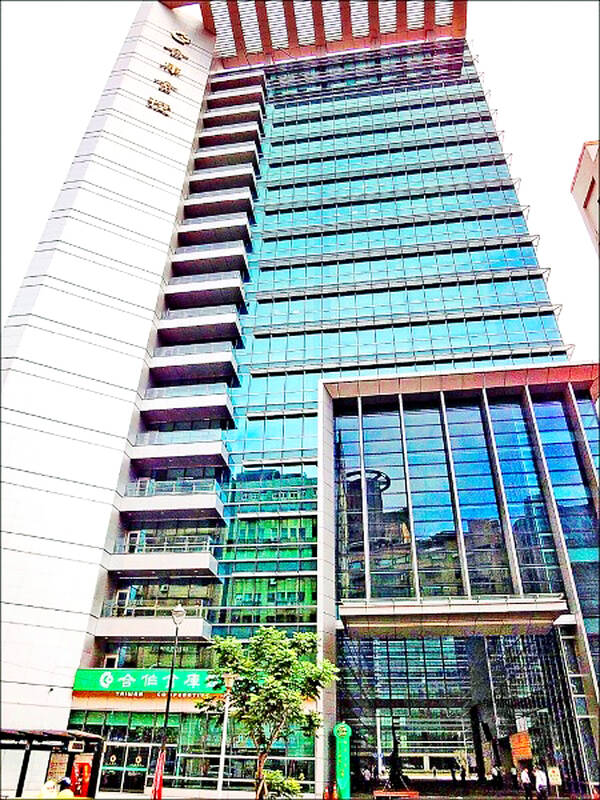
Photo: Chen Mei-ying, Taipei Times
Main subsidiary Taiwan Cooperative Bank (合作金庫銀行) generated NT$44.57 billion, accounting for 90.14 percent of overall profit and offsetting Taiwan Cooperative Bills Finance Corp’s (合作金庫票?金融) losses of NT$59 million linked to higher provision costs, Chen said.
Further, market volatility weakened earnings at the securities and life insurance arms, the official said, adding that different subsidiaries have drawn up profit enhancement strategies, in line with the conglomerate’s pursuit of stable profitability.
Net interest income at Taiwan Cooperative Bank shrank 2.23 percent to NT$85.39 billion, while fee income declined 2.27 percent to NT$15.92 billion, company data showed.
Interest spread narrowed to 1.219 percent, while net interest margin dropped to 0.839 percent, a company official said.
The loan structure also grew unfavorable, with time deposits expanding 11.19 percent, much faster than a 2.65 percent increase in demand deposits, a company financial statement said, as people avoid risky assets and put money away during a tight monetary cycle.
Loans to the government and public enterprises soared 37.8 percent, while lending to large-capital companies gained 16.16 percent, the statement showed.
At the same time, more profitable loans with small and medium-sized enterprises advanced 1.3 percent and lending to retail customers grew 1.51 percent, it said.
The mortgage business declined as unfavorable policy measures and interest-rate hikes chilled property transactions, officials said.
Taiwan Cooperative Bank expects to expand its mortgage business this year by targeting customers with real demand, they said.
Overseas lending drove 11.86 percent of total profit, falling from 28.19 percent three months earlier, it said, as the failure of several US regional banks prompted lenders to turn cautious.
The bad loan ratio climbed to 0.2 percent, from 0.18 percent in the preceding quarter.
The rise was related to unprofitable LED maker Genesis Photonics Inc (新世紀光電), which in November last year filed for bankruptcy and laid off 238 employees, officials said.

Taichung reported the steepest fall in completed home prices among the six special municipalities in the first quarter of this year, data compiled by Taiwan Realty Co (台灣房屋) showed yesterday. From January through last month, the average transaction price for completed homes in Taichung fell 8 percent from a year earlier to NT$299,000 (US$9,483) per ping (3.3m²), said Taiwan Realty, which compiled the data based on the government’s price registration platform. The decline could be attributed to many home buyers choosing relatively affordable used homes to live in themselves, instead of newly built homes in the city’s prime property market, Taiwan Realty
The government yesterday approved applications by Alphabet Inc’s Google to invest NT$27.08 billion (US$859.98 million) in Taiwan, the Ministry of Economic Affairs said in a statement. The Department of Investment Review approved two investments proposed by Google, with much of the funds to be used for data processing and electronic information supply services, as well as inventory procurement businesses in the semiconductor field, the ministry said. It marks the second consecutive year that Google has applied to increase its investment in Taiwan. Google plans to infuse NT$25.34 billion into Charter Investments Ltd (特許投資顧問) through its Singapore-based subsidiary Fructan Holdings Singapore Pte Ltd, and

Micron Technology Inc is a driving force pushing the US Congress to pass legislation that would put new export restrictions on equipment its Chinese competitors use to make their chips, according to people familiar with the matter. A US House of Representatives panel yesterday was to vote on the “MATCH Act,” a bill designed to close gaps in restrictions on chipmaking equipment. It would also pressure foreign companies that sell equipment to Chinese chipmaking facilities to align with export curbs on US companies like Lam Research Corp and Applied Materials Inc. The bill targets facilities operated by China’s ChangXin Memory Technologies Inc

Singapore-based ride-hailing and delivery giant Grab Holdings’ planned acquisition of Foodpanda’s Taiwan operations has yet to enter the formal review stage, as regulators await supplementary documents, the Fair Trade Commission (FTC) said yesterday. Acting FTC Chairman Chen Chih-min (陳志民) told the legislature’s Economics Committee that although Grab submitted its application on March 27, the case has not been officially accepted because required materials remain incomplete. Once the filing is finalized, the FTC would launch a formal probe into the deal, focusing on issues such as cross-shareholding and potential restrictions on market competition, Chen told lawmakers. Grab last month announced that it would acquire


 RSS
RSS