


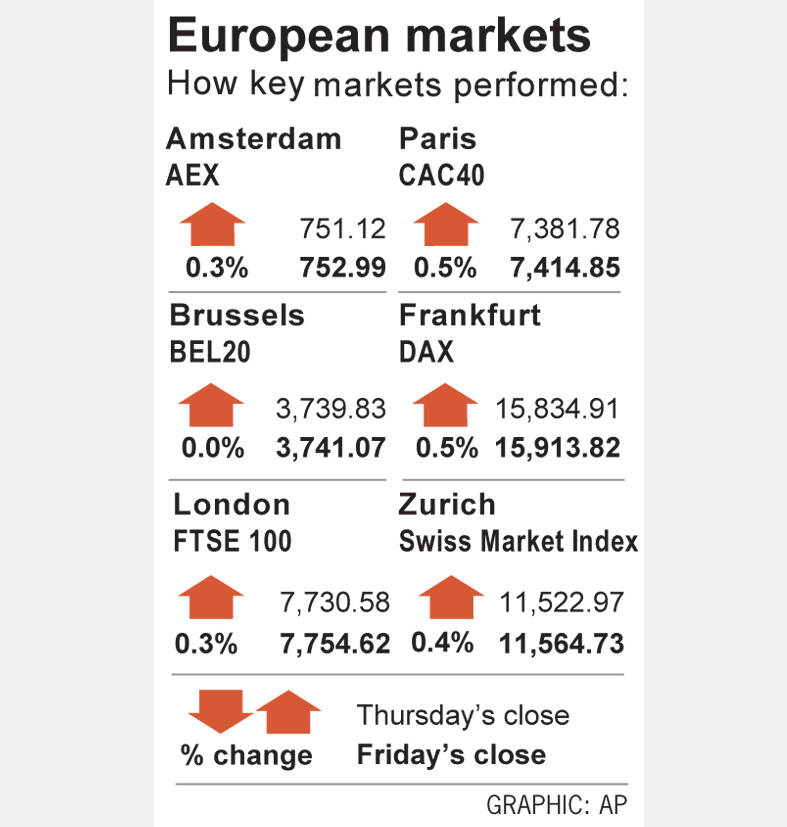
Britain’s FTSE 100 on Friday closed higher, with healthcare and energy stocks leading as drugmaker GSK PLC rose, while data showed that the British economy grew slightly in the first quarter of the year.
European shares also rose on upbeat results from luxury major Compagnie Financiere Richemont SA and gains in energy stocks, while investors assessed inflation data from France and Spain for signals about the European Central Bank’s (ECB) plans on interest rate hikes.
The blue-chip FTSE 100 rose 0.31 percent to 7,754.62, snapping a three-day losing streak.
GSK added 1.8 percent after the drugmaker said a Canadian provincial supreme court dismissed a proposed class action against heartburn drug Zantac over increased cancer risk.
A British Office for National Statistics report showed that the economy grew sluggishly early in the year, better than the shallow recession once expected, but an unexpectedly sharp drop in output in March underscored how fragile its recovery remains.
“The GDP [figure] today is not sending out a good signal,” HYCM chief market analyst Giles Coghlan said.
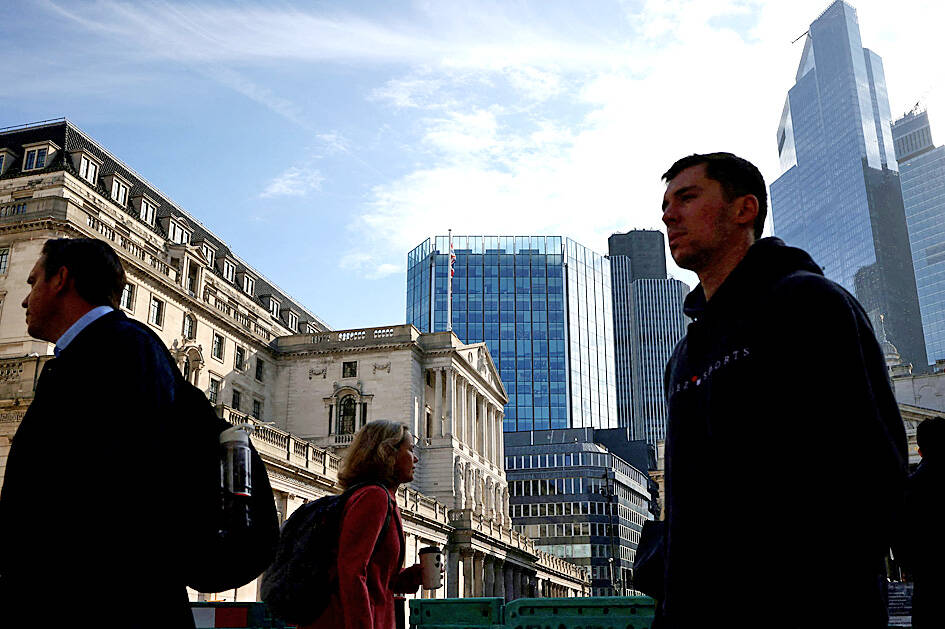
Photo: Reuters
“Even though there’s some confusing input points that allow enough room to overlook this initial print, it will put more pressure on the prints to come,” he said.
British banks recovered from Thursday’s losses, gaining 0.5 percent a day after the country’s central bank lifted borrowing costs.
Morgan Stanley and Bank of America Corp raised their terminal rate forecasts, with both expecting one more interest hike from the Bank of England next month.
Energy stocks rose 0.9 percent, as oil prices rebounded after Thursday’s fall.
The mid-cap FTSE 250 fell 0.4 percent to 19,188.37.
Both London-based indices end the week lower, with the FTSE 100 falling 0.31 percent to log a third straight weekly drop, its longest streak of weekly losses in seven months. The FTSE 250 fell 1.36 percent for the week.
The pan-European STOXX 600 closed 0.4 percent higher at 465.49, gaining 0.04 percent from the previous week.
The benchmark index has traded in a tight range in the past few weeks as investors remain concerned about the possibility of a US recession and further rate hikes from the ECB.
Richemont rose 3.5 percent, after touching a record high in early trading, as the luxury goods group beat expectations after strong demand from Chinese consumers for jewelry and watches boosted net profit and sales in the 12 months through March.
“Luxury is doing very well because the Chinese story is more about domestic recovery, not so much manufacturing. What we’re getting out of China and the way it affects the European market is very uneven,” said Anthi Tsouvali, a multiasset strategist at State Street Global Markets.
“Within Europe, we’re more positive on defensive sectors versus cyclicals,” she said.
Meanwhile, data showed that Spanish national consumer prices rose 4.1 percent in the 12 months through last month, while French inflation rose 6.9 percent — both in line with economists’ estimates.
The ECB’s latest interest rate hike would not be the last as it needs to ensure the current wave of inflation comes to an end, ECB policymaker Deutsche Bundesbank President Joachim Nagel said.

The Eurovision Song Contest has seen a surge in punter interest at the bookmakers, becoming a major betting event, experts said ahead of last night’s giant glamfest in Basel. “Eurovision has quietly become one of the biggest betting events of the year,” said Tomi Huttunen, senior manager of the Online Computer Finland (OCS) betting and casino platform. Betting sites have long been used to gauge which way voters might be leaning ahead of the world’s biggest televised live music event. However, bookmakers highlight a huge increase in engagement in recent years — and this year in particular. “We’ve already passed 2023’s total activity and
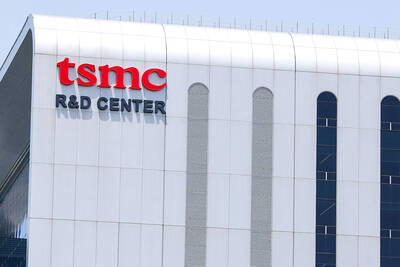
BIG BUCKS: Chairman Wei is expected to receive NT$34.12 million on a proposed NT$5 cash dividend plan, while the National Development Fund would get NT$8.27 billion Taiwan Semiconductor Manufacturing Co (TSMC, 台積電), the world’s largest contract chipmaker, yesterday announced that its board of directors approved US$15.25 billion in capital appropriations for long-term expansion to meet growing demand. The funds are to be used for installing advanced technology and packaging capacity, expanding mature and specialty technology, and constructing fabs with facility systems, TSMC said in a statement. The board also approved a proposal to distribute a NT$5 cash dividend per share, based on first-quarter earnings per share of NT$13.94, it said. That surpasses the NT$4.50 dividend for the fourth quarter of last year. TSMC has said that while it is eager
‘IMMENSE SWAY’: The top 50 companies, based on market cap, shape everything from technology to consumer trends, advisory firm Visual Capitalist said Taiwan Semiconductor Manufacturing Co (TSMC, 台積電) was ranked the 10th-most valuable company globally this year, market information advisory firm Visual Capitalist said. TSMC sat on a market cap of about US$915 billion as of Monday last week, making it the 10th-most valuable company in the world and No. 1 in Asia, the publisher said in its “50 Most Valuable Companies in the World” list. Visual Capitalist described TSMC as the world’s largest dedicated semiconductor foundry operator that rolls out chips for major tech names such as US consumer electronics brand Apple Inc, and artificial intelligence (AI) chip designers Nvidia Corp and Advanced
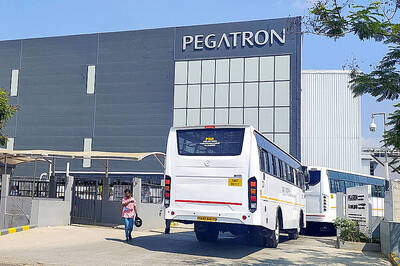
Pegatron Corp (和碩), an iPhone assembler for Apple Inc, is to spend NT$5.64 billion (US$186.82 million) to acquire HTC Corp’s (宏達電) factories in Taoyuan and invest NT$578.57 million in its India subsidiary to expand manufacturing capacity, after its board approved the plans on Wednesday. The Taoyuan factories would expand production of consumer electronics, and communication and computing devices, while the India investment would boost production of communications devices and possibly automotive electronics later, a Pegatron official told the Taipei Times by telephone yesterday. Pegatron expects to complete the Taoyuan factory transaction in the third quarter, said the official, who declined to be


 RSS
RSS