


Investment tycoon Warren Buffett on Saturday said that messaging from the US government over the regional banking crisis had been “poor,” suggesting that is why confidence has not returned among consumers.
Four regional banks have been caught up in crisis since the beginning of March in the US, three of them subsequently taken over by other institutions with the help of authorities.
For two of them — Silicon Valley Bank (SVB) and Signature Bank — the Federal Deposit Insurance Corp (FDIC) took the controversial decision to support their uninsured deposits, citing fears of contagion.
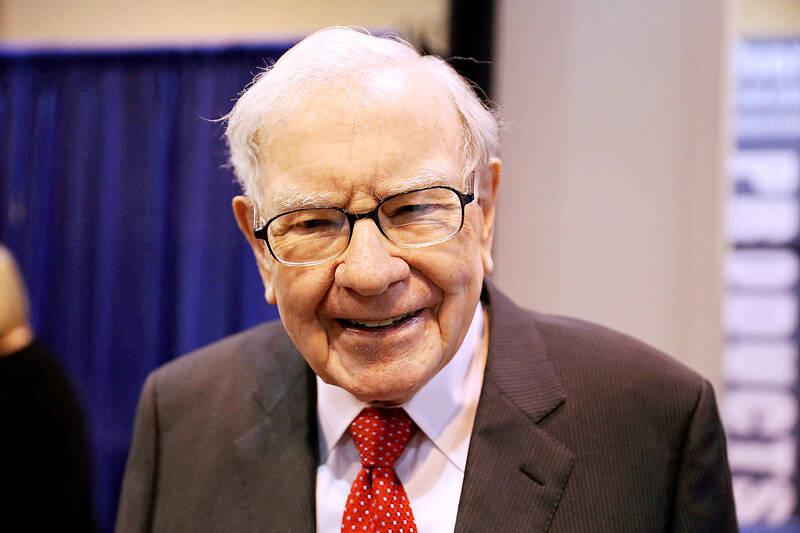
Photo: Reuters
By law, the FDIC insures up to US$250,000 of customers’ deposits in eligible banks, but for SVB and Signature the body insured all deposits, including those above the legal limit.
Yet, despite that extraordinary step, consumers are still worried, Buffett said at a shareholder meeting of his holding company, Berkshire Hathaway Inc, in Omaha, Nebraska.
“That just shouldn’t happen. The messaging has been very poor,” said the billionaire, who continues to run his group at the age of 92.
“It’s been poor by the politicians who sometimes have an interest in having it poor, it’s been poor by the agencies. And I’d say it’s been poor by the press,” he said.
What happened with SVB demonstrated a government takeover completed with an expanded deposit guarantee, “and the public is still confused,” he said.
While the emergency takeover of First Republic Bank by the giant JPMorgan Chase & Co on Monday last week seemed likely to ease anxiety about the banks, it has been a turbulent week. Several mid-sized banks were targeted on Wall Street, in particular PacWest Bancorp, which fell 68 percent before recovering 82 percent in Friday’s session alone.
On Saturday, Berkshire Hathaway reported a US$35.5 billion profit for the first quarter alone, largely due to strong financial markets.
In the first three months of the year, the group sold US$13.2 billion worth of equities from its investment portfolio, while only buying US$2.8 billion, drastically reducing its exposure to stocks.
Buffett reaffirmed that his successor, Greg Abel, was “100 percent comfortable” with the decision and even indicated a largely business-as-usual transition, for whenever that could be.
“Greg understands capital allocation as well as I do. That’s lucky for us,” Buffett said at the meeting. “He will make those decisions, I think, very much in the same framework as I would make them. We have laid out that framework now for 30 years.”
Abel, 60, who joined Buffett and his long-term business partner Charlie Munger on stage for the morning, has built Berkshire’s energy business into one of the largest in the US. He was named as heir apparent in 2021.
Additional reporting by Bloomberg

The domestic unit of the Chinese-owned, Dutch-headquartered chipmaker Nexperia BV will soon be able to produce semiconductors locally within China, according to two company sources. Nexperia is at the center of a global tug-of-war over critical semiconductor technology, with a Dutch court in February ordering a probe into alleged mismanagement at the company. The geopolitical tussle has disrupted supply chains, with some carmakers reportedly forced to cut production due to chip shortages. Local production would allow Nexperia’s domestic arm, Nexperia Semiconductors (China) Ltd (安世半導體中國), to bypass restrictions in place since October on the supply of silicon wafers — etched with tiny components to

Singapore-based ride-hailing and delivery giant Grab Holdings Ltd has applied for regulatory approval to acquire the Taiwan operations of Germany-based Delivery Hero SE's Foodpanda in a deal valued at about US$600 million. Grab submitted the filing to the Fair Trade Commission on Friday last week, with the transaction subject to regulatory review and approval, the company said in a statement yesterday. Its independent governance structure would help foster a healthy and competitive market in Taiwan if the deal is approved, Grab said. Grab, which is listed on the NASDAQ, said in the filing that US-based Uber Technologies Inc holds about 13 percent of

Taiwan Semiconductor Manufacturing Co (TSMC, 台積電) yesterday received government approval to deploy its advanced 3-nanometer (3nm) process at its second fab currently under construction in Japan, the Ministry of Economic Affairs said in a news release. The ministry green-lit the plan for the facility in Kumamoto, which is scheduled to start installing equipment and come online in 2028 with a monthly production capacity of 15,000 12-inch wafers, the ministry said. The Department of Investment Review in June 2024 authorized a US$5.26 billion investment for the facility, slated to manufacture 6- to 12nm chips, significantly less advanced than 3nm process. At a meeting with

Taiwan is open to joining a global liquefied natural gas (LNG) program if one is created, but on the condition that countries provide delivery even in a scenario where there is a conflict with China, an energy department official said yesterday. While Taiwan’s priority is to have enough LNG at home, the nation is open to exploring potential strategic reserves in other countries such as Japan or South Korea, Energy Administration Deputy Director-General Chen Chung-hsien (陳崇憲) said. While the LNG market does not have a global reserve for emergencies like that of oil, the concept has been raised a few times —


 RSS
RSS