


Adidas AG has yet to decide on what to do with its mountain of unsold Yeezy sneakers, but new CEO Bjorn Gulden said its turnaround is nonetheless off to a good start.
The German sneaker maker in a statement yesterday said that it still expects to post losses of 700 million euros (US$772.1 million) this year if it cannot sell the Yeezy products, although it is making headway in improving operations and relations with suppliers and retailers.
Adidas reported sales of 5.3 billion euros in the first quarter of this year, about in line with a year earlier and ahead of analysts’ estimates.
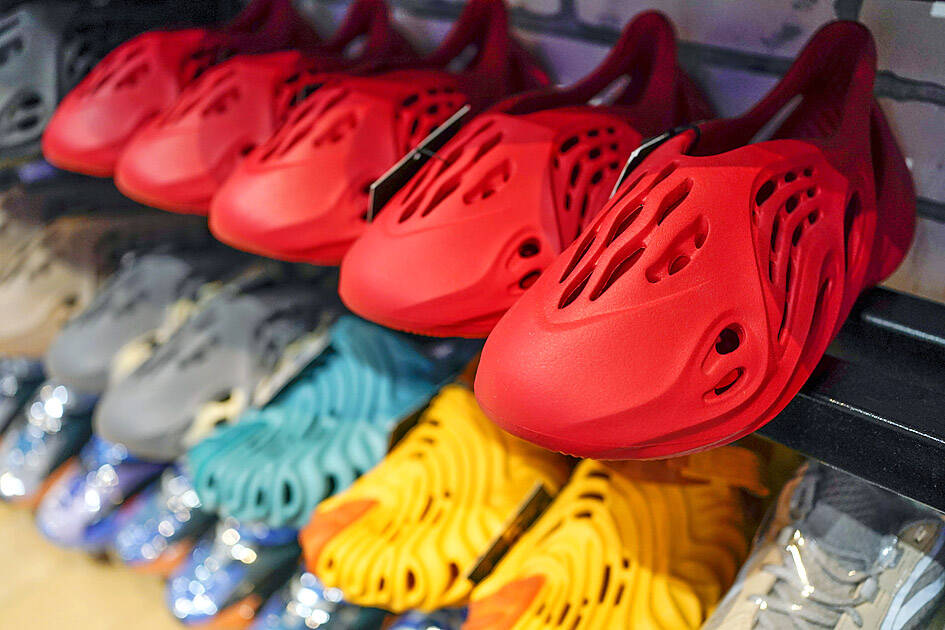
Photo: AP
Business was stronger in Latin America and parts of Asia, while the company is ramping up production of the classic Samba, Gazelle and Campus sneakers to serve high demand.
Adidas shares rose as much as 6 percent in early German trading, the biggest intraday gain in three months.
This year would be bumpy with disappointing numbers, but Adidas is not worried about maximizing its short-term financial results, Gulden said in the statement.
Instead, the company is focused on building a strong base for better results next year and beyond, he said.
That would require more markdowns to reduce the 5.7 billion euros inventory of unsold sneakers and apparel.
While that figure is down from late December last year, the stockpiles are still too high for Adidas to rebuild its brand momentum, the company said.
Adidas is still reviewing its options for the 1.2 billion euro pile of unsold Yeezy merchandise stemming from the canceled collaboration with rapper and designer Ye, formerly known as Kanye West. Adidas terminated that partnership in October last year after the performer made a string of anti-Semitic remarks.
Investors are looking for signs that Gulden, who became CEO in January, is injecting fresh optimism into the brand. In nearly a decade leading cross-town rival Puma SE, he refocused that company on sports and about tripled its sales, including posting fast growth during the COVID-19 pandemic.
Gulden is looking to renew the focus at Adidas on performance sports, and working to speed up decisionmaking, including installing himself as the company’s head of global brands.
One of his first moves has been scaling up production for hot-selling sneakers such as the Samba, which in the past few months began appearing on the feet of celebrities including Bella Hadid and Kylie Jenner.

The domestic unit of the Chinese-owned, Dutch-headquartered chipmaker Nexperia BV will soon be able to produce semiconductors locally within China, according to two company sources. Nexperia is at the center of a global tug-of-war over critical semiconductor technology, with a Dutch court in February ordering a probe into alleged mismanagement at the company. The geopolitical tussle has disrupted supply chains, with some carmakers reportedly forced to cut production due to chip shortages. Local production would allow Nexperia’s domestic arm, Nexperia Semiconductors (China) Ltd (安世半導體中國), to bypass restrictions in place since October on the supply of silicon wafers — etched with tiny components to

Singapore-based ride-hailing and delivery giant Grab Holdings Ltd has applied for regulatory approval to acquire the Taiwan operations of Germany-based Delivery Hero SE's Foodpanda in a deal valued at about US$600 million. Grab submitted the filing to the Fair Trade Commission on Friday last week, with the transaction subject to regulatory review and approval, the company said in a statement yesterday. Its independent governance structure would help foster a healthy and competitive market in Taiwan if the deal is approved, Grab said. Grab, which is listed on the NASDAQ, said in the filing that US-based Uber Technologies Inc holds about 13 percent of

Taiwan Semiconductor Manufacturing Co (TSMC, 台積電) yesterday received government approval to deploy its advanced 3-nanometer (3nm) process at its second fab currently under construction in Japan, the Ministry of Economic Affairs said in a news release. The ministry green-lit the plan for the facility in Kumamoto, which is scheduled to start installing equipment and come online in 2028 with a monthly production capacity of 15,000 12-inch wafers, the ministry said. The Department of Investment Review in June 2024 authorized a US$5.26 billion investment for the facility, slated to manufacture 6- to 12nm chips, significantly less advanced than 3nm process. At a meeting with

Taiwan is open to joining a global liquefied natural gas (LNG) program if one is created, but on the condition that countries provide delivery even in a scenario where there is a conflict with China, an energy department official said yesterday. While Taiwan’s priority is to have enough LNG at home, the nation is open to exploring potential strategic reserves in other countries such as Japan or South Korea, Energy Administration Deputy Director-General Chen Chung-hsien (陳崇憲) said. While the LNG market does not have a global reserve for emergencies like that of oil, the concept has been raised a few times —


 RSS
RSS