

Yageo Corp (國巨) yesterday announced that it has signed a deal to invest 205 million euros (US$224.9 million) in North Macedonia over the next 10 years.
The company, which supplies passive components, such as chip resistors, inductors, tantalum capacitors and multi-layer ceramic capacitors, said that it would build plants in the Technological Industrial Development Zones (TIDZs) in the capital, Skopje, and the city of Stip in the country’s east.
Yageo made the announcement after a company representative and Jovan Despotovski, general manager at the Directorate for Technological Industrial Development Zones, signed an investment agreement at the company’s headquarters in New Taipei City’s Sindian District (新店).

Photo: Chang Hui-wen, Taipei Times
The two sides have been in talks over the past year, Despotovski said.
North Macedonian Prime Minister Dimitar Kovacevski attended the signing ceremony via videolink, the statement said.
“I would like to express my sincere welcome and respect to Yageo, a global high-tech company, to have such meaningful investment in North Macedonia. It’s [the investment] confirmation of the good economic policies that we are leading and the stable investment climate that we are creating in the country,” Kovacevski said.
Yageo said its investment is the biggest “greenfield investment” in the country since independence.
A greenfield investment means the company would build operations from the ground up, from searching for a plot to the construction of plants and other facilities, Yageo said.
The investment is expected to create more than 3,900 jobs in the Skopje and Stip TIDZs, it added.
Yageo subsidiary Kemet Corp operates two plants, and one research and development center in North Macedonia, mainly producing capacitors for electric vehicles, the company said.
“With a strategic geographical position, a stable monetary and favorable tax environment, and highly qualified workforce with competitive labor costs, North Macedonia is an ideal location for Yageo to expand its business in Europe,” Yageo chairman Pierre Chen (陳泰銘) said in the statement.
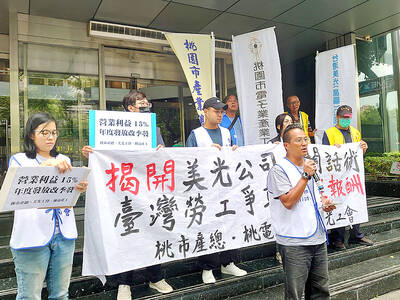
UNION DETERMINATION: Rejecting an offer for a one-time payout as an attempt to influence opinion, the union said a strike at the memory chip manufacturer is possible The Micron Taiwan workers’ union yesterday rejected a one-time payout unveiled by US-based Micron Technology Inc last week, saying it wants a long-term mechanism under which employees would share 15 percent of the company’s operating profits. While the union and the company are still in talks over the dispute, the reward package was proposed unilaterally by the employer without reaching an agreement with the union, union head Jerry Lin (林哲瑞) told reporters. Lin said he suspected the company was seeking to influence public opinion with the move. On Friday last week, Micron announced a reward package under which employees in Taiwan would receive
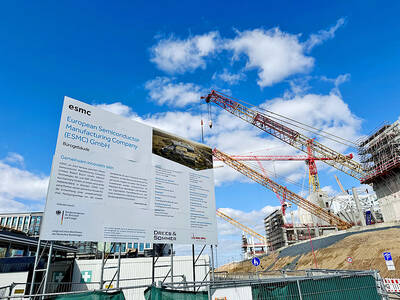
BUILDER’s RITES: The topping out ceremony is held when a project being built has its highest point laid out, a sure sign that TSMC’s European project is making solid progress A “topping out” ceremony was held on Monday at a plant under construction in Germany by Taiwan Semiconductor Manufacturing Co (TSMC, 台積電), indicating that the fab is progressing as planned and within budget, the head of a joint-venture company in charge of the project said. A topping out ceremony is the construction milestone of laying the final beam or structural piece at the highest point of a building, and it honors the construction crew, architects and engineers. European Semiconductor Manufacturing Co (ESMC) president Christian Koitzsch said that about 2,000 workers from 106 countries are working around the clock at the site in
SOME CUSHION: Taiwan’s GDP is forecast to grow more than 11 percent this year, so the economy should be able to absorb the impact of a rate hike, an expert said With domestic inflation topping the 2 percent alert level for a fourth consecutive month last month and several major central banks around the world raising their key interest rates, Taiwan’s central bank is facing growing pressure to raise rates at its quarterly policymaking meeting on Thursday, economists said. At its June meeting, the central bank left interest rates unchanged for the ninth consecutive quarter, with the discount rate at 2 percent. Central Bank Governor Yang Chin-long (楊金龍) had said that the bank maintained a somewhat hawkish stance, with two board directors voicing support for a rate hike at the meeting. Cathay United
APPEAL: Any agreement to produce advanced memory such as HBM or DRAM could run into opposition from Seoul as those technologies are sensitive, sources said South Korea’s SK Hynix Inc is in talks with Intel Corp about a deal that would see it manufacture memory chips on US soil for the first time, three people familiar with the discussions said. Under one potential scenario, SK Hynix would lease part of Intel’s long-planned chipmaking facility in Ohio, they said. Under another scenario, it could form a venture with Intel and major cloud firms that are keen to lock in memory supplies, two of the people said. A deal would relieve pressure on Intel, which has been struggling, and mark a big win for US President Donald


 RSS
RSS