


Shoemaker Pou Chen Corp (寶成工業) yesterday signed a memorandum of understanding (MOU) with Tamil Nadu to invest 23 billion rupees (US$280.6 million) in the Indian state, the company and a government agency said.
The world’s largest contract maker of branded athletic and casual footwear is to establish a manufacturing base in a special economic zone in the state’s Kallakurichi District through High Glory Footwear India Pvt Ltd, Pou Chen said in a Taiwan Stock Exchange filing.
High Glory Footwear is a wholly owned subsidiary of Yue Yuen Industrial (Holdings) Ltd (裕元工業), which is 51.11 percent owned by Pou Chen and mainly responsible for the shoe-making group’s original equipment manufacturing (OEM) business.

Photo: Bloomberg
The investment is to be carried out in two phases from fiscal year 2023-2024 to fiscal year 2034-2035, the filing said.
Under the terms of the MOU, the Tamil Nadu government would provide infrastructure support, land allotment, investment subsidies and tax breaks to High Glory Footwear, the filing said.
The agreement gives High Glory Footwear the flexibility to complete its commitments at any time within the 12-year investment period, it said, adding that any changes to its commitments or the investment period are subject to approval by the Tamil Nadu government.
“As India offers a large supply of labor and extends favorable government policies, it is expected that this investment would be able to expand and diversify the group’s production capacities in an economically sound manner to support the sustainable of business,” the filing said.
Pou Chen last week reported that its first-quarter consolidated revenue fell 4.3 percent year-on-year to NT$64.37 billion, as OEM sales dropped 18.1 percent year-on-year amid inventory adjustments by major brands. Sales at its retail business, handled by subsidiary Pou Sheng International Ltd (寶勝國際), improved 6.5 percent thanks to steady recovery in end-market demand.
Pou Chen’s OEM business counts international brands such as Nike Inc, Adidas AG, Asics Corp, New Balance Athletic Shoe Inc, Timberland Co and Salomon SAS among its customers, company data showed.
“Over the next 12 years, this partnership will generate employment opportunities for more than 20,000 people in the non-leather footwear sector, especially for the youth and women in and around the Kallakurichi district,” Guidance Tamil Nadu wrote on Twitter yesterday.
Guidance Tamil Nadu, the state’s investment promotion agency, earlier this month announced that Hong Fu Footwear Group (宏福鞋業), another Taiwanese shoemaker, plans to invest 10 billion rupees over three to five years to establish a manufacturing base in Ranipet District, which is expected to create 20,000 jobs, the Central News Agency reported.
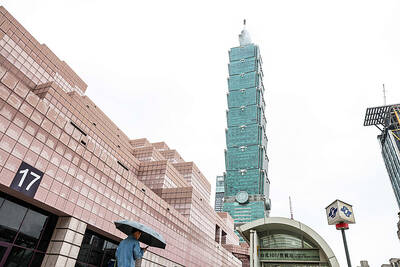
MANAGING RISKS: Taiwan has secured LNG sufficient to cover 95 percent of electricity demand for next month, UBS said, describing the government’s approach as proactive UBS Group AG has raised its forecast for Taiwan’s economic growth this year to 8 percent, up from 6.9 percent previously, and said expansion could reach as high as 8.6 percent if external energy shocks are avoided. The upgrade reflects a stronger-than-expected first-quarter performance and sustained momentum in artificial intelligence (AI)-driven exports, which UBS said are providing a firm foundation for growth despite geopolitical and energy risks. Taiwan’s GDP expanded 13.69 percent year-on-year in the first quarter, the fastest growth since the second quarter of 1987, the Directorate-General of Budget, Accounting and Statistics (DGBAS) reported on Thursday. On a seasonally
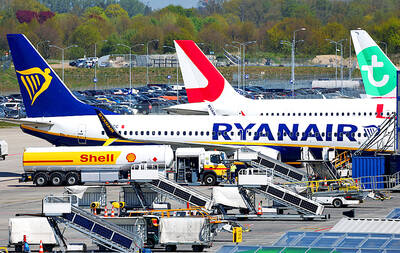
Ryanair, Transavia, Volotea and other low-cost airlines are feeling the financial pain from high jet fuel prices as a result of the Middle East war and are cutting flights. The closure of the Strait of Hormuz has taken a huge chunk of oil supplies off the market, sending the price of jet fuel soaring and triggering fears of shortages that could force airlines to cancel flights. Airlines are not waiting for a lack of supplies to react. “Travel alert: Airlines are cutting thousands of flights right now,” Travel Therapy host Karen Schaler said in an Instagram reel this past weekend.
Shares of Taiwan Semiconductor Manufacturing Co (TSMC, 台積電) have repeatedly hit new highs, but an equity analyst said the stock’s valuation remains within a reasonable range and any pullback would likely be technical. The contract chipmaker’s historical price-to-earnings (P/E) ratio has ranged between 20 and 30, Cathay Futures Consultant Co (國泰證期) analyst Tsai Ming-han (蔡明翰) told Central News Agency. With market consensus projecting that TSMC would post earnings per share of about NT$100 (US$3.17) this year, supported by strong global demand for artificial intelligence (AI) applications, and the stock currently trading at a P/E ratio of below 25, Tsai said the valuation

The list of Asian stocks that benefit from business partnership with Nvidia Corp is getting longer, as the region further integrates into the artificial intelligence (AI) chip giant’s business ecosystem. Just in the past week, South Korea’s LG Electronics Inc, Taiwan’s Nanya Technology Corp (南亞科技), as well as China’s Huizhou Desay SV Automotive Co (德賽西威) and Pateo Connect Technology Shanghai Corp (博泰車聯) have become the latest to rally on news of tie-ups, supply-chain participation or product collaboration with the US chip designer. Asian suppliers account for about 90 percent of Nvidia’s production costs, up from about 65 percent last year, data compiled


 RSS
RSS