


Online video streaming service Netflix Inc on Friday confirmed that Taiwan has not been included in its latest price reduction for Asian markets.
A company representative said that Netflix fees in Taiwan would not be reduced, unlike in Indonesia, Malaysia, the Philippines, Thailand and Vietnam.
The representative said Netflix is seeking to continuously improve its user experience, including by updating its fees.

Photo: REUTERS
They did not elaborate on how much the fees would be cut in other countries.
The streaming service’s most recent price adjustments were reported by the Wall Street Journal on Thursday.
The newspaper said Netflix has reduced fees in more than 30 countries in the past few weeks as part of efforts to attract more subscribers.
It said Netflix has reduced fees in the five Southeast Asian countries, as well as Bulgaria, Croatia, Ecuador, Guatemala, Iran, Jordan, Kenya, Libya, Slovakia and Yemen, by up to 50 percent.
The newspaper earlier reported that Netflix’s executives were in talks to raise the price of its services last month, making the reduction a surprise.
The Wall Street Journal said the price cuts were likely part of a marketing strategy to attract new subscribers, as streaming services are becoming the dominant form of entertainment globally.
US ALSO EXLUDED
However, Netflix would not update its fees in its largest markets, including the US, where it has regularly increased its rates in the past four years as it seeks to offset the cost of producing hit series such as The Crown and Stranger Things.
Although Netflix has established itself as the largest video streaming service in the US, it has been vying for viewers with other deep-pocketed rivals such as Apple Inc, Amazon.com Inc and Walt Disney Co, while high inflation has prompted many people to tighten their budgets.
Those factors contributed to Netflix losing nearly 1.2 million subscribers during the first half of last year, prompting it to introduce an advertising-supported version.
That helped Netflix bounce back during the second half of last year, when it added 10 million subscribers.
In another attempt to gain more subscribers, the company has started to crack down on password-sharing, which it said has enabled about 100 million people worldwide to watch Netflix for free.
The company earlier this month clamped down on the practice in Latin America and several other countries, including Canada, New Zealand, Portugal and Spain.
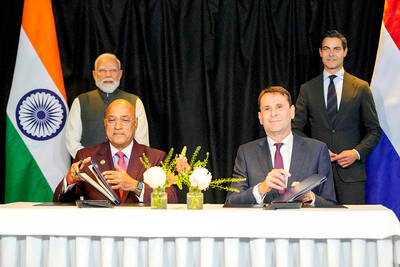
NEW MARKET: The partnership opens up India to the Dutch company, which already has a strong hold in the semiconductor market of South Korea, Taiwan and China ASML Holding NV entered into a partnership agreement with Tata Electronics Pvt Ltd aimed at ramping up India’s goal to develop domestic chip-manufacturing capabilities. The Dutch company’s technology would help power Tata Electronics’ planned 300 millimeter (mm) semiconductor foundry in Gujarat, according to a joint statement from the two companies on Saturday. The signing of a memorandum of understanding coincides with a visit by Indian Prime Minister Narendra Modi to the Netherlands, which is looking to deepen bilateral relations with New Delhi. ASML, whose top customers include Taiwan Semiconductor Manufacturing Co (台積電) and Samsung Electronics Co, makes lithography machines that can print
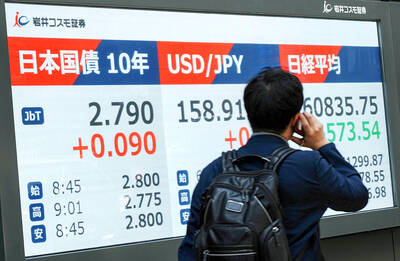
ROUGH RECORDS: Bonds in Japan, as well is in New Zealand, Australia and the US, are seeing the effects of a nervy market as stock exchanges across Asia edge down A deepening slump in Japanese government bonds added fuel to the selloff in global debt markets as rising oil prices stoked inflation fears and pushed yields to multi-decade highs. Japan’s 30-year yield yesterday surged as much as 20 basis points to the highest level since the tenor’s debut in 1999, before paring some of the move. Shorter-maturity Japanese debt was also under pressure, underscored by weak demand at a sale of five-year notes that offered a record-high coupon of 2 percent. Concerns over inflation and government spending rippling through markets including the US, Australia and New Zealand are being amplified in Japan,

Tokyo Electron's Taiwan unit today said in a written response that it respects the judicial process, takes the court ruling seriously and would not appeal in the Taiwan Semiconductor Manufacturing Co (TSMC, 台積電) trade secrets case. Last month, a court fined the Taiwan unit of Japan's Tokyo Electron NT$150 million (US$4.74 million) in a case involving trade secrets related to TSMC's sensitive chip technology.
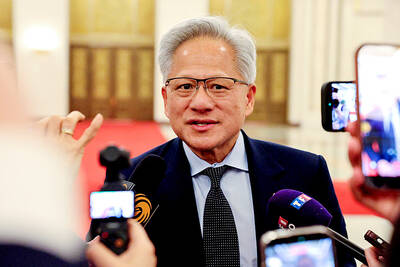
The US has cleared about 10 Chinese firms to buy Nvidia Corp’s second-most powerful artificial intelligence (AI) chip, the H200, but not a single delivery has been made so far, three people familiar with the matter said, leaving a major technology deal in limbo as chief executive officer Jensen Huang (黃仁勳) seeks a breakthrough in China this week. Huang, who was not initially listed in a White House delegation to Beijing, joined the trip after an invitation from US President Donald Trump, a source said. Trump picked him up in Alaska en route to a summit with Chinese President Xi Jinping


 RSS
RSS