


Tending to his camels in Petra, Jordan’s spectacular archeological marvel hidden deep in a desert canyon, Hussein Bdoul is all smiles: The tourists are back.
After years in which the COVID-19 pandemic turned the storied “Rose City” into a ghost town, the father of seven is back at work, offering visitors rides on his decorated animals.
“Tourism has returned and the numbers are even greater,” said Bdoul, 35, wearing Bedouin garb with a red keffiyeh over his long black hair, reflecting on a resurgence last year.

Photo: AFP
“At the time of the coronavirus pandemic, we did not see anyone in Petra,” Bdoul said, adding that it was a disaster for the town where “90 percent of people work in tourism.”
Jordan tourism authorities said that Petra is back in business and drew 900,000 visitors last year, close to the record of one million set in 2019.
Jordan received 4.6 million visitors last year — almost four times the level from 2020 — earning the country US$5.3 billion.
Top draw Petra, famous for its stunning temples hewn out of the rose-pink cliffs, is a UNESCO World Heritage Site and was chosen as one of the New Seven Wonders of the World in a 2007 online poll.
It was built in 312 BC as the capital of the ancient Arab kingdom of the Nabataeans, which fell to the Romans in 106 BC.
“This place and the colors are incredible,” marveled French student Alia, 16, taking a break from exploring with her mother to check out a souvenir stand.
About 1,700 people make a living from Petra as tour guides, trinket sellers or by taking visitors through the site on donkeys, horses, camels or electric buggies.
“We breathed a sigh of relief when we saw the return of tourists,” said Muhammad Samahin, 16, selling drinks while sat on woven rugs inside the Moon Cave near the famed Treasury site.
Petra Development and Tourism Regional Authority head Suleiman Farajat said the post-pandemic tourism comeback had exceeded all expectations.
At the height of the pandemic, “there were days when there were no tourists” in Petra, located 230km south of the capital, Amman.
The recovery was helped by official promotional campaigns in new overseas markets, low-cost airline flights and new hotel rooms, Farajat said.
Petra has 4,000 rooms, and permits have been granted for three new five-star hotels, so capacity would soon almost double from 2019, he said.
“If things continue this way, we may reach, during the next three to four years, the threshold of two million tourists in Petra” every year, he added.
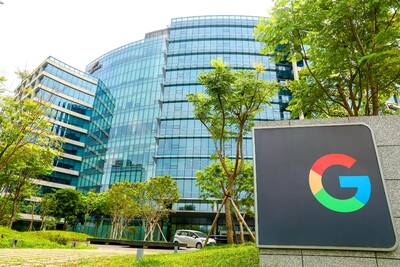
The government yesterday approved applications by Alphabet Inc’s Google to invest NT$27.08 billion (US$859.98 million) in Taiwan, the Ministry of Economic Affairs said in a statement. The Department of Investment Review approved two investments proposed by Google, with much of the funds to be used for data processing and electronic information supply services, as well as inventory procurement businesses in the semiconductor field, the ministry said. It marks the second consecutive year that Google has applied to increase its investment in Taiwan. Google plans to infuse NT$25.34 billion into Charter Investments Ltd (特許投資顧問) through its Singapore-based subsidiary Fructan Holdings Singapore Pte Ltd, and

SECOND-RATE: Models distilled from US products do not perform the same as the original and undo measures that ensure the systems are neutral, the US’ cable said The US Department of State has ordered a global push to bring attention to what it said are widespread efforts by Chinese companies, including artificial intelligence (AI) start-up DeepSeek (深度求索), to steal intellectual property from US AI labs, according to a diplomatic cable. The cable, dated Friday and sent to diplomatic and consular posts around the world, instructs diplomatic staff to speak to their foreign counterparts about “concerns over adversaries’ extraction and distillation of US AI models.” Distillation is the process of training smaller AI models using output from larger, more expensive ones to lower the costs of training a powerful new

Micron Technology Inc is a driving force pushing the US Congress to pass legislation that would put new export restrictions on equipment its Chinese competitors use to make their chips, according to people familiar with the matter. A US House of Representatives panel yesterday was to vote on the “MATCH Act,” a bill designed to close gaps in restrictions on chipmaking equipment. It would also pressure foreign companies that sell equipment to Chinese chipmaking facilities to align with export curbs on US companies like Lam Research Corp and Applied Materials Inc. The bill targets facilities operated by China’s ChangXin Memory Technologies Inc

Singapore-based ride-hailing and delivery giant Grab Holdings’ planned acquisition of Foodpanda’s Taiwan operations has yet to enter the formal review stage, as regulators await supplementary documents, the Fair Trade Commission (FTC) said yesterday. Acting FTC Chairman Chen Chih-min (陳志民) told the legislature’s Economics Committee that although Grab submitted its application on March 27, the case has not been officially accepted because required materials remain incomplete. Once the filing is finalized, the FTC would launch a formal probe into the deal, focusing on issues such as cross-shareholding and potential restrictions on market competition, Chen told lawmakers. Grab last month announced that it would acquire


 RSS
RSS