


To promote environmental sustainability, HSBC Bank Taiwan Ltd (滙豐台灣商銀) held a nature conservation activity at Guandu Nature Park (關渡自然公園) on Saturday.
HSBC Taiwan CEO Adam Chen (陳志堅) led more than 250 colleagues, together with family and friends, to help conserve the wetlands, find out about the local ecology, and explore the importance of biodiversity and the relationship between the wetlands’ carbon sequestration function and climate change.
HSBC Taiwan corporate sustainability head Janice Hwang said that “the decline of Earth’s biodiversity has become a major topic in global environmental conservation, and wetlands are one of the key areas for biodiversity conservation because of their unique and diverse habitats.”
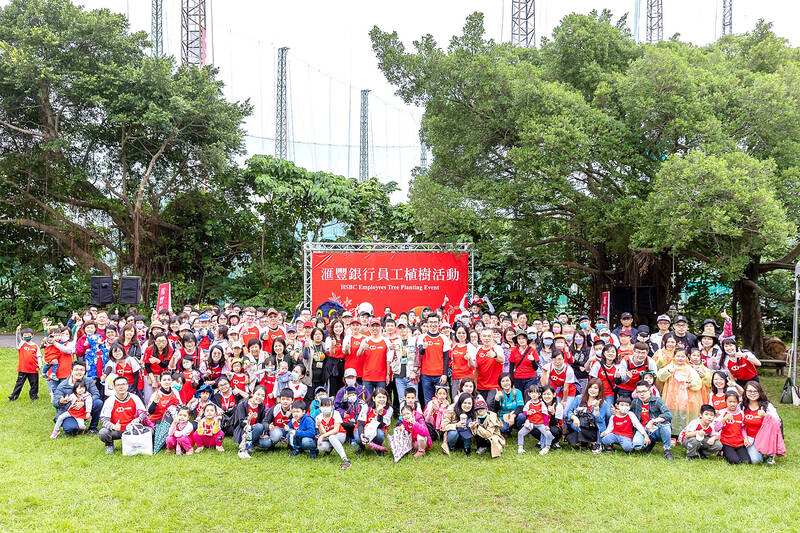
Photo courtesy of HSBC Bank Taiwan Ltd
“Guandu Nature Park has a special natural ecology, nurturing diverse wetland organisms, and is classified by BirdLife International as one of the Important Bird Areas,” she said.
“HSBC Taiwan is the first private company in Taiwan to sponsor Guandu Nature Park on a long-term basis, and has pro-actively invested in wetland conservation, helping establish the park as a nature education center in this country,” Hwang said, adding that since 2002, more than 17,000 volunteers from HSBC have devoted more than 30,000 hours to the park.
“Today, Guandu Nature Park is a rich ecological resource environment and an ecological classroom that both teaches and entertains,” she said.
This year’s activity was focused on environmental education and wetland protection.
Through fun activities, HSBC volunteers learned about climate change and ecological conservation, and cleaned up the environment to help protect the wetlands through various tasks, including relocating frogs into ditches, removing weeds and trash, clearing areas around saplings and removing invasive species to help indigenous species return.
In addition, the HSBC Taiwan management team planted indigenous tree species to help preserve the biodiversity of the park.
HSBC has been operating in Taiwan for nearly 40 years and has always taken a socially and environmentally responsible approach to its business, promoting environmental sustainability goals and making sustainable development a long-term strategy.
This year, HSBC Taiwan won first prize in the Foreign Enterprise category of CommonWealth Magazine’s Excellence in Corporate Social Responsibility Award and the 2022 Taiwan Corporate Sustainability Awards’ Most Prestigious Sustainability Award — Top Ten Domestic Corporates Award.
HSBC’s commitment to Taiwan is not limited to financial services, but also to financial education and social responsibility. Each year, HSBC Taiwan provides employees two days of paid volunteer leave to engage in giving back to the community, encouraging employees to take part in environmental activities, as well as helping disadvantaged groups.

Netherlands-based semiconductor equipment supplier ASML Holding NV yesterday said that it is planning to hire an additional 1,000 people in Taiwan this year in response to growing demand from clients. ASML had previously planned to recruit 600 people this year, but that the plan has been adjusted upward, ASML vice president and ASML Taiwan general manager Grace Wang (汪佳慧) told reporters. ASML has a workforce of more than 4,500 in Taiwan, accounting for about 10 percent of its global total, Wang said. This year’s recruitment campaign would focus on adding people in the customer support, manufacturing and supply chain domains to assist ASML

UNDER MICROSCOPE: Taiwan detained three people who allegedly conspired to buy servers in Taiwan and export them using fraudulent documentation, prosecutors said Nvidia Corp chief executive officer Jensen Huang (黃仁勳) on Saturday urged Super Micro Computer Inc to tighten up on compliance after Taiwan detained three people this week for allegedly making fraudulent declarations about artificial intelligence (AI) servers made by its US partner. The development marked the nation’s first crackdown on semiconductor smuggling, which grew after the US slapped restrictions on exports of high-end chips such as Nvidia AI accelerators to China. Nvidia is “rigorous” in explaining regulations to all of its partners, Huang told reporters after arriving in Taipei. “Ultimately Super Micro has to run their own company,” he said in response to

Nvidia Corp yesterday announced that CEO Jensen Huang (黃仁勳) would attend an employee meeting in Taipei tomorrow to celebrate the launch of the company’s Taiwan headquarters project. Huang would attend a gathering at the site of Nvidia’s planned headquarters in Beitou Shilin Technology Park (北投士林科技園區), the company said in a statement. After arriving in Taiwan on Saturday last week, Huang told reporters that he plans to meet with Quanta Computer Inc (廣達) chairman Barry Lam (林百里) and Taiwan Semiconductor Manufacturing Co (TSMC, 台積電) chairman C.C. Wei (魏哲家), and would attend the groundbreaking ceremony for Nvidia’s Taiwan headquarters tomorrow. Nvidia has not yet applied

Huawei Technologies Co (華為) said it has come up with a new pathway to shorten its gap with industry leader Taiwan Semiconductor Manufacturing Co (TSMC, 台積電), potentially achieving a breakthrough in making advanced semiconductors without cutting-edge equipment. Right now there is about a five-year gap between what TSMC is capable of and what Huawei, together with its manufacturing partner Semiconductor Manufacturing International Corp (中芯), can produce. Huawei is to start making 1.4-nanometer chips by 2031 with its own “LogicFolding” technology, Huawei semiconductor chief He Tingbo (何庭波) said in a rare public appearance during a chip conference yesterday, while TSMC has


 RSS
RSS