


Shares of Elan Microelectronics Corp (義隆電子) yesterday tumbled 4.22 percent after the chip designer gave a gloomy financial forecast for this quarter given weaker-than-expected demand for notebook computers and penalties for not exercising a contract signed with its chip supplier.
As customer demand has weakened significantly, Elan said it opted not to honor a three-year chip supply agreement with a foundry service provider, making it the nation’s first chip designer to default on a chip supply contract.
During the height of the chip crunch in the past two years, many chip designers signed long-term supply agreements with foundry service providers to secure supply.
“Customers have become extraordinarily conservative at this point, even though some of them have managed to lower their inventory compared with the same period last year,” Elan chairman Yeh I-hau (葉儀皓) said. “Our orders from Chromebook makers are only half of that last year.”
As customer demand dipped, Elan chose to default on the supply contract and book the full penalty this quarter, Yeh said.
Elan’s stock price sank to NT$79.50 yesterday, underperforming the TAIEX, which gained 0.31 percent.
Commenting on customers’ inventory digestion, Yeh said most Windows-based PC makers are expected to complete their inventory correction at the end of this year, but Chromebook makers would take a longer time — likely the first or second quarter of next year.
“We hope the fourth quarter would be the worst period,” Yeh said.
Revenue is forecast to plunge sequentially between 29 percent and 38 percent to between NT$1.8 billion and NT$2 billion (US$55.9 million and US$62.1 million) this quarter from NT$2.82 billion last quarter.
Three months ago, Elan, which designs chips for PC touch pads and laptop touch screens, expected revenue to pick up this quarter after a 32 percent sequential decline last quarter.
“However, we saw purchasing sentiment worsen, with PC brands cutting their sales forecast because of weak consumer demand, which slowed inventory digestion,” Elan spokesman Dennis Liu (劉代銘) told investors during an online meeting on Thursday.
“All of our product lines have shown weak momentum in the fourth quarter compared with the third quarter,” he said.
Gross margin is forecast to range from 45 percent to 47 percent this quarter, compared with 46 percent last quarter, as demand for high-margin touch screens drops, Liu said.
Operating margin is expected to plunge to between 3.6 percent and 9.8 percent this quarter, from 18.9 percent last quarter. That meant Elan’s bottom line might approach the break-even point this quarter.
Last quarter, Elan reported that net profit contracted 33 percent to NT$522 million from NT$784 million in the third quarter. That represented an annual decline of 62 percent from NT$1.32 billion.
Earnings per share fell to NT$1.83 last quarter, from NT$2.75 in the second quarter and NT$4.7 in the third quarter last year.


Taiwan’s foreign exchange reserves fell below the US$600 billion mark at the end of last month, with the central bank reporting a total of US$596.89 billion — a decline of US$8.6 billion from February — ending a three-month streak of increases. The central bank attributed the drop to a combination of factors such as outflows by foreign institutional investors, currency fluctuations and its own market interventions. “The large-scale outflows disrupted the balance of supply and demand in the foreign exchange market, prompting the central bank to intervene repeatedly by selling US dollars to stabilize the local currency,” Department of Foreign

Intel Corp is joining Elon Musk’s long-shot effort to develop semiconductors for Tesla Inc, Space Exploration Technologies Corp and xAI, marking a surprising twist in the chipmaker’s comeback bid. Intel would help the Terafab project “refactor” the technology in a chip factory, the company said on Tuesday in a post on X, Musk’s social media platform. That is a stage in the development process that typically helps make chips more powerful or reliable. The chipmaker’s shares jumped 4.2 percent to US$52.91 in New York trading on Tuesday. The Terafab project is a grand plan by Musk to eventually manufacture his own chips for

Some robotaxi passengers were left stranded in the middle of fast-moving traffic in a major Chinese city after their driverless vehicles stopped running, according to police and media reports on Wednesday. A preliminary investigation indicates more than 100 robotaxis came to a halt because of a “system malfunction,” police in the city of Wuhan said in a statement, without elaborating. No injuries were reported. One passenger told Chinese media that their robotaxi stopped after turning a corner. An instruction on a screen read: “Driving system malfunction. Staff are expected to arrive in 5 minutes.” After no one showed up, the passenger pushed
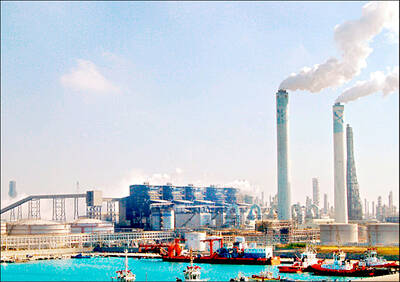
Taiwan Power Co (Taipower, 台電) yesterday said it plans to resume operations at two coal-fired power generators for three months to boost security of electricity supply as liquefied natural gas (LNG) supply risks are running high due to the Middle East conflict. The two coal-fired power generators are at Mailiao Power Plant in Yunlin County’s Mailiao Township (麥寮). The plant, operated by Formosa Plastics Group (台塑集團), supplied electricity to Taipower’s power grid until the end of last year. Taipower’s decision came about one month after Minister of Economic Affairs Kung Ming-hsin (龔明鑫) on March 10 said that the nation had no imminent


 RSS
RSS