


UNITED KINGDOM
Air fryer sales jump 320%
Britons are turning to energy-saving products such as air fryers and slow cookers as they look for ways to combat the cost of living crisis, supermarket group Asda Stores Ltd said yesterday. Publishing its monthly Asda Income Tracker for last month, the group said it had seen a 320 percent increase in air fryer sales year-on-year, while sales of slow cookers had more than doubled. Both products generally use less energy than traditional ovens. Asda’s data also showed that UK families were £141 (US$163) worse off last month from a year earlier, mainly due to soaring utility bills.
SINGAPORE
Crypto restrictions planned
The Monetary Authority of Singapore might ban retail investors from borrowing to fund cryptocurrency purchases. Other potential steps in a central bank consultation paper include stopping companies from using tokens deposited by retail investors for lending or staking to generate yields. Staking is the process of earning rewards by deploying coins for cryptoapplications. The central bank said in the paper yesterday that the retail sector should not be able to use credit cards or other credit facilities to buy tokens. The restrictions would not apply to high-net-worth investors, who can qualify for a wider range of investments in the city-state.
BANKING
Deutsche Bank profit soars
Germany’s biggest lender, Deutsche Bank AG, yesterday said its third-quarter net profit had risen more than fivefold year-on-year, far better than expected, as a restructuring program bears fruit. The group’s net profit from July to last month reached 1.1 billion euros (US$1.1 billion), compared with 194 million euros in the same period last year, it said in a statement. Profit before tax hit 1.6 billion euros — the best third-quarter result since 2006, the bank said. Revenues increased 15 percent from a year earlier to 6.9 billion euros. They were driven by corporate banking, which rose 25 percent to 1.6 billion euros.
BEVERAGES
Heineken says demand weak
Heineken NV yesterday said it sees signs of weakness in consumer demand after beer sales missed estimates amid growing inflationary pressures. “We increasingly see reasons to be cautious on the macroeconomic outlook, including some signs of softness in consumer demand,” Heineken CEO Dolf van den Brink said. The world’s second-largest brewer said beer volumes rose 8.9 percent on an organic basis in the third quarter. The Dutch brewer in a statement noted “early signs of demand slowdown at the end of September and into October” in some parts of Europe.
FINANCE
Visa spending growth slows
Visa Inc saw spending growth slow the most since the depths of the COVID-19 pandemic as inflation weighs on consumers. Volume on the network rose 10.5 percent to US$2.93 trillion last quarter, Visa said on Tuesday. That was a decrease from the 12 percent growth the firm reported for the previous three months. It was the slowest expansion since Visa posted less than 5 percent for the first fiscal quarter of last year. “As we look ahead, while some short-term uncertainty exists, we remain confident in Visa’s long-term growth trajectory across consumer payments, new flows and value-added services,” chief executive officer Al Kelly said.

The Eurovision Song Contest has seen a surge in punter interest at the bookmakers, becoming a major betting event, experts said ahead of last night’s giant glamfest in Basel. “Eurovision has quietly become one of the biggest betting events of the year,” said Tomi Huttunen, senior manager of the Online Computer Finland (OCS) betting and casino platform. Betting sites have long been used to gauge which way voters might be leaning ahead of the world’s biggest televised live music event. However, bookmakers highlight a huge increase in engagement in recent years — and this year in particular. “We’ve already passed 2023’s total activity and

Nvidia Corp CEO Jensen Huang (黃仁勳) today announced that his company has selected "Beitou Shilin" in Taipei for its new Taiwan office, called Nvidia Constellation, putting an end to months of speculation. Industry sources have said that the tech giant has been eyeing the Beitou Shilin Science Park as the site of its new overseas headquarters, and speculated that the new headquarters would be built on two plots of land designated as "T17" and "T18," which span 3.89 hectares in the park. "I think it's time for us to reveal one of the largest products we've ever built," Huang said near the
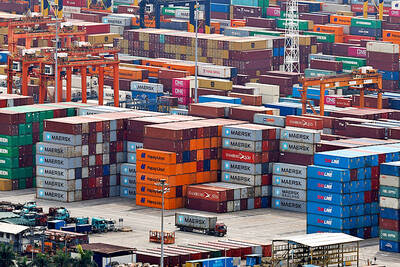
China yesterday announced anti-dumping duties as high as 74.9 percent on imports of polyoxymethylene (POM) copolymers, a type of engineering plastic, from Taiwan, the US, the EU and Japan. The Chinese Ministry of Commerce’s findings conclude a probe launched in May last year, shortly after the US sharply increased tariffs on Chinese electric vehicles, computer chips and other imports. POM copolymers can partially replace metals such as copper and zinc, and have various applications, including in auto parts, electronics and medical equipment, the Chinese ministry has said. In January, it said initial investigations had determined that dumping was taking place, and implemented preliminary

Intel Corp yesterday reinforced its determination to strengthen its partnerships with Taiwan’s ecosystem partners including original-electronic-manufacturing (OEM) companies such as Hon Hai Precision Industry Co (鴻海精密) and chipmaker United Microelectronics Corp (UMC, 聯電). “Tonight marks a new beginning. We renew our new partnership with Taiwan ecosystem,” Intel new chief executive officer Tan Lip-bu (陳立武) said at a dinner with representatives from the company’s local partners, celebrating the 40th anniversary of the US chip giant’s presence in Taiwan. Tan took the reins at Intel six weeks ago aiming to reform the chipmaker and revive its past glory. This is the first time Tan


 RSS
RSS