


Apple Inc wants to power the dashboard of your next vehicle, but first it must convince automakers that they will not end up surrendering future profits to the iPhone company like the makers of flip-phone handsets.
Apple on Monday gave a preview of a new generation of its CarPlay software that would migrate from its home on the entertainment screen to power everything in front of the driver.
While the move from one screen to another might seem like a small step for Apple, it is a huge leap in terms of the technological and business engagement between the iPhone maker and the world’s automakers.
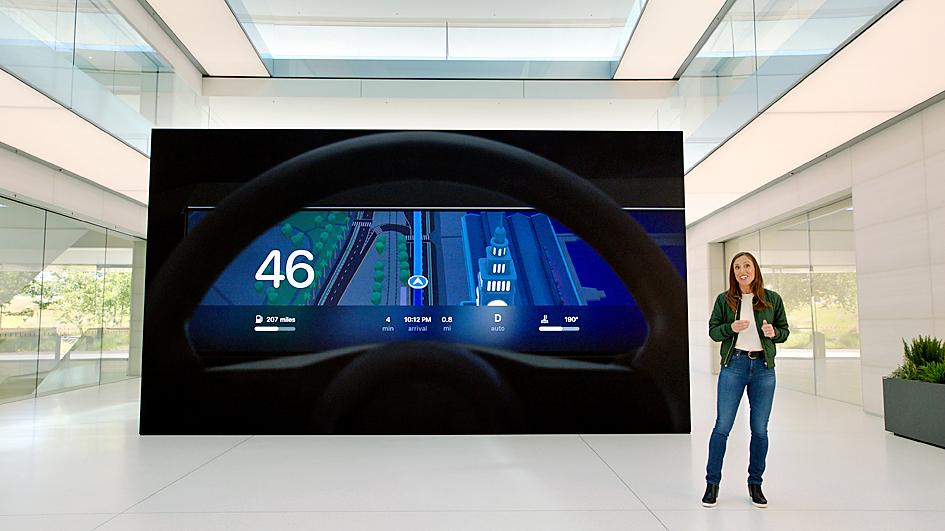
Photo: EPA-EFE / Apple Inc
Electric vehicle leader Tesla Inc has proven the popularity of a large in-vehicle screen and fully integrated software with consumers. Automakers are pushing to control the relationship with consumers in the more software-dominated vehicle as a way to generate more profits.
The current version of Apple CarPlay, available in 98 percent of new cars in the US, is fundamentally limited in its capabilities.
CarPlay apps live on the entertainment screens of vehicles and can play music or podcasts after a user has connected their iPhone to the vehicle, but the software cannot control even basic functions of a vehicle, such as changing climate control settings.
Presenters at Apple’s developer conference on Monday showed a slide with the logos of more than a dozen automotive brands, including Ford Motor Co, Mercedes-Benz AG, Audi AG and Porsche AG.
Apple said the automakers are “excited” about the concept of dashboard displays that offer a more consistent Apple look and feel.
To do so, iPhones would communicate with a vehicle’s real-time driving systems for the first time — a critical step toward Apple potentially powering autonomous driving functions.
Representatives of some of those brands described their companies as interested, but said no decisions have yet been made for future models.
“We are working with Apple on this development project,” a Porsche spokesperson said.
Automakers are wary of Apple and other tech giants. They saw how phone makers such as Motorola Inc and Nokia Corp and the one-time powers of the music industry shriveled as iPhones and Android smartphones consumed those businesses.
“There’s no question this is a threat, because the automakers, particularly as we transition to software-defined vehicles, realize they run a significant risk of losing whatever ability they have to interact with the consumer unless they get their act together,” said Evangelos Simoudis, a Silicon Valley venture capital investor and adviser who closely follows connected vehicle technology.
At the same time, big automakers know their entertainment systems are a persistent cause of consumer complaints to quality scorekeepers at J.D. Power and Associates and other market research firms.
In China, younger consumers are turning their backs on established brands, in part because their connectivity does not match what Tesla or China’s own technology-industry bred electric vehicle start-ups offer.
The next generation of vehicles from major automakers are to have sprawling dashboard screens. Mercedes-Benz, for example, has shown a prototype Vision EQXX electric sedan with a display screen that is 121cm wide, and would offer functions such as an “efficiency assistant” that would calculate the most fuel-efficient route for a journey.
The competition now is over who would develop the software to power such displays, who would control the data flowing from the vehicle and the customers on board, and who would get to generate revenue as vehicles roll down the road.
Automakers do have one advantage over former phone handset makers: They are the gatekeepers for the critical electronic systems of vehicles, which are subject to extensive government safety regulation and hardware durability requirements that are far more stringent than those of the smartphone industry.
There are signs that automakers and technology industry companies are coming to terms. Alphabet Inc’s Google has agreements with General Motors Co, Volvo Cars and the Renault-Nissan-Mitsubishi Alliance to provide software for the next generation of systems. Amazon.com has cut deals with automakers to integrate its Alexa voice assistant in vehicles.
At Apple, Emily Schubert, an engineering manager for car experience, said during Monday’s conference that using the new software, “your iPhone communicates with your vehicle’s real-time systems in an on-device, privacy friendly way, showing all of your driving information.”
The software also provides hints at Apple’s future in autonomous driving.
While Reuters previously reported that Apple could release its own electric vehicle with autonomous feature as early as 2024 or 2025, moving its software to instrument clusters puts the iPhone maker closer to the key vehicle systems and controls Apple would need to access to provide autonomous driving software to other companies.
“Cars have changed a lot, with larger-sized screens and more of them throughout the car,” Schubert said during the keynote. “There’s an opportunity for iPhone to play an even more important role.”
Apple announced the software far ahead of its release to the public, saying vehicles using it would not be announced until late next year. Apple appears to be giving automakers plenty of time to customize the new CarPlay software, an acknowledgment that the final look of the software could be different for Fords and Ferraris.

SECOND-RATE: Models distilled from US products do not perform the same as the original and undo measures that ensure the systems are neutral, the US’ cable said The US Department of State has ordered a global push to bring attention to what it said are widespread efforts by Chinese companies, including artificial intelligence (AI) start-up DeepSeek (深度求索), to steal intellectual property from US AI labs, according to a diplomatic cable. The cable, dated Friday and sent to diplomatic and consular posts around the world, instructs diplomatic staff to speak to their foreign counterparts about “concerns over adversaries’ extraction and distillation of US AI models.” Distillation is the process of training smaller AI models using output from larger, more expensive ones to lower the costs of training a powerful new
Shares of Taiwan Semiconductor Manufacturing Co (TSMC, 台積電) have repeatedly hit new highs, but an equity analyst said the stock’s valuation remains within a reasonable range and any pullback would likely be technical. The contract chipmaker’s historical price-to-earnings (P/E) ratio has ranged between 20 and 30, Cathay Futures Consultant Co (國泰證期) analyst Tsai Ming-han (蔡明翰) told Central News Agency. With market consensus projecting that TSMC would post earnings per share of about NT$100 (US$3.17) this year, supported by strong global demand for artificial intelligence (AI) applications, and the stock currently trading at a P/E ratio of below 25, Tsai said the valuation
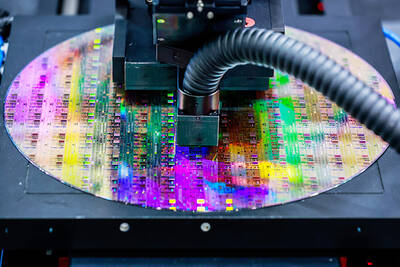
The artificial intelligence (AI) boom has triggered a seismic reshuffling of global equity markets, with Taiwan and South Korea muscling past European nations one by one. With its stock market now valued at nearly US$4.3 trillion, Taiwan surpassed the UK, Europe’s biggest market, earlier this month, data compiled by Bloomberg showed. South Korea is about US$140 billion away from doing the same. The tech-heavy Asian markets have shot past Germany and France in the past seven months. The shift is largely down to massive gains in shares of three companies that provide essential hardware for AI: Taiwan Semiconductor Manufacturing Co (TSMC, 台積電),
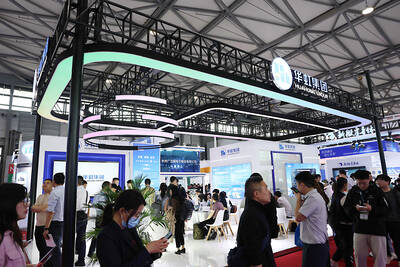
The US Department of Commerce last week ordered multiple chip equipment companies to halt shipments of certain tools to China’s second-largest chipmaker, Hua Hong Semiconductor Ltd (華虹半導體), its latest action to slow the country’s development of advanced chips, two people familiar with the matter said. The department sent letters to at least a handful of companies informing them of restrictions on tools and other materials destined for two Hua Hong facilities US officials believe make China’s most sophisticated chips, the people said. Top US chip equipment companies Lam Research Corp, Applied Materials Inc and KLA Corp, each of which has significant


 RSS
RSS