


After struggling to find staff during the COVID-19 pandemic, businesses in Singapore have increasingly turned to deploying robots to help carry out a range of tasks, from surveying construction sites to scanning library bookshelves.
The city-state relies on foreign workers, but their number fell by 235,700 between December 2019 and September last year, the Singaporean Ministry of Manpower said, adding that COVID-19 curbs have sped up “the pace of technology adoption and automation” by companies.
At a Singapore construction site, a four-legged robot called Spot, built by US company Boston Dynamics Inc, scans sections of mud and gravel to check on work progress, with data fed back to Gammon Construction Ltd’s control room.
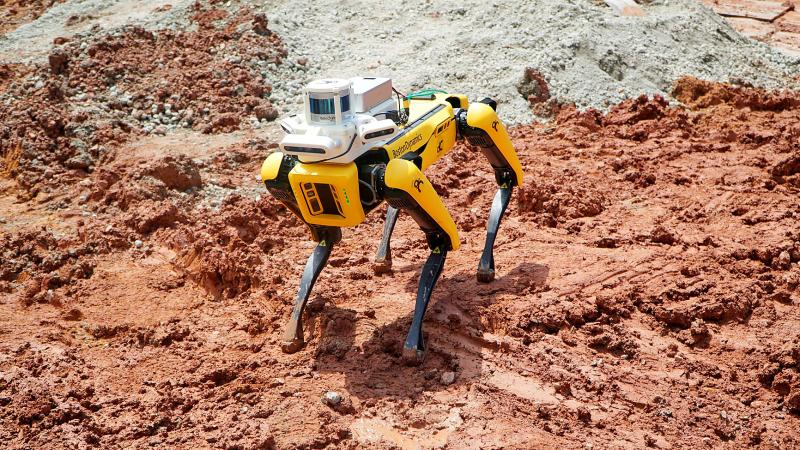
Photo: Reuters
Gammon general manager Michael O’Connell said using Spot requires only one human employee instead of the two previously needed to do the job manually.
“Replacing the need for manpower on-site with autonomous solutions is gaining real traction,” said O’Connell, who believes industry labor shortages made worse by the pandemic are here to stay.
Meanwhile, Singapore’s National Library has introduced two shelf-reading robots that can scan labels on 100,000 books, or about 30 percent of its collection, per day.
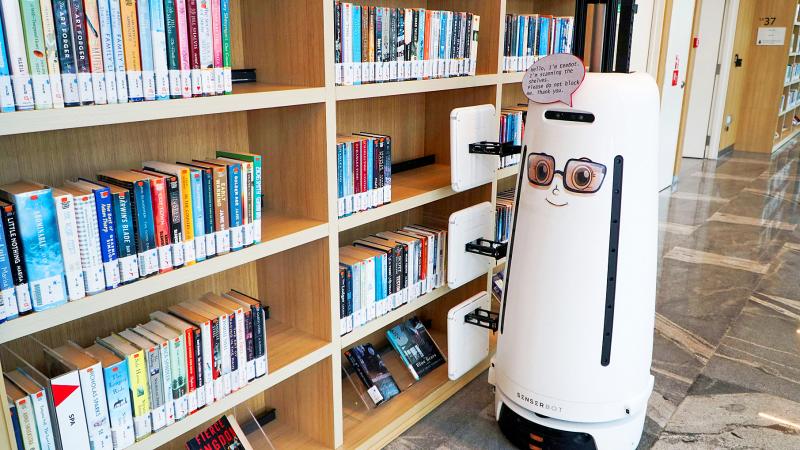
Photo: Reuters
“Staff need not read the call numbers one by one on the shelf, and this reduces the routine and labor-intensive aspects,” National Library Board assistant director Lee Yee Fuang said.
Singapore has 605 robots installed per 10,000 employees in the manufacturing industry, the second-highest number globally, after South Korea’s 932, last year’s report by the International Federation of Robotics said.
Robots are also being used for customer-facing tasks, with more than 30 metro stations set to have robots making coffee for commuters.
Keith Tan (陳邦耀), chief executive officer of Crown Digital Pte Ltd, which created the barista robot, said that it was helping solve the “biggest pain-point” in food and beverage — finding staff — while also creating well-paid positions to help automate the sector.
However, some people trying the service still yearned for human interaction.
“We always want to have some kind of human touch,” said commuter Ashish Kumar, while sipping on a robot-brewed drink.
Taichung reported the steepest fall in completed home prices among the six special municipalities in the first quarter of this year, data compiled by Taiwan Realty Co (台灣房屋) showed yesterday. From January through last month, the average transaction price for completed homes in Taichung fell 8 percent from a year earlier to NT$299,000 (US$9,483) per ping (3.3m²), said Taiwan Realty, which compiled the data based on the government’s price registration platform. The decline could be attributed to many home buyers choosing relatively affordable used homes to live in themselves, instead of newly built homes in the city’s prime property market, Taiwan Realty
The government yesterday approved applications by Alphabet Inc’s Google to invest NT$27.08 billion (US$859.98 million) in Taiwan, the Ministry of Economic Affairs said in a statement. The Department of Investment Review approved two investments proposed by Google, with much of the funds to be used for data processing and electronic information supply services, as well as inventory procurement businesses in the semiconductor field, the ministry said. It marks the second consecutive year that Google has applied to increase its investment in Taiwan. Google plans to infuse NT$25.34 billion into Charter Investments Ltd (特許投資顧問) through its Singapore-based subsidiary Fructan Holdings Singapore Pte Ltd, and

Micron Technology Inc is a driving force pushing the US Congress to pass legislation that would put new export restrictions on equipment its Chinese competitors use to make their chips, according to people familiar with the matter. A US House of Representatives panel yesterday was to vote on the “MATCH Act,” a bill designed to close gaps in restrictions on chipmaking equipment. It would also pressure foreign companies that sell equipment to Chinese chipmaking facilities to align with export curbs on US companies like Lam Research Corp and Applied Materials Inc. The bill targets facilities operated by China’s ChangXin Memory Technologies Inc

Singapore-based ride-hailing and delivery giant Grab Holdings’ planned acquisition of Foodpanda’s Taiwan operations has yet to enter the formal review stage, as regulators await supplementary documents, the Fair Trade Commission (FTC) said yesterday. Acting FTC Chairman Chen Chih-min (陳志民) told the legislature’s Economics Committee that although Grab submitted its application on March 27, the case has not been officially accepted because required materials remain incomplete. Once the filing is finalized, the FTC would launch a formal probe into the deal, focusing on issues such as cross-shareholding and potential restrictions on market competition, Chen told lawmakers. Grab last month announced that it would acquire


 RSS
RSS