


Facebook parent Meta Platforms Inc on Wednesday reported better-than-expected profit in the recently ended quarter, calming investors worried about the toll of competition from TikTok and eased COVID-19 pandemic restrictions.
Meta said it made a profit of US$7.5 billion on revenue of US$27.9 billion in the first three months of this year, sending its shares up more than 18 percent in aftermarket trading.
“We made progress this quarter across a number of key company priorities, and we remain confident in the long-term opportunities and growth that our product roadmap will unlock,” Meta chief Mark Zuckerberg said.
Photo: Reuters
The average number of people using Facebook monthly rose 3 percent to 2.94 billion by the end of March, while 3.64 billion people used at least one member of Meta’s family of apps each month, the tech giant reported.
Meta owns Facebook, Messenger, WhatsApp, Instagram and virtual reality firm Oculus.
“More people use our services today than ever before, and I’m proud of how our products are serving people around the world,” Zuckerberg said.
Investors had been worried that as the pandemic eased and people socialized more in real life that they would engage less on Facebook. There were also concerns about competition from video sharing sensation TikTok.
Zuckerberg has cited pressure from TikTok, and launched his own short-form video sharing feature Reels which has seen fast growth on Facebook and Instagram.
“Video is the main way that people experience content online,” Zuckerberg said on an earnings call.
Reels accounts for more than a fifth of the time that people spend on image-centric social network Instagram, Zuckerberg told analysts.
Meta said it ended the quarter with 77,805 employees, an increase of 28 percent from a year earlier.
Meta has been investing heavily in a future that Zuckerberg believes will include spending time in immersive virtual worlds referred to as the metaverse. It has a Reality Labs unit devoted to what he has predicted is the future of the Internet.
The metaverse is a 3D virtual world where people will be able to interact using sensors, head gear and other gadgets, but doubts have swirled about whether the major metaverse investments will pay off for Meta.
Meta’s early metaverse platform, called Horizon Worlds, already allows people to socialize virtually while represented by avatars.
“Over the next several years, our goal from a financial perspective is to generate sufficient operating income growth from our family of apps to fund the growth of investment in Reality Labs, while still growing our overall profitability,” Zuckerberg said. “Now, unfortunately, that’s not gonna happen in 2022, given the revenue headwinds.”
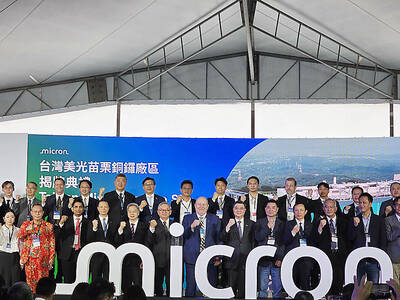
UNPRECEDENTED PACE: Micron Technology has announced plans to expand manufacturing capabilities with the acquisition of a new chip plant in Miaoli Micron Technology Inc unveiled a newly acquired chip plant in Miaoli County yesterday, as the company expands capacity to meet growing demand for advanced DRAM chips, including high-bandwidth memory chips amid the artificial intelligence boom. The plant in Miaoli County’s Tongluo Township (銅鑼), which Micron acquired from Powerchip Semiconductor Manufacturing Corp (力積電) for US$1.8 billion, is expected to make a sizeable capacity contribution to the company from fiscal 2028, the company said in a statement. It would be an extended production site of Micron’s large-scale manufacturing hub in Taichung, the company said. As the global semiconductor industry is racing to reach US$1 trillion

A man walks past real-estate advertisements outside a house in Taipei yesterday. The central bank yesterday said it plans to establish an “Inflation-at-Risk” gauge as a supplementary tool for observing inflation, as policymakers express wish to communicate more effectively with the public when making inflation forecasts.
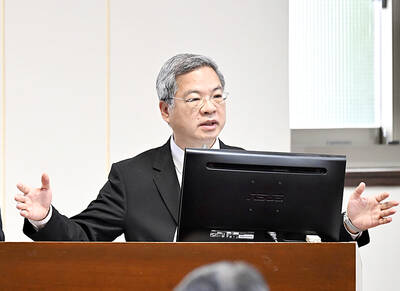
ABOVE LEGAL REQUIREMENT: The Ministry of Economic Affairs is prepared if LNG supply is disrupted, with more than the legal requirement of 11 days of inventory Taiwan has largely secured liquefied natural gas (LNG) supplies through May and arranged about half of June’s supply, Minister of Economic Affairs Kung Ming-hsin (龔明鑫) said yesterday. Since the Middle East conflict began on Feb. 28, Taiwan’s LNG inventories have remained more than 12 days, exceeding the legal requirement of 11 days, indicating no major supply concerns for domestic gas and electricity, Kung said at a meeting of the legislature’s Economics Committee in Taipei. The ministry aims to increase the figure to 14 days by the end of next year, he said. While one or two LNG or crude oil shipments for May

Memory chip stocks extended their losses yesterday after Alphabet Inc’s Google publicized research that could allow more efficient use of the storage needed for artificial intelligence (AI) development. SK Hynix Inc and Samsung Electronics Co, South Korean leaders in the market, fell more than 6 percent and about 5 percent respectively in Seoul. In the US, Micron Technology Inc, Western Digital Corp and Sandisk Corp slid more than 2 percent in pre-market trading, after they all closed lower on Wednesday. Memory companies have been on a tear in recent months as the rapid development of AI infrastructure triggered a spike in chip


 RSS
RSS