

China’s services sector took a massive knock last month amid the nation’s worst COVID-19 outbreak since the start of the pandemic, with latest holiday spending figures showing that more damage is expected this month.
The Caixin China Services Purchasing Managers’ Index (PMI) fell to 42 from 50.2 in February, the lowest since the depths of the 2020 lockdown after the initial outbreak in Wuhan.
The reading was below the 50 mark that separates expansion from contraction and well below the 49.7 median estimate in a survey of economists.
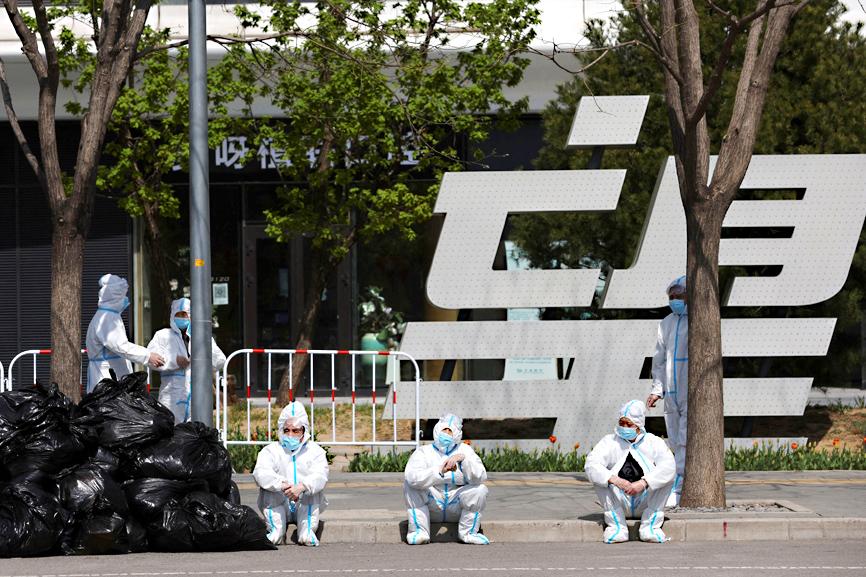
Photo: Reuters
Spending over the Tomb Sweeping Day holiday points to weak data for this month as well.
Domestic tourism revenue over the holiday plunged 31 percent from a year earlier, while delivery of packages and cinema box office sales also declined.
The Caixin index painted an even bleaker picture than China’s official non-manufacturing PMI, which fell to 48.4 from February’s 51.6.
The official survey tracks larger companies and includes the construction sector, while the Caixin survey focuses more on smaller businesses.
“Both supply and demand in the services sector contracted sharply after the latest wave of COVID outbreaks started to take off in early March,” Caixin Insight Group (財新智庫) senior economist Wang Zhe (王喆) said.
“Businesses grew less optimistic,” Wang said, with the subindex for planned activity hitting a 19-month low last month.
Lockdowns and other restrictions to curb the spread of COVID-19 show spending is still well below pre-pandemic levels.
Tourism revenue over the three-day national holiday that ended on Tuesday was only about 39 percent of the level reached during the same period in 2019, Chinese Ministry of Culture and Tourism data showed.
Separate data from the Chinese Ministry of Transport showed that about 53.8 million trips were made by rail, road, waterways and air during the holiday, down 62.7 percent from a year earlier and 9.8 percent from the same period in 2020.
The number of packages delivered by the postal industry likely fell 12.8 percent year-on-year to 690 million during the holiday, the Chinese State Post Bureau said in a statement.
Box office sales totaled 122 million yuan (US$19.2 million), about one-seventh of the 822 million yuan recorded in the comparable period last year, data provided by ticketing company Maoyan showed.
Separately, private-sector economic activity in Hong Kong slid further into contraction last month as lockdowns in mainland China added more pressure to businesses.
The S&P Global PMI fell to 42 from 42.9 in February as the gauge continued to fall to levels not seen since April 2020.
It was also the third consecutive month that the index was below 50, the level separating expansion from contraction.
New orders and output declined at a faster rate last month.
Orders from mainland China “were affected by the COVID-19 lockdowns in the region,” S&P Global said in a statement.
Hong Kong has been fighting a prolonged virus outbreak for months, leading authorities to implement strict measures to control infections.
Meanwhile, lockdowns in mainland China are aggravating lead times and price pressures, S&P Global said in the statement.
“Hong Kong’s private sector can be seen shrinking at a faster rate in March, faced with all the negative consequences of the latest COVID-19 wave and the corresponding movement restrictions,” S&P Global economics associate director Pan Jingyi (潘婧怡) said. “Supply constraints, made worse by lockdowns in mainland China, and price pressures, aggravated by the Ukraine war, further weighed on Hong Kong private sector firms.”
Pan expects Hong Kong’s GDP to contract in the first quarter.
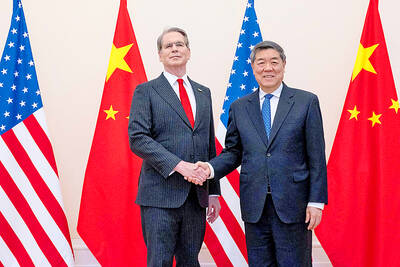
MINIMAL EXPECTATIONS: Analysts think that the two sides are likely to aim for ‘status quo’-level agreements, maintaining civility, without major trade breakthroughs US Secretary of the Treasury Scott Bessent and Chinese Vice Premier He Lifeng (何立峰) were set to meet yesterday to try to set up potential agreements on artificial intelligence (AI), tariffs and critical minerals for a summit in Washington this week between US President Donald Trump and Chinese President Xi Jinping (習近平). The meetings at JPMorgan Chase & Co’s headquarters in Manhattan, which included US Trade Representative Jamieson Greer, were due to start at about 10:30am on Sunday morning and were expected to run all day. Key topics would be the status of a US-China trade truce that is set to expire

APPEAL: Any agreement to produce advanced memory such as HBM or DRAM could run into opposition from Seoul as those technologies are sensitive, sources said South Korea’s SK Hynix Inc is in talks with Intel Corp about a deal that would see it manufacture memory chips on US soil for the first time, three people familiar with the discussions said. Under one potential scenario, SK Hynix would lease part of Intel’s long-planned chipmaking facility in Ohio, they said. Under another scenario, it could form a venture with Intel and major cloud firms that are keen to lock in memory supplies, two of the people said. A deal would relieve pressure on Intel, which has been struggling, and mark a big win for US President Donald

MORE DATA CENTERS: Microsoft’s Taiwan-area general manager said the corporation is looking to add two more data centers in northern Taiwan over the next few years Microsoft Corp plans to double its data centers in Taiwan from two facilities to four, Microsoft Taiwan general manager Sean Pien (卞志祥) said yesterday. “Over the past two to three years, we have consistently seen demand outstrip supply, and we expect that situation to continue over the next two to three years,” Pien said on the sidelines of a news conference in Taipei. The data center sites would mainly be in northern Taiwan to meet customer demand and reduce the risk of operational disruptions caused by a single event, he said, without saying their exact locations. Microsoft enabled the first phase of

Anthropic PBC CEO Dario Amodei and Salesforce Inc CEO Marc Benioff said companies have just begun taking advantage of artificial intelligence (AI) tools and need more help to gain the greatest benefits for their businesses. The power of AI is barely diffused through the economy, with only 5 to 10 percent of the value of the technology being used, Amodei said on Tuesday during an appearance with Benioff at Salesforce’s annual Dreamforce conference in San Francisco. Implementation of AI at large businesses — like the kind Salesforce mostly serves — remains far away from the futuristic vision professed by executives such as


 RSS
RSS