


Shining Building Business Co (鄉林建設) plans to launch new housing projects worth NT$30 billion (US$1.08 billion) in Taiwan and China, unfazed by increasing measures to cool the property market, company chairman Lai Cheng-i (賴正鎰) said yesterday.
The plan includes projects valued at NT$10.8 billion in Taiwan and NT$19 million in Chengdu, China, Lai said at a gathering in Taipei.
He said he believes that Taiwan’s policymakers would introduce more unfavorable local property market measures, as real-estate lending has failed to slow down.

Photo: Hsu Yi-ping, Taipei Times
It would have a very limited effect, because excessive global liquidity, capital repatriation and low interest rates underpin housing price hikes, Lai said.
Housing price increases also have the support of economic fundamentals in light of the global economic recovery, and rising building material and labor costs, Lai said, adding that the government has encouraged the trend by offering incentives to encourage Taiwanese companies abroad to return home.
That explains why prices for industrial plots of land and office space have risen rapidly in the past few years, he said.
Housing prices across Taiwan last year rose 30 percent, with the increase approaching 100 percent in Taichung, as its improving infrastructure is attracting more people, Lai said.
A Taichung-based developer, Shining is looking for land in rezoning areas to take advantage of the demographic bonus, Lai said, adding that the company is about to launch a presale housing project in Changhua County that is only one stop from Taichung by high-speed rail.
The Changhua project has 238 apartment units on plot of 1,500 ping (4,959m2) and could generate NT$2.8 billion in sales, the company said.
In the meantime, Shining aims to focus on urban renewal projects in Taipei and New Taipei City, as such undertakings are not affected by credit controls, Lai said.
The firm aims to roll out urban renewal projects in Taipei’s Zhongshan (中山) and Wanhua (萬華) districts that respectively feature 130 and 320 apartment units on plots of 1,008 ping and 2,125 ping, and could generate NT$3.5 billion and NT$4.5 billion of revenue, he said.
Inflation concerns would lend strength to real-estate properties, Lai added.
Affiliated luxury hotel The Lalu (涵碧樓) near Sun Moon Lake (日月潭) in Nantou County has remained resilient, because it had been popular with domestic tourists during the COVID-19 pandemic, Lai said, adding that he expects authorities to maintain border controls for another year.
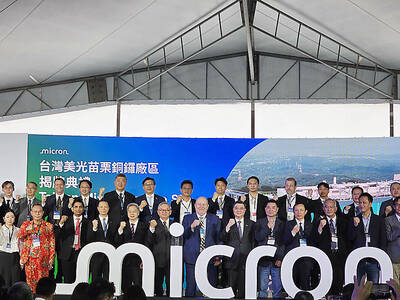
UNPRECEDENTED PACE: Micron Technology has announced plans to expand manufacturing capabilities with the acquisition of a new chip plant in Miaoli Micron Technology Inc unveiled a newly acquired chip plant in Miaoli County yesterday, as the company expands capacity to meet growing demand for advanced DRAM chips, including high-bandwidth memory chips amid the artificial intelligence boom. The plant in Miaoli County’s Tongluo Township (銅鑼), which Micron acquired from Powerchip Semiconductor Manufacturing Corp (力積電) for US$1.8 billion, is expected to make a sizeable capacity contribution to the company from fiscal 2028, the company said in a statement. It would be an extended production site of Micron’s large-scale manufacturing hub in Taichung, the company said. As the global semiconductor industry is racing to reach US$1 trillion

Singapore-based ride-hailing and delivery giant Grab Holdings Ltd has applied for regulatory approval to acquire the Taiwan operations of Germany-based Delivery Hero SE's Foodpanda in a deal valued at about US$600 million. Grab submitted the filing to the Fair Trade Commission on Friday last week, with the transaction subject to regulatory review and approval, the company said in a statement yesterday. Its independent governance structure would help foster a healthy and competitive market in Taiwan if the deal is approved, Grab said. Grab, which is listed on the NASDAQ, said in the filing that US-based Uber Technologies Inc holds about 13 percent of

Taiwan’s food delivery market could undergo a major shift if Singapore-based Grab Holdings Ltd completes its planned acquisition of Delivery Hero SE’s Foodpanda business in Taiwan, industry experts said. Grab on Monday last week announced it would acquire Foodpanda’s Taiwan operations for US$600 million. The deal is expected to be finalized in the second half of this year, with Grab aiming to complete user migration to its platform by the first half of next year. A duopoly between Uber Eats and Foodpanda dominates Taiwan’s delivery market, a structure that has remained intact since the Fair Trade Commission (FTC) blocked Uber Technologies Inc’s

Memory chip stocks extended their losses yesterday after Alphabet Inc’s Google publicized research that could allow more efficient use of the storage needed for artificial intelligence (AI) development. SK Hynix Inc and Samsung Electronics Co, South Korean leaders in the market, fell more than 6 percent and about 5 percent respectively in Seoul. In the US, Micron Technology Inc, Western Digital Corp and Sandisk Corp slid more than 2 percent in pre-market trading, after they all closed lower on Wednesday. Memory companies have been on a tear in recent months as the rapid development of AI infrastructure triggered a spike in chip


 RSS
RSS