


CONSUMER GOODS
Reckitt might sell unit
Reckitt Benckiser Group PLC’s plan to review its infant nutrition unit and weigh options, including a potential sale, boosted shares of the maker of Lysol. The British consumer goods company is reviewing the business globally and has been informally gauging buyer interest in the operations, Bloomberg reported on Friday, citing people familiar with the situation. The unit could be worth £5.5 billion (US$7.4 billion), an estimate by Jefferies showed.
INTERNET
PriceRunner sues Google
Alphabet Inc’s Google is being sued by Nordic price comparison provider PriceRunner AB for about 22 billion kronor (US$2.4 billion) at Sweden’s patent and market court. The lawsuit follows the conclusion of a legal ruling in the EU that established Google has breached antitrust laws by manipulating search results in favor of its own comparison-shopping services, PriceRunner said in a statement yesterday. It is also about job opportunities and a matter of survival for many European entrepreneurial companies, it said.
TRAVEL
Crystal Cruises ships seized
Two Crystal Cruises ships operating under a Genting Hong Kong Ltd (雲頂香港) unit have been seized in the Bahamas after a fuel supplier sought their arrest for US$4.6 million in unpaid bills, according to a video filmed by crew and the Cruise Law News Web site. The Crystal Symphony and Crystal Serenity were seized late on Friday night in Freeport in the Bahamas, said Cruise Law News, a site run by Jim Walker, a maritime lawyer based in Florida. The luxury cruise ships were anchored in Freeport on Saturday.
CUBA
New tax for food sales
Havana on Saturday announced a new 10 percent tax on retail food sales, as the nation endures economic woes marked by rampant inflation. The levy, which took effect yesterday, targets self-employed people and small and medium-sized companies in the retail food sector, said the decree published in the official government gazette. The sales were only allowed starting in August last year as part of government reforms. The nation imports 80 percent of the food it consumes.
EUROZONE
Investors bet on rate change
Investors are betting that the European Central Bank (ECB) raises the deposit rate by 25 basis points in September and takes it to zero by the end of the year, following a shift in tone at last week’s Governing Council meeting. That is more aggressive than the time line that Klaas Knot, one of the ECB’s most hawkish policymakers, laid out in a TV interview on Sunday. A first hike could come in the fourth quarter, with a second one possibly following in the spring, he said.
REAL ESTATE
Home to be sold as NFT
A home along Florida’s Gulf Coast is to be auctioned off this week as a non-fungible token (NFT) in what is believed to be among the first such transactions in the US. In the case of the four-bedroom home in Gulfport, Florida, California-based real-estate technology company Propy is to mint the property rights into a digital token and host an online auction, with bids starting at US$650,000. Minting property rights into an NFT would allow owners to sell a home as quickly as a Venmo transaction, said Leslie Alessandra, the home’s current owner.

SECOND-RATE: Models distilled from US products do not perform the same as the original and undo measures that ensure the systems are neutral, the US’ cable said The US Department of State has ordered a global push to bring attention to what it said are widespread efforts by Chinese companies, including artificial intelligence (AI) start-up DeepSeek (深度求索), to steal intellectual property from US AI labs, according to a diplomatic cable. The cable, dated Friday and sent to diplomatic and consular posts around the world, instructs diplomatic staff to speak to their foreign counterparts about “concerns over adversaries’ extraction and distillation of US AI models.” Distillation is the process of training smaller AI models using output from larger, more expensive ones to lower the costs of training a powerful new

Singapore-based ride-hailing and delivery giant Grab Holdings’ planned acquisition of Foodpanda’s Taiwan operations has yet to enter the formal review stage, as regulators await supplementary documents, the Fair Trade Commission (FTC) said yesterday. Acting FTC Chairman Chen Chih-min (陳志民) told the legislature’s Economics Committee that although Grab submitted its application on March 27, the case has not been officially accepted because required materials remain incomplete. Once the filing is finalized, the FTC would launch a formal probe into the deal, focusing on issues such as cross-shareholding and potential restrictions on market competition, Chen told lawmakers. Grab last month announced that it would acquire
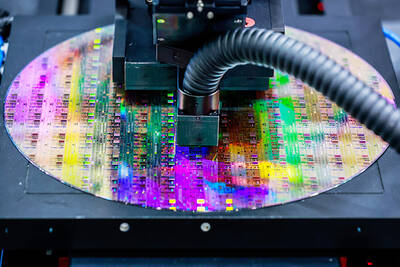
The artificial intelligence (AI) boom has triggered a seismic reshuffling of global equity markets, with Taiwan and South Korea muscling past European nations one by one. With its stock market now valued at nearly US$4.3 trillion, Taiwan surpassed the UK, Europe’s biggest market, earlier this month, data compiled by Bloomberg showed. South Korea is about US$140 billion away from doing the same. The tech-heavy Asian markets have shot past Germany and France in the past seven months. The shift is largely down to massive gains in shares of three companies that provide essential hardware for AI: Taiwan Semiconductor Manufacturing Co (TSMC, 台積電),
Shares of Taiwan Semiconductor Manufacturing Co (TSMC, 台積電) have repeatedly hit new highs, but an equity analyst said the stock’s valuation remains within a reasonable range and any pullback would likely be technical. The contract chipmaker’s historical price-to-earnings (P/E) ratio has ranged between 20 and 30, Cathay Futures Consultant Co (國泰證期) analyst Tsai Ming-han (蔡明翰) told Central News Agency. With market consensus projecting that TSMC would post earnings per share of about NT$100 (US$3.17) this year, supported by strong global demand for artificial intelligence (AI) applications, and the stock currently trading at a P/E ratio of below 25, Tsai said the valuation


 RSS
RSS