


Billionaire philanthropist George Soros said Chinese President Xi Jinping (習近平) may fail in his widely expected bid to extend his rule of the country later this year.
“Given the strong opposition within the Communist Party, Xi Jinping’s carefully choreographed elevation to the level of Mao Zedong (毛澤東) and Deng Xiaoping (鄧小平) may never occur,” Soros, 91, said in remarks prepared for delivery on Monday at an event sponsored by the Hoover Institution at Stanford University.
Soros, speaking days before the start of the Winter Olympics in Beijing, cited Xi’s enemies within the party, a real-estate crisis, ineffective vaccines and a falling birthrate as factors working against him.
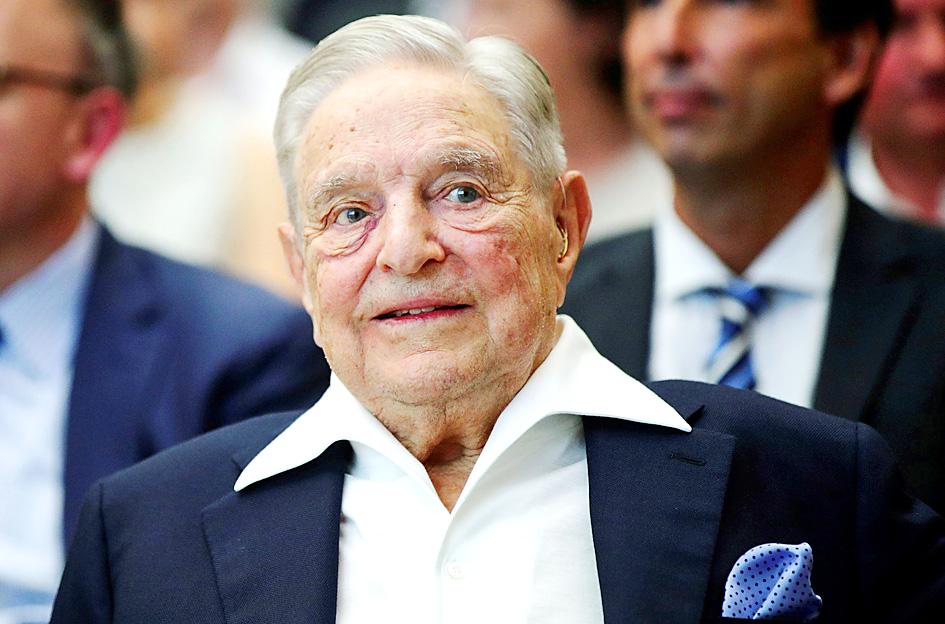
Photo: Reuters
Xi, 68, has positioned himself to secure a precedent-breaking third term as president and general secretary when the Chinese Communist Party holds a twice-a-decade Party Congress toward the end of this year.
The lead-up to the congress is one of the most sensitive periods in China’s political calendar, with much of the jockeying for positions taking place behind closed doors in the country’s opaque one-party system. On the surface, however, Xi has appeared to consolidate power and sideline potential challengers, leading most China watchers to conclude that he will easily extend his rule.
Soros, however, sees a fight brewing over Xi’s management of the economy and the pandemic that could see him ousted from power. The billionaire is the founder of the Open Society Foundations, the second-largest private charitable foundation in the US, with assets of about US$28 billion, which works to build democracies around the globe and oppose authoritarianism.
Internal divisions in China are “so sharp that it has found expression in various party publications,” Soros said. “Xi is under attack from those who are inspired by Deng Xiaoping’s ideas and want to see a greater role for private enterprise.”
China has long dismissed Soros’ criticism. In 2019, when he called Xi the world’s “most dangerous opponent of open societies,” the Foreign Ministry in Beijing said the remarks were “meaningless and not worth refuting.”
Under Xi, Chinese regulators have reined in some of the nation’s most successful technology companies, including curbing their listings on US exchanges. The government also took aim at the nation’s US$100 billion for-profit education sector, part of Xi’s wider “common prosperity” campaign to rein in the billionaire class and improve the lives of ordinary citizens.
The troubled real-estate market, the country’s main engine of growth since Xi became president in 2013, could also derail the Chinese leader, Soros said.
The current model is “unsustainable,” he said, with buyers, using borrowed money, forced to start paying for their apartments before they were even built. Local governments derived most of their revenue from selling land at ever-rising prices, which were 30 percent higher in June from a year earlier, Soros said.
With housing increasingly unaffordable for most people, prices for both land and apartments are starting to fall. China Evergrande Group (恆大集團), the world’s most indebted developer, was labeled a defaulter for the first time in December after it missed payments on several bonds, and many of its competitors are struggling. Citizens who invested the bulk of their savings in real estate will turn against Xi, Soros predicted.
The question now is whether Xi will use the necessary tools to re-establish confidence, Soros said.
“The second quarter of 2022 will show whether he has succeeded,” he said. “The current situation doesn’t look promising for Xi.”
The rise of the Omicron variant of SARS-CoV-2 will also pose a serious danger to the economy and Xi’s ability to control the spread of the disease, Soros said. He said that the variant “is no longer under control” and Xi’s strategy of strict lockdowns risked spurring a backlash among the population.
“Omicron threatens to be Xi Jinping’s undoing,” Soros said. He added that he hopes Xi is replaced by a leader who is less repressive at home and more peaceful abroad.
“This would remove the greatest threat that open societies face today,” Soros said. “And they should do everything within their power to encourage China to move in the desired direction.”
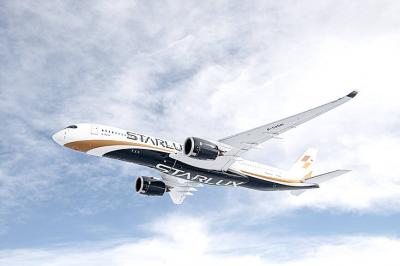
Starlux Airlines Co (星宇航空) today unveiled a long-haul network expansion plan at a shareholders’ meeting in Taipei, including direct flights to Barcelona, Spain, and Zurich, Switzerland, as well as a service connecting Taipei, Sydney and New Zealand. Starlux is to become the first Taiwanese carrier to offer non-stop services to the two European cities, while the inaugural oceanic route is expected to expand transit opportunities within the Australia-New Zealand market, Starlux said. Flight services to Chicago, Dallas, Washington and New York are under evaluation, the airline added. Prior to the shareholders’ meeting, the airline earlier this year announced that it would be

Cairo’s new monorail slices across the city skyline, running above the familiar chaos of blaring horns and aging buses’ exhaust fumes that mark rush hour below. The US$4.5 billion monorail, opened this month, is among Egypt’s most prominent new transport projects, part of a debt-funded infrastructure drive criticized for sapping state finances while bringing limited benefits to most of the country’s 109 million people. “It feels like you’re in a different country,” said Ramy Sayed, a restaurant manager, aboard a driverless Innovia 300 train. “No noise, no traffic, we’re not used to this.” The eastern line runs 56km from the bustling middle-class
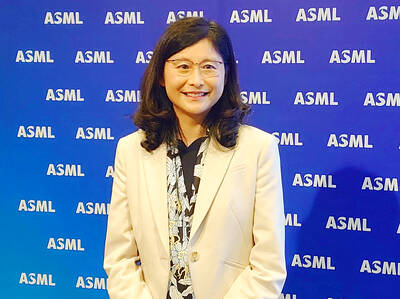
Netherlands-based semiconductor equipment supplier ASML Holding NV yesterday said that it is planning to hire an additional 1,000 people in Taiwan this year in response to growing demand from clients. ASML had previously planned to recruit 600 people this year, but that the plan has been adjusted upward, ASML vice president and ASML Taiwan general manager Grace Wang (汪佳慧) told reporters. ASML has a workforce of more than 4,500 in Taiwan, accounting for about 10 percent of its global total, Wang said. This year’s recruitment campaign would focus on adding people in the customer support, manufacturing and supply chain domains to assist ASML
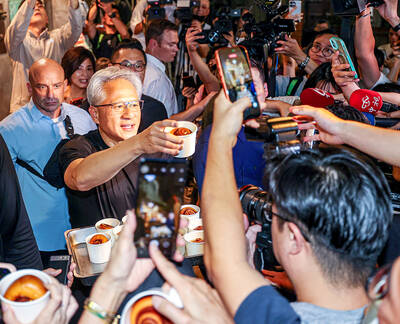
Nvidia Corp yesterday announced that CEO Jensen Huang (黃仁勳) would attend an employee meeting in Taipei tomorrow to celebrate the launch of the company’s Taiwan headquarters project. Huang would attend a gathering at the site of Nvidia’s planned headquarters in Beitou Shilin Technology Park (北投士林科技園區), the company said in a statement. After arriving in Taiwan on Saturday last week, Huang told reporters that he plans to meet with Quanta Computer Inc (廣達) chairman Barry Lam (林百里) and Taiwan Semiconductor Manufacturing Co (TSMC, 台積電) chairman C.C. Wei (魏哲家), and would attend the groundbreaking ceremony for Nvidia’s Taiwan headquarters tomorrow. Nvidia has not yet applied


 RSS
RSS