


The COVID-19 pandemic has hit the world hard, changed people’s lives and pushed contactless services into the mainstream.
The Discovery Channel noticed the rapid digital transformation taking place in Taiwan’s financial industry and took six months to produce the Tomorrow by Taiwan: Virtual World program, which premiered at 10pm on Wednesday.
The program showed how CTBC Bank (中國信託商銀) pays attention to the customer experience and uses artificial intelligence (AI), blockchain, cloud technology and big data to provide financial services that are available anytime, anywhere.
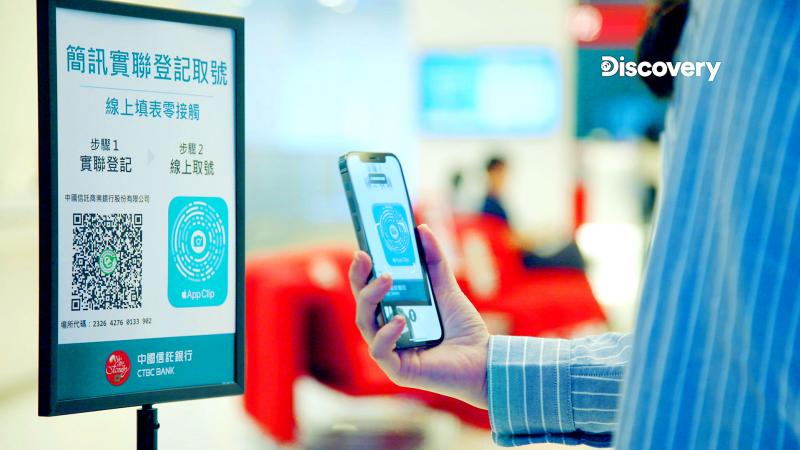
Photo courtesy of the Discovery Channel
Tomorrow by Taiwan: Virtual World was hosted by TV personality Janet Hsieh (謝怡芬), who led the audience in exploring the development of financial technology in the post-pandemic era.
The program aired on the Discovery Channel in 13 countries and territories in Asia, including Taiwan, Hong Kong, Macau, Singapore, Malaysia, the Philippines, Indonesia and Thailand.
CTBC has had excellent performance in the digitalization of its financial services.
In particular, the bank has processed more than 360,000 COVID-19 relief loan applications per year over the two years of the pandemic, the highest output among Taiwan’s private banks.
CTBC president James Chen (陳佳文) said that the bank’s online platform for processing relief loans integrates cash data with information data to provide a contactless application service.
A crucial step for digital innovation at the bank was its adoption of a “mobile first” approach six years ago, which it has invested in ever since.
The pandemic has also helped to accelerate the digital transformation, making it more acceptable to the public.
In the next stage, the challenge for the financial industry will be to increase the capabilities of digital services, Chen said.
Only firms that can provide high-quality remote digital services will remain competitive, he added.
CTBC has been using blockchain technology to provide corporate customers with a smoother trade finance process.
In 2016, the bank took the lead in joining the R3 Alliance, the largest international financial blockchain ecosystem, becoming the first R3 Alliance member in Taiwan.
By adopting blockchain technology to replace the complicated and time-consuming issuance of letters of credit, and using AI technology to automatically identify traditional Chinese documents, the bank has optimized the international trade finance process.
CTBC has made good use of big data, and is implementing end-to-end digitization to build a personalized smart financial environment for its customers and provide them with a better experience.
To extend the reach of its financial services, the bank has been working with partners such as Line Pay, CPC Pay and Hotai Pay to build a more convenient financial ecosystem.
CTBC has also taken the lead in adopting Apple Inc’s Business Chat financial service, which is integrated directly into Apple’s Messages app.

Taiwan Semiconductor Manufacturing Co (TSMC, 台積電) last week recorded an increase in the number of shareholders to the highest in almost eight months, despite its share price falling 3.38 percent from the previous week, Taiwan Stock Exchange data released on Saturday showed. As of Friday, TSMC had 1.88 million shareholders, the most since the week of April 25 and an increase of 31,870 from the previous week, the data showed. The number of shareholders jumped despite a drop of NT$50 (US$1.59), or 3.38 percent, in TSMC’s share price from a week earlier to NT$1,430, as investors took profits from their earlier gains
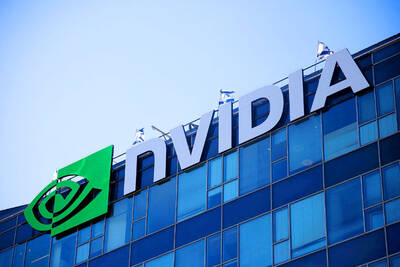
AI TALENT: No financial details were released about the deal, in which top Groq executives, including its CEO, would join Nvidia to help advance the technology Nvidia Corp has agreed to a licensing deal with artificial intelligence (AI) start-up Groq, furthering its investments in companies connected to the AI boom and gaining the right to add a new type of technology to its products. The world’s largest publicly traded company has paid for the right to use Groq’s technology and is to integrate its chip design into future products. Some of the start-up’s executives are leaving to join Nvidia to help with that effort, the companies said. Groq would continue as an independent company with a new chief executive, it said on Wednesday in a post on its Web

CHINA RIVAL: The chips are positioned to compete with Nvidia’s Hopper and Blackwell products and would enable clusters connecting more than 100,000 chips Moore Threads Technology Co (摩爾線程) introduced a new generation of chips aimed at reducing artificial intelligence (AI) developers’ dependence on Nvidia Corp’s hardware, just weeks after pulling off one of the most successful Chinese initial public offerings (IPOs) in years. “These products will significantly enhance world-class computing speed and capabilities that all developers aspire to,” Moore Threads CEO Zhang Jianzhong (張建中), a former Nvidia executive, said on Saturday at a company event in Beijing. “We hope they can meet the needs of more developers in China so that you no longer need to wait for advanced foreign products.” Chinese chipmakers are in
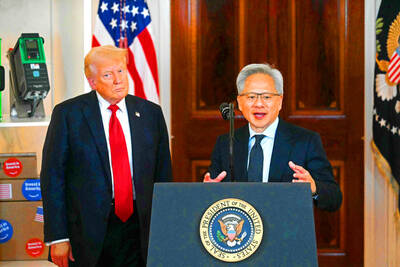
POLICY REVERSAL: The decision to allow sales of Nvidia’s H200 chips to China came after years of tightening controls and has drawn objections among some Republicans US House Republicans are calling for arms-sale-style congressional oversight of artificial intelligence (AI) chip exports as US President Donald Trump’s administration moves to approve licenses for Nvidia Corp to ship its H200 processor to China. US Representative Brian Mast, the Republican chairman of the US House Committee on Foreign Affairs, which oversees export controls, on Friday introduced a bill dubbed the AI Overwatch Act that would require the US Congress to be notified of AI chips sales to adversaries. Any processors equal to or higher in capabilities than Nvidia’s H20 would be subject to oversight, the draft bill says. Lawmakers would have


 RSS
RSS