


Intel Taiwan is to reward employees who recommend female semiconductor talent as part of a global effort by the US-based company to diversify its workforce.
If a recommended female candidate is hired in the company’s IC design or research and development department, the employee who recommended her would receive a bonus of NT$160,000, double that paid for new male employees, Grace Wang (汪佳慧), vice president and general manager of sales and marketing, told local media on Friday.
Intel Taiwan’s “Rise 2030” project aims to double the number of female workers and those coming from multicultural backgrounds in ranking managerial positions, Wang said.
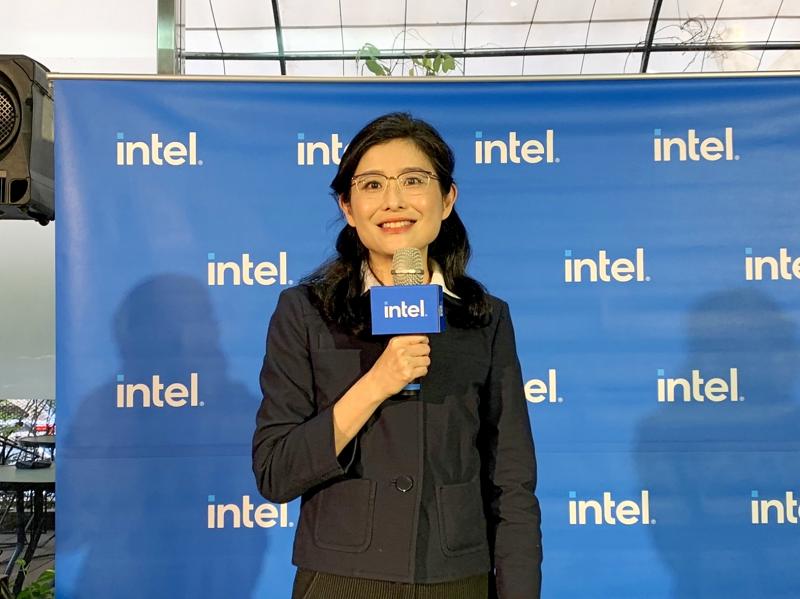
Photo: Vanessa Cho, Taipei Times
The company also aims to raise the percentage of female professionals to 40 percent during the 10-year project, she said.
Worldwide, the percentage of female workers at Intel Corp rose by 0.4 percentage points over the past year to 27.8 percent, while that of ranking female managers grew by 0.8 percentage points to 21.1 percent, she said, adding that female technicians would account for 26 percent by the end of this year, up from 25.2 percent a year ago.
Intel stresses inclusiveness and has a multicultural workforce, Wang said.
Intel Taiwan has also been seeking to hire talent on university campuses across the nation, she said.
In related news, more women are taking supervisory and executive positions in the private sector and government, two reports showed on Tuesday.
There were 374,000 elected officials, business leaders or managers in the nation last year, of whom 114,000, or 30.5 percent, were women, a report by the Directorate-General of Budget, Accounting and Statistics said.
That was 10 percentage points higher than the level in 2010 and the first time the figure surpassed 30 percent, the agency said in its latest national statistics report.
Last year’s figure was lower than the 44.6 percent in the US, but higher than the 15.7 percent in South Korea and 13.3 percent in Japan.
However, the number of women in top positions in Taiwan still remained well short of the 260,000 men who were elected officials, business leaders or managers, the report said.
China Credit Information Service Ltd (中華徵信所), a Taipei-based credit rating services company, also issued a report on the nation’s top 100 business groups, which found that 89.3 percent of the core decision-makers in the top 100 enterprises were men this year.
Of the 845 core decision-makers in those companies, 755 were men, the report said, but added that a growing number of listed companies and public banks have chairwomen at the helm.
Each year, the company selects 100 core enterprise figures, and the number of women on the list rose to 12 this year, up from four in 2017, the report said.
The firm expects the ratio to exceed 15 percent by 2029.


Taiwanese firms have increased investment in the Philippines in recent years as Manila’s ties with Washington deepen and global supply chains continue to shift away from China, an expert at the Chung-Hua Institution for Economic Research (CIER, 中華經濟研究院) said yesterday. The Philippines had not been among Taiwanese investors’ top choices in Southeast Asia, CIER Taiwan ASEAN Studies Center director Kristy Hsu (徐遵慈) said at a seminar in Taipei. However, Taiwan’s investment in the country has grown significantly since the COVID-19 pandemic, reaching US $257 million last year, a high in recent years, she said. Although Taiwan’s total investment in the Philippines still lags

Intel Corp regards Taiwan Semiconductor Manufacturing Co (TSMC, 台積電) as a longstanding partner, as the US chipmaker would continue outsourcing production of advanced chips to TSMC, Intel chief executive officer Lip-Bu Tan (陳立武) said yesterday. “I don’t look at people as competitors. I look at the collaboration... Nvidia is also, you know, a good friend,” Tan told a news conference following his keynote speech at the Computex trade show in Taipei. “It’s a very trusted partnership for us... We are a big, top customer for them, and we’re going to continue doing that,” he said, referring to TSMC, the world’s largest foundry

Hon Hai Precision Industry Co (鴻海精密) yesterday said it would work with US chipmaker Intel Corp to jointly develop and deploy next-generation artificial intelligence (AI) infrastructure and intelligent computing platforms in a move to capture booming demand for AI computing systems. Hon Hai, also known as Foxconn Technology Group (富士康), said in a statement that the partnership would combine its global manufacturing scale, system integration expertise and AI data center deployment capabilities with Intel’s strengths in processor architecture, silicon technologies and software ecosystem. The companies said they plan to work on equipment used in AI data centers, including server racks powered by

Artificial intelligence (AI) agents would supplant smartphones as the center of people’s digital lives, fundamentally reshaping personal devices and driving a major computing upgrade cycle, Qualcomm Inc CEO Cristiano Amon said yesterday. In his keynote speech for this year’s Computex trade show in Taipei, Amon said that the rise of "agentic AI" — AI systems capable of reasoning, planning and carrying out tasks autonomously — would transform how people interact with technology across phones, PCs, vehicles and wearable devices. Describing the technology as the next major evolution in computing, Amon said that "2026 is the year of agents.” For decades, smartphones have sat


 RSS
RSS