


Rivian Automotive Inc on Friday significantly raised the expected offer price of its shares, with the Amazon.com Inc-backed electric vehicle (EV) manufacturer aiming for a valuation of as much as US$65 billion in its initial public offering (IPO).
It had earlier this week aimed for a valuation of more than US$53 billion at a price of US$62 per share.
The company now expects to sell 135 million shares in the range of US$72 to US$74 apiece to raise nearly US$10 billion at its trading debut tomorrow.
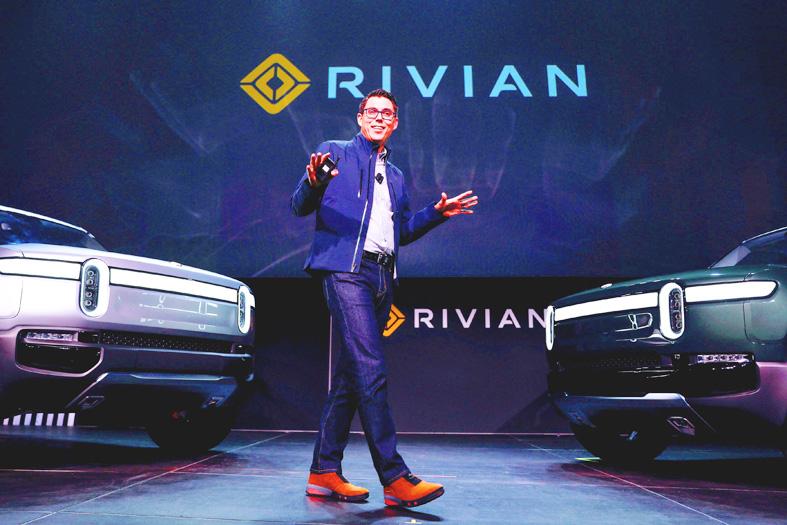
Photo: Reuters
The increased price band follows a successful investor roadshow this week, as Wall Street’s big IPO investors bet on Rivian to be the next big player in a sector dominated by Tesla Inc.
The IPO could make Rivian one of only three companies that have raised more than US$8 billion at their trading debut in the past decade, after Alibaba Group Holding Ltd (阿里巴巴) and Facebook Inc.
While the start-up has yet to sell any significant volume of its electric vans or trucks, a US$65 billion valuation for Rivian could make it more valuable than Fiat maker Stellantis NV and bring it closer to legacy automakers Ford Motor Co and General Motors Co.
Rivian has been investing heavily to ramp up production, including for its upscale all-electric R1T pickup truck, which was launched in September, beating out competition from established rivals Tesla, General Motors and Ford.
As of the end of last month, Rivian had about 55,400 R1T and R1S preorders in the US and Canada.
The company said it had started deliveries of the R1T and recorded revenue for the three months ended Sept. 30.
However, net loss for that period is estimated to increase due to higher production costs.
The electric vehicle market is booming, as consumers are more environment conscious and is seen as a symbol of luxury for many brands.
Tesla produced a record number of vehicles last quarter, suggesting strong demand in the sector.
Amazon has ordered 100,000 of Rivian’s electric delivery vans as part of the e-commerce giant’s broader effort to cut its carbon footprint.
However, Rivian might face competition from automakers in the consumer and commercial van markets.
Ford said it has more than 160,000 orders for its F-150 Lightning electric pickup truck and that an electric version of its Transit commercial van is “completely sold out.”
General Motors is also gearing up production of electric delivery vans, sports utility vehicles and pickup trucks.
Morgan Stanley, Goldman Sachs Group Inc and JPMorgan Chase & Co are Rivian’s lead underwriters.
Rivian would list on the NASDAQ under the symbol “RIVN.”
The valuation includes shares that underwriters could exercise under the “greenshoe” option.
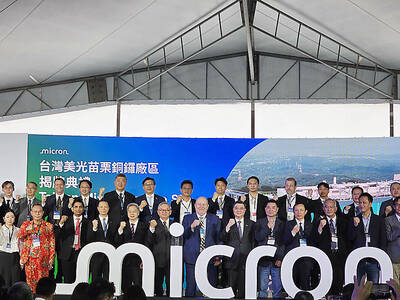
UNPRECEDENTED PACE: Micron Technology has announced plans to expand manufacturing capabilities with the acquisition of a new chip plant in Miaoli Micron Technology Inc unveiled a newly acquired chip plant in Miaoli County yesterday, as the company expands capacity to meet growing demand for advanced DRAM chips, including high-bandwidth memory chips amid the artificial intelligence boom. The plant in Miaoli County’s Tongluo Township (銅鑼), which Micron acquired from Powerchip Semiconductor Manufacturing Corp (力積電) for US$1.8 billion, is expected to make a sizeable capacity contribution to the company from fiscal 2028, the company said in a statement. It would be an extended production site of Micron’s large-scale manufacturing hub in Taichung, the company said. As the global semiconductor industry is racing to reach US$1 trillion

Singapore-based ride-hailing and delivery giant Grab Holdings Ltd has applied for regulatory approval to acquire the Taiwan operations of Germany-based Delivery Hero SE's Foodpanda in a deal valued at about US$600 million. Grab submitted the filing to the Fair Trade Commission on Friday last week, with the transaction subject to regulatory review and approval, the company said in a statement yesterday. Its independent governance structure would help foster a healthy and competitive market in Taiwan if the deal is approved, Grab said. Grab, which is listed on the NASDAQ, said in the filing that US-based Uber Technologies Inc holds about 13 percent of

ABOVE LEGAL REQUIREMENT: The Ministry of Economic Affairs is prepared if LNG supply is disrupted, with more than the legal requirement of 11 days of inventory Taiwan has largely secured liquefied natural gas (LNG) supplies through May and arranged about half of June’s supply, Minister of Economic Affairs Kung Ming-hsin (龔明鑫) said yesterday. Since the Middle East conflict began on Feb. 28, Taiwan’s LNG inventories have remained more than 12 days, exceeding the legal requirement of 11 days, indicating no major supply concerns for domestic gas and electricity, Kung said at a meeting of the legislature’s Economics Committee in Taipei. The ministry aims to increase the figure to 14 days by the end of next year, he said. While one or two LNG or crude oil shipments for May

Taiwan’s food delivery market could undergo a major shift if Singapore-based Grab Holdings Ltd completes its planned acquisition of Delivery Hero SE’s Foodpanda business in Taiwan, industry experts said. Grab on Monday last week announced it would acquire Foodpanda’s Taiwan operations for US$600 million. The deal is expected to be finalized in the second half of this year, with Grab aiming to complete user migration to its platform by the first half of next year. A duopoly between Uber Eats and Foodpanda dominates Taiwan’s delivery market, a structure that has remained intact since the Fair Trade Commission (FTC) blocked Uber Technologies Inc’s


 RSS
RSS