


Taiwan needs to scale up port and transportation infrastructure to accommodate the next generation of mega turbines, industry representatives said yesterday as the nation enters a third round of offshore wind farm development.
Government and industry representatives at the Global Offshore Wind Energy Summit Taiwan organized by the European Chamber of Commerce Taiwan and the Global Wind Energy Council discussed the “urgent need for investment” in Taichung Harbor as the construction season — which has been affected by global restrictions amid the COVID-19 pandemic — draws to a close.
“Taichung Harbor is a great port, but it wasn’t built as an offshore port,” Siemens Gamesa Offshore for Asia-Pacific general manager Niels Steenberg said. “You need really stable quaysides for the next generation of offshore wind turbines.”
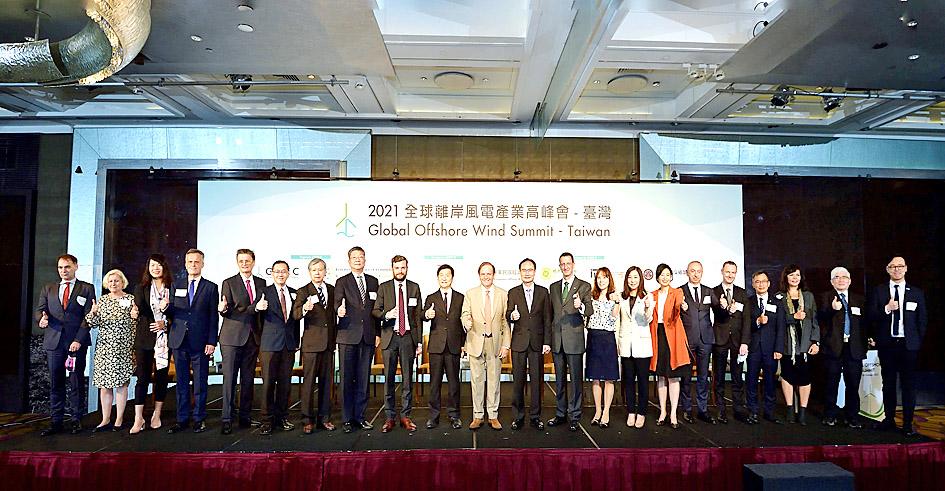
Photo courtesy of the European Chamber of Commerce Taiwan
In the years since Taiwan began its offshore wind farm development in 2016, the industry standard for the largest turbines has grown from about 10 megawatts of capacity to the Siemens-Gamesa SG 14-222 DD 14MW turbines to be used at the Hailong Offshore Wind Farm (海龍離岸風電).
Deputy Minister of Transportation and Communications Chi Wen-jong (祁文中) pledged to upgrade the harbor to suit the needs of the offshore wind farm industry.
“We have dedicated space at Taichung Harbor for the needs of the offshore wind farm industry — such as turbine assembly, transportation and component manufacturing — and five new heavy-duty quays will be constructed,” Chi said.
Elsewhere, a 15.8-hectare area has been earmarked near Taipei Harbor to be a construction zone for underwater infrastructure for the industry, he said.
In addition to a target of 5.6 gigawatts (GW) of offshore wind capacity installed by the end of 2025, Taiwan hopes to add 15GW of offshore wind capacity from 2026 to 2035 as part of its third round of development.
“As an export-oriented economy, Taiwan needs to keep up with the global trend to switch to renewable energy,” Vice Premier Shen Jong-chin (沈榮津) said. “By 2035, Taiwan will generate 77.3 billion kilowatt-hours of electricity per year through offshore wind farms.”
By then, the industry would have triggered NT$3.2 trillion (US$114.93 billion) in investment and created 74,000 local jobs, Shen said.
Industry representatives also asked for more “flexibility and support” with regard to Taiwan’s local content plan.
In the second round of development, participants were offered a choice of feed-in tariff-supported projects with a requirement that a proportion of components be made in Taiwan, but third round projects would no longer benefit from the tariffs, but are still subject to local content requirements.
Taiwan Offshore Wind Industry Association chairwoman Marina Hsu (許乃文) said that the “dual burden” of localization and price bids would be passed on from developers to power suppliers.
“We must ask: Are the local supply chains mature enough to bear this pressure?” she said.
While Taiwan is still “undoubtedly” the leader in non-China Asia-Pacific (APAC) offshore wind farm development, Japan and South Korea are aggressively entering the market and “offering a lot of subsidies and support,” said Alex Robertson, country manager for Danish turbine maker Vestas.
“Taiwanese offshore wind localization needs to move away from a rule-based approach and into a competition-based approach, and we want the kind of ambitious local partners who will be capable of exporting into the APAC region and even beyond,” Robertson said.

Cairo’s new monorail slices across the city skyline, running above the familiar chaos of blaring horns and aging buses’ exhaust fumes that mark rush hour below. The US$4.5 billion monorail, opened this month, is among Egypt’s most prominent new transport projects, part of a debt-funded infrastructure drive criticized for sapping state finances while bringing limited benefits to most of the country’s 109 million people. “It feels like you’re in a different country,” said Ramy Sayed, a restaurant manager, aboard a driverless Innovia 300 train. “No noise, no traffic, we’re not used to this.” The eastern line runs 56km from the bustling middle-class

Taiwanese firms have increased investment in the Philippines in recent years as Manila’s ties with Washington deepen and global supply chains continue to shift away from China, an expert at the Chung-Hua Institution for Economic Research (CIER, 中華經濟研究院) said yesterday. The Philippines had not been among Taiwanese investors’ top choices in Southeast Asia, CIER Taiwan ASEAN Studies Center director Kristy Hsu (徐遵慈) said at a seminar in Taipei. However, Taiwan’s investment in the country has grown significantly since the COVID-19 pandemic, reaching US $257 million last year, a high in recent years, she said. Although Taiwan’s total investment in the Philippines still lags

Intel Corp regards Taiwan Semiconductor Manufacturing Co (TSMC, 台積電) as a longstanding partner, as the US chipmaker would continue outsourcing production of advanced chips to TSMC, Intel chief executive officer Lip-Bu Tan (陳立武) said yesterday. “I don’t look at people as competitors. I look at the collaboration... Nvidia is also, you know, a good friend,” Tan told a news conference following his keynote speech at the Computex trade show in Taipei. “It’s a very trusted partnership for us... We are a big, top customer for them, and we’re going to continue doing that,” he said, referring to TSMC, the world’s largest foundry

Artificial intelligence (AI) agents would supplant smartphones as the center of people’s digital lives, fundamentally reshaping personal devices and driving a major computing upgrade cycle, Qualcomm Inc CEO Cristiano Amon said yesterday. In his keynote speech for this year’s Computex trade show in Taipei, Amon said that the rise of "agentic AI" — AI systems capable of reasoning, planning and carrying out tasks autonomously — would transform how people interact with technology across phones, PCs, vehicles and wearable devices. Describing the technology as the next major evolution in computing, Amon said that "2026 is the year of agents.” For decades, smartphones have sat


 RSS
RSS