


US stocks rose on Friday and the Dow Jones Industrial Average scored its biggest weekly percentage gain since June, as Goldman Sachs Group Inc rounded out a week of strong quarterly earnings for the big banks.
Goldman Sachs shares jumped 3.8 percent and gave the Dow its biggest boost, as a record wave of dealmaking activity drove a surge in the bank’s quarterly profit.
Goldman’s report followed strong results from Bank of America and others this week. Banks were among the biggest positives for the S&P 500 on the day, and the index’s bank index climbed 2.1 percent.
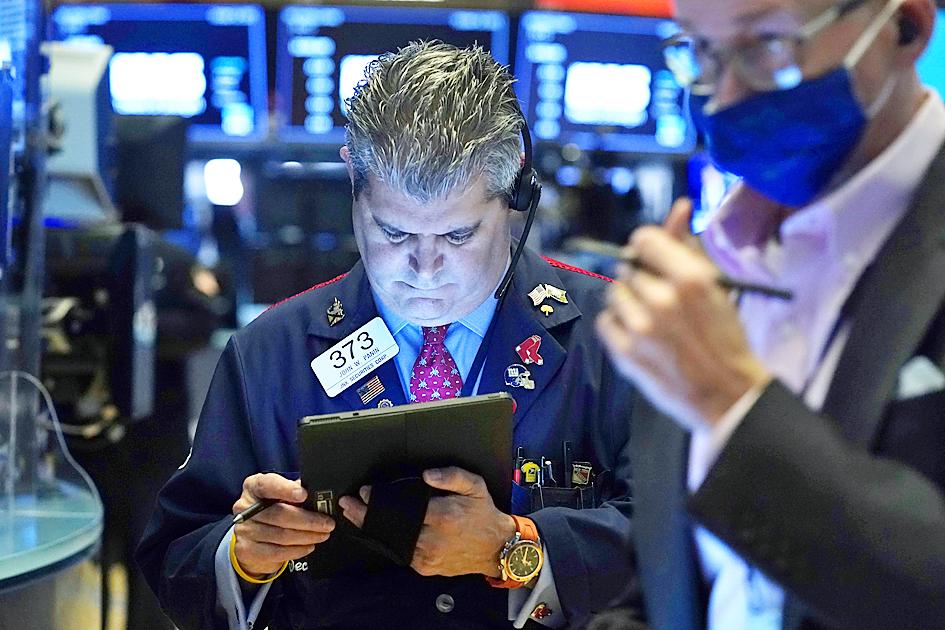
Photo: AP
Results from big financial institutions provided a strong start to third-quarter US earnings, although investors would still watch in coming weeks for signs of impacts from supply chain disruptions and higher costs, especially for energy.
Forecasts now call for third-quarter S&P 500 earnings to show a 32 percent rise from a year earlier. The latest forecast, based on results from 41 S&P 500 companies and estimates for the rest, is up from 29.4 percent at the start of this month, according to IBES data from Refinitiv.
“We’re starting to get into an earnings-driven rally here that I hope lasts. We’ll really see the results in the next couple of weeks as a great bulk of companies in all sectors report,” said Peter Tuz, president of Chase Investment Counsel in Charlottesville, Virginia.
Alcoa Corp shares surged 15.2 percent after the aluminum producer reported stronger-than-expected results, announced a US$500 million buyback program and initiated a quarterly cash dividend.
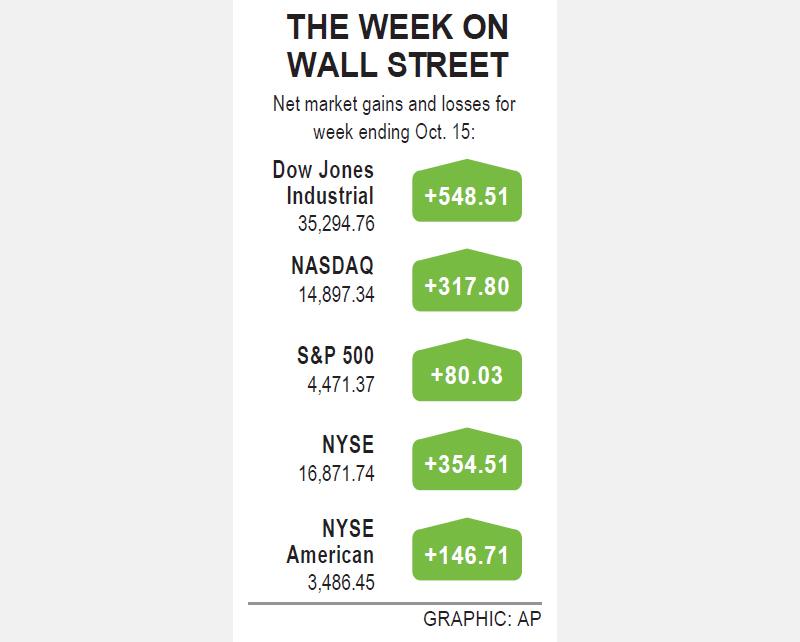
The Dow Jones Industrial Average rose 382.2 points, or 1.09 percent, to 35,294.76, the S&P 500 gained 33.11 points, or 0.75 percent, to 4,471.37 and the NASDAQ Composite added 73.91 points, or 0.5 percent, to 14,897.34.
The Dow jumped 1.6 percent for the week, its biggest weekly percentage gain since June 25. The S&P 500 had its strongest weekly advance since July 23, gaining 1.8 percent.
The NASDAQ added 2.2 percent for the week.
The US Department of Commerce reported a surprise rise in retail sales last month, although investors still worried that supply constraints could disrupt the holiday shopping season. A preliminary reading for consumer sentiment this month came in slightly below expectations.
Moderna Inc shares fell 2.3 percent. A Wall Street Journal report, citing people familiar with the matter, said the US Food and Drug Administration (FDA) is delaying its decision on authorizing Moderna’s COVID-19 vaccine for adolescents to check if the shot could increase the risk of heart inflammation.
On Thursday, Moderna shares jumped when an FDA panel voted to recommend booster shots of its COVID-19 vaccine for Americans aged 65 or older and high-risk people.
Shares of cryptocurrency and blockchain-related firms gained as bitcoin hit US$60,000 for the first time since April. Riot Blockchain Inc ended up 6.6 percent.
Advancing issues outnumbered declining ones on the New York Stock Exchange by a 1.12-to-1 ratio; on NASDAQ, a 1.24-to-1 ratio favored decliners.
The S&P 500 posted 57 new 52-week highs and no new lows; the NASDAQ Composite recorded 124 new highs and 59 new lows.
DAMAGE REPORT: Global central banks are assessing war-driven inflation risks as the law of unintended consequences careens around the world, spiking oil prices Central banks from Washington to London and from Jakarta to Taipei are about to make their first assessments of economic damage after more than two weeks of conflict between the US and Iran. Decisions this week encompassing every member of the G7 and eight of the world’s 10 most-traded currency jurisdictions are likely to confirm to investors that the specter of a new inflation shock is already worrying enough to prompt heightened caution. The US Federal Reserve is widely expected to do exactly what everyone anticipated weeks ahead of its March 17-18 policy gathering: hold rates steady. The narrative surrounding that
Taiwan Semiconductor Manufacturing Co’s (TSMC, 台積電) share of the global foundry market rose to almost 70 percent last year amid booming demand for artificial intelligence (AI), market information advisory firm TrendForce Corp (集邦科技) said on Thursday. The contract chipmaker posted US$122.54 billion in revenue, up 36.1 percent from a year earlier, accounting for 69.9 percent of the global market, TrendForce said. Its share was up from 64.4 percent in 2024, it said. TSMC’s closest rival, Samsung Electronics, was a distant second, posting US$12.63 billion in sales, down 3.9 percent from a year earlier, for a 7.2 percent share of the global market. In the
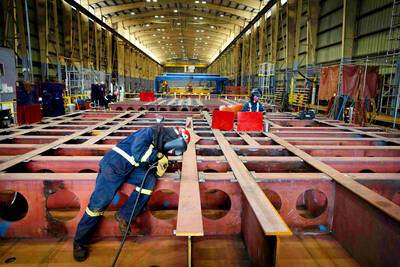
At a massive shipyard in North Vancouver, Canadian workers grind metal beams for a powerful new icebreaker crucial to cementing the country’s presence in the increasingly contested arctic. Icebreakers are specialized, expensive vessels able to navigate in the frozen far north. And “this is the crown jewel,” said Eddie Schehr, vice president of production at the Seaspan shipyard. For Canadian Prime Minister Mark Carney, who heads to Norway next Friday to observe arctic defense drills involving troops from 14 NATO states, Canada’s extreme north has emerged as a strategic priority. “Canada is and forever will be an Arctic nation,” he said ahead of

Chinese entrepreneur Frank Gao used to spend long hours running his social media accounts but now outsources the chore to artificial intelligence (AI) agent tool OpenClaw, which is taking China by storm despite official warnings over cybersecurity. OpenClaw, created in November by an Austrian coder, differs from bots such as ChatGPT because it can execute real-life tasks such as sending e-mails, organizing files or even booking flight tickets. “Since January, I’ve spent hours on the lobster every day,” Gao said in an interview, referring to OpenClaw’s red crustacean mascot. “We’re family.” After downloading OpenClaw, users connect it to artificial intelligence models of their


 RSS
RSS