


US stocks ended sharply lower in a broad sell-off on Friday, ending a week buffeted by strong economic data, corporate tax hike worries, the Delta variant of SARS-CoV-2 and possible shifts in the US Federal Reserve’s timeline for tapering asset purchases.
All three major US stock indices lost ground, with the NASDAQ Composite Index’s weighed down as rising US Treasury yields pressured market-leading growth stocks.
They also posted weekly losses, with the S&P index suffering its biggest two-week drop since February.
“The market is struggling with prospects for tighter fiscal policy due to tax increases, and tighter monetary policy due to Fed tapering,” said David Carter, chief investment officer at Lenox Wealth Advisors Inc in New York.
“Equity markets are also a little softer due to today’s weak consumer sentiment data,” Carter added. “It’s triggering concerns that the Delta variant could slow economic growth.”
A potential hike in corporate taxes could eat into earnings also weigh on markets, with leading Democrats seeking to raise the top tax rate on corporations to 26.5 percent from 21 percent.
While consumer sentiment steadied this month, it remains depressed, according to a University of Michigan report, as Americans postpone purchases while inflation remains high.
Inflation is likely to be a major issue next week, when the US Federal Open Markets Committee holds its two-day monetary policy meeting. Market participants will be watching closely for changes in nuance, which could signal a shift in the Fed’s tapering timeline.
“It has been a week of mixed economic data and we are focused clearly on what will come out of the Fed meeting next week,” said Bill Northey, senior investment director at US Bank Wealth Management in Helena, Montana.
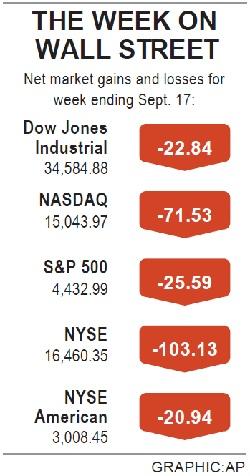
The Dow Jones Industrial Average on Friday fell 166.44 points, or 0.48 percent, to 34,584.88; the S&P 500 lost 40.76 points, or 0.91 percent, at 4,432.99; and the NASDAQ Composite dropped 137.96 points, or 0.91 percent, to 15,043.97.
For the week, fell less than 0.1 percent, the S&P 500 lost 0.6 percent and the NASDAQ shed 0.5 percent.
The S&P 500 ended below its 50-day moving average, which in recent history has proven a rather sturdy support level.
Of the 11 major sectors in the S&P 500, all but healthcare ended in the red, with materials and utilities suffering the biggest percentage drops.
COVID-19 vaccine manufacturers Pfizer Inc and Moderna Inc dropped 1.3 percent and 2.4 percent respectively as US health officials moved the debate over booster doses to a panel of independent experts.
US Steel Corp shed 8 percent after it unveiled a US$3 billion mini-mill investment plan.
Robinhood Markets Inc rose 1 percent after Cathie Wood’s ARK Invest bought US$14.7 million worth of shares in the trading platform.
Volume and volatility spiked toward the end of the session due to “triple witching,” which is the quarterly, simultaneous expiration of stock options, stock index futures and stock index options contracts.
Volume on US exchanges was 15.51 billion shares, compared with the 9.70 billion average over the past 20 trading days.
Declining issues outnumbered advancing ones on the New York Stock Exchange by a 1.97-to-1 ratio; on NASDAQ, a 1.00-to-1 ratio favored advancers.
The S&P 500 posted seven new 52-week highs and two new lows; the NASDAQ Composite recorded 67 new highs and 82 new lows.

The domestic unit of the Chinese-owned, Dutch-headquartered chipmaker Nexperia BV will soon be able to produce semiconductors locally within China, according to two company sources. Nexperia is at the center of a global tug-of-war over critical semiconductor technology, with a Dutch court in February ordering a probe into alleged mismanagement at the company. The geopolitical tussle has disrupted supply chains, with some carmakers reportedly forced to cut production due to chip shortages. Local production would allow Nexperia’s domestic arm, Nexperia Semiconductors (China) Ltd (安世半導體中國), to bypass restrictions in place since October on the supply of silicon wafers — etched with tiny components to

Singapore-based ride-hailing and delivery giant Grab Holdings Ltd has applied for regulatory approval to acquire the Taiwan operations of Germany-based Delivery Hero SE's Foodpanda in a deal valued at about US$600 million. Grab submitted the filing to the Fair Trade Commission on Friday last week, with the transaction subject to regulatory review and approval, the company said in a statement yesterday. Its independent governance structure would help foster a healthy and competitive market in Taiwan if the deal is approved, Grab said. Grab, which is listed on the NASDAQ, said in the filing that US-based Uber Technologies Inc holds about 13 percent of

Taiwan is open to joining a global liquefied natural gas (LNG) program if one is created, but on the condition that countries provide delivery even in a scenario where there is a conflict with China, an energy department official said yesterday. While Taiwan’s priority is to have enough LNG at home, the nation is open to exploring potential strategic reserves in other countries such as Japan or South Korea, Energy Administration Deputy Director-General Chen Chung-hsien (陳崇憲) said. While the LNG market does not have a global reserve for emergencies like that of oil, the concept has been raised a few times —

Taiwan Semiconductor Manufacturing Co (TSMC, 台積電) yesterday received government approval to deploy its advanced 3-nanometer (3nm) process at its second fab currently under construction in Japan, the Ministry of Economic Affairs said in a news release. The ministry green-lit the plan for the facility in Kumamoto, which is scheduled to start installing equipment and come online in 2028 with a monthly production capacity of 15,000 12-inch wafers, the ministry said. The Department of Investment Review in June 2024 authorized a US$5.26 billion investment for the facility, slated to manufacture 6- to 12nm chips, significantly less advanced than 3nm process. At a meeting with


 RSS
RSS