


Taiwan’s top 50 corporations could see their profitability improve in the next 12 months, backed by continued robust demand for electronics goods in which local firms have a competitive advantage globally, Taiwan Ratings Corp (中華信評) said in a report released on Tuesday.
The leading 50 corporations could achieve an overall increase of 16.6 percent in earnings before interest, taxes, depreciation and amortization (EBITDA) this year, slowing from a 19 percent rise last year, said Raymond Hsu (許智清), a corporate credit analyst from the local arm of S&P Global Ratings.
Meanwhile, their average EBITDA margin could rise from 15.1 percent to a decade-high of 16.2 percent, Hsu said.
Photo: Clare Cheng, Taipei Times
Companies’ creditworthiness has picked up across sectors, with high-tech firms accounting for half of the top 50, followed by suppliers of commodity chemicals, he said.
Taiwanese tech firms have benefited from the low-contact economy fueled by remote working and learning trends, Hsu said, adding that e-commerce operators, logistics service providers and shipping companies also gainedfrom behavioral changes caused by the COVID-19 pandemic.
Looking ahead, robust export demand would further boost their credit strength over the coming year, he said.
Profitability and cash flow at the top 50 corporations would remain near current record levels well into the first half of next year on the back of demand recovery in advanced markets, thanks to the positive effect of COVID-19 vaccinations, Hsu said.
A fast increase in cash flows has enabled the companies invest aggressively and offer generous dividend payouts, he said.
However, uncertainty lingers, as infections linked to the Delta variant of SARS-CoV-2 are escalating around the world, and Southeast Asian countries have introduced lockdowns to rein in the outbreak, Hsu said.
Taiwan Ratings said that local semiconductor and shipping companies could experience supply gluts in three to five years because they have expanded their capacity.
Congestion at ports caused by COVID-19 infections — rather than a lack of ships and containers — have slowed sea transportation and pushed up freight rates, a phenomenon that could reverse once the outbreak is under control, the agency said, opposing views by other research bodies and shipping companies.
The same issue could hit semiconductor suppliers that are building plants at home and abroad to ease chip shortages, Hsu said.
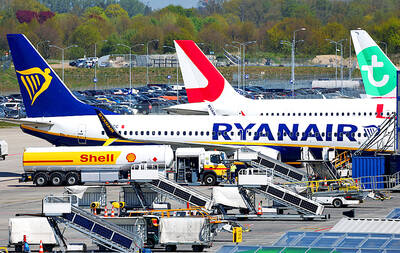
Ryanair, Transavia, Volotea and other low-cost airlines are feeling the financial pain from high jet fuel prices as a result of the Middle East war and are cutting flights. The closure of the Strait of Hormuz has taken a huge chunk of oil supplies off the market, sending the price of jet fuel soaring and triggering fears of shortages that could force airlines to cancel flights. Airlines are not waiting for a lack of supplies to react. “Travel alert: Airlines are cutting thousands of flights right now,” Travel Therapy host Karen Schaler said in an Instagram reel this past weekend.

MANAGING RISKS: Taiwan has secured LNG sufficient to cover 95 percent of electricity demand for next month, UBS said, describing the government’s approach as proactive UBS Group AG has raised its forecast for Taiwan’s economic growth this year to 8 percent, up from 6.9 percent previously, and said expansion could reach as high as 8.6 percent if external energy shocks are avoided. The upgrade reflects a stronger-than-expected first-quarter performance and sustained momentum in artificial intelligence (AI)-driven exports, which UBS said are providing a firm foundation for growth despite geopolitical and energy risks. Taiwan’s GDP expanded 13.69 percent year-on-year in the first quarter, the fastest growth since the second quarter of 1987, the Directorate-General of Budget, Accounting and Statistics (DGBAS) reported on Thursday. On a seasonally

The Fair Trade Commission’s (FTC) ongoing review of Grab Holdings Ltd’s US$600 million acquisition of Foodpanda Taiwan’s operations, announced on March 23, has taken on fresh urgency as industry experts warn that the transaction could embed significant Chinese cybersecurity vulnerabilities into Taiwan’s digital infrastructure through Grab’s deep ties to autonomous-driving firm WeRide (文遠知行). Less than 16 months after the FTC blocked Uber Eats’ direct attempt to acquire Foodpanda Taiwan — citing potential combined market shares of 80 to 90 percent — the emergence of Grab as the buyer has prompted questions about whether the same competitive harm is simply being rerouted

The list of Asian stocks that benefit from business partnership with Nvidia Corp is getting longer, as the region further integrates into the artificial intelligence (AI) chip giant’s business ecosystem. Just in the past week, South Korea’s LG Electronics Inc, Taiwan’s Nanya Technology Corp (南亞科技), as well as China’s Huizhou Desay SV Automotive Co (德賽西威) and Pateo Connect Technology Shanghai Corp (博泰車聯) have become the latest to rally on news of tie-ups, supply-chain participation or product collaboration with the US chip designer. Asian suppliers account for about 90 percent of Nvidia’s production costs, up from about 65 percent last year, data compiled


 RSS
RSS