


The three major US stock indices rallied to record closing highs on Friday as financials and other economically focused sectors rebounded from a sell-off sparked by growth worries earlier in the week.
The rally allowed the indices to notch slight gains for the week, which also saw a sharp rally in US Treasuries as investors worried the US economic recovery might be losing steam as the Delta variant of SARS-CoV-2 spread globally.
US 10-year Treasury notes fell on Friday, halting an eight-day price rise, while the S&P 500 financials sector jumped 2.9 percent in the sector’s biggest daily percentage gain since March 1.
Financials led sector advances followed by energy, materials and industrials. Big banks, including JPMorgan Chase & Co, are to begin the second-quarter earnings season next week when they report results.
“What an about-face from all of the gloom and doom from yesterday,” said Jake Dollarhide, chief executive officer of Longbow Asset Management in Tulsa, Oklahoma.
“The US is in a bubble compared to the rest of the world, in a break from COVID. How long that’s going to last we don’t know,” he said, but “until that narrative changes, this is a market with a lot of free money and low interest rates.”
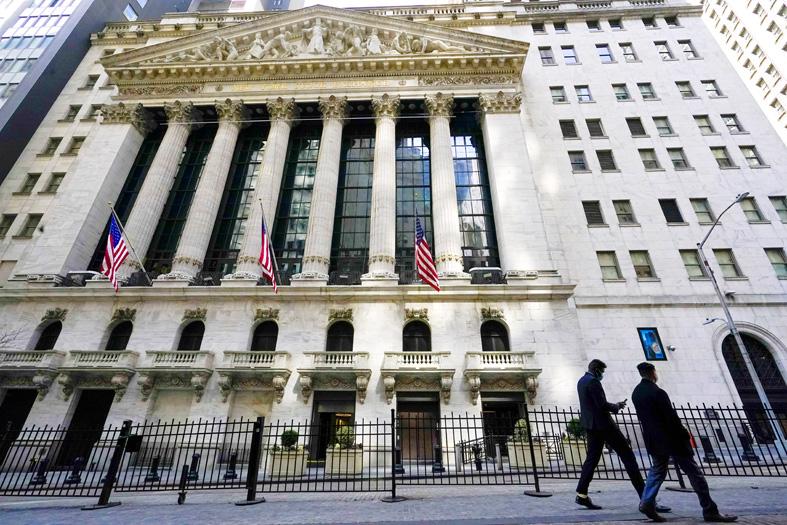
Photo: AP
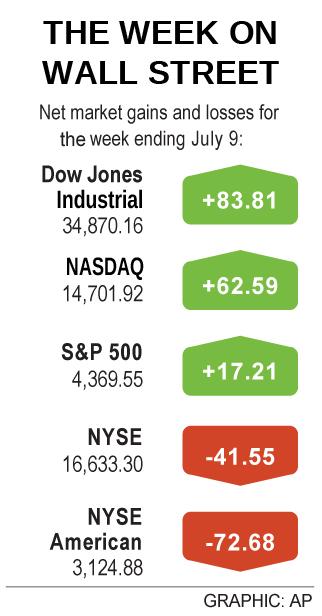
The Dow Jones Industrial Average on Friday rose 448.23 points, or 1.3 percent, to 34,870.16, the S&P 500 gained 48.73 points, or 1.13 percent, to 4,369.55 and the NASDAQ Composite added 142.13 points, or 0.98 percent, to 14,701.92.
For the week, the Dow rose 0.2 percent, and the S&P 500 and NASDAQ each added 0.4 percent.
A big jump in quarterly earnings is expected to mark a peak for US profit growth in the recovery from last year’s COVID-19 pandemic-induced collapse. Investors are looking to US companies’ upcoming quarterly results and forecasts about the recovery in the second half of this year as some worry that the recent economic surge is already waning.
Analysts expect earnings growth of 65.8 percent for companies in the S&P 500 index in the quarter, up from a previous forecast of 54 percent growth at the start of the period, according to Refinitiv IBES data.
Among individual stocks, Levi Strauss & Co rose 1.4 percent as it forecast a strong full-year profit after beating quarterly earnings estimates on improving demand across its markets for jeans, tops and jackets.
US-listed shares of Chinese ride-hailing company Didi Global Inc (滴滴) gained 7.3 percent after four sessions of losses, as it was recently hit by an investigation from China’s Internet watchdog.
Volume on US exchanges was 8.51 billion shares, compared with the 10.5 billion average for the full session over the past 20 trading days.
Advancing issues outnumbered declining ones on the New York Stock Exchange by a 3.77-to-1 ratio; on NASDAQ, a 3.33-to-1 ratio favored advancers.
The S&P 500 posted 44 new 52-week highs and no new lows; the NASDAQ Composite recorded 60 new highs and 32 new lows.

NEW MARKET: The partnership opens up India to the Dutch company, which already has a strong hold in the semiconductor market of South Korea, Taiwan and China ASML Holding NV entered into a partnership agreement with Tata Electronics Pvt Ltd aimed at ramping up India’s goal to develop domestic chip-manufacturing capabilities. The Dutch company’s technology would help power Tata Electronics’ planned 300 millimeter (mm) semiconductor foundry in Gujarat, according to a joint statement from the two companies on Saturday. The signing of a memorandum of understanding coincides with a visit by Indian Prime Minister Narendra Modi to the Netherlands, which is looking to deepen bilateral relations with New Delhi. ASML, whose top customers include Taiwan Semiconductor Manufacturing Co (台積電) and Samsung Electronics Co, makes lithography machines that can print
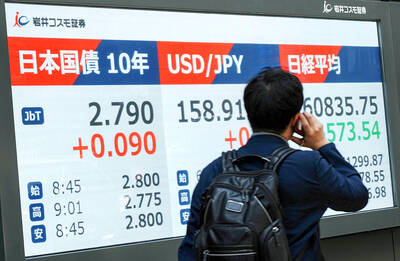
ROUGH RECORDS: Bonds in Japan, as well is in New Zealand, Australia and the US, are seeing the effects of a nervy market as stock exchanges across Asia edge down A deepening slump in Japanese government bonds added fuel to the selloff in global debt markets as rising oil prices stoked inflation fears and pushed yields to multi-decade highs. Japan’s 30-year yield yesterday surged as much as 20 basis points to the highest level since the tenor’s debut in 1999, before paring some of the move. Shorter-maturity Japanese debt was also under pressure, underscored by weak demand at a sale of five-year notes that offered a record-high coupon of 2 percent. Concerns over inflation and government spending rippling through markets including the US, Australia and New Zealand are being amplified in Japan,
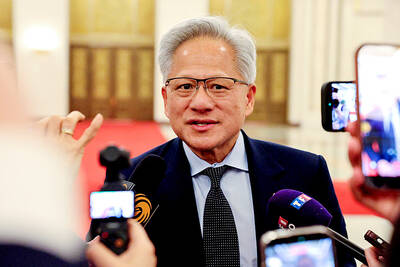
The US has cleared about 10 Chinese firms to buy Nvidia Corp’s second-most powerful artificial intelligence (AI) chip, the H200, but not a single delivery has been made so far, three people familiar with the matter said, leaving a major technology deal in limbo as chief executive officer Jensen Huang (黃仁勳) seeks a breakthrough in China this week. Huang, who was not initially listed in a White House delegation to Beijing, joined the trip after an invitation from US President Donald Trump, a source said. Trump picked him up in Alaska en route to a summit with Chinese President Xi Jinping
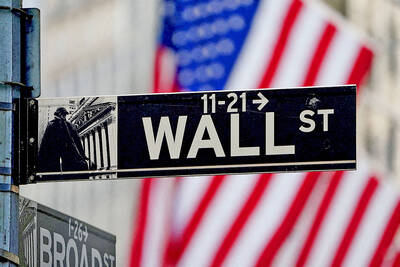
Wall Street is licking its chops over an unprecedented slate of massive initial public offerings (IPOs) set to arrive in the coming months, beginning with Elon Musk’s Space Exploration Technologies Corp (SpaceX) next month. That is expected to be followed by artificial intelligence (AI) rivals OpenAI and Anthropic PBC. The trio of mega listings, each eyeing valuations around US$1 trillion or more, constitutes a heady period of elevated risk and reward. SpaceX is targeting an IPO that would raise up to US$80 billion — about double the funds generated from all IPOs last year. OpenAI and Anthropic are eyeing IPOs raising US$60 billion. “We’re


 RSS
RSS