


Taiwan’s foreign exchange reserves last month climbed to US$543.28 billion — the second-highest figure in the nation’s history — increasing for a third consecutive month and retaining the fifth-largest position globally, the central bank said yesterday.
Department of Foreign Exchange Director-General Eugene Tsai (蔡炯民) mainly attributed the monthly increase of US$304 million in foreign exchange reserves last month to the central bank’s management, even though its euro, British pound, Japanese yen and Chinese yuan holdings weakened against the US dollar.
“Overall, the market maintained its equilibrium despite a net global fund outflow,” Tsai said.

Photo: Chen Mei-ying, Taipei Times
Foreign funds fled Taiwan last month after US economic data beat market expectations and the US Federal Reserve said that it would contemplate raising interest rates ahead of schedule, Tsai said.
The greenback gained in value as a result of global capital movements, he said.
Foreign portfolio managers trimmed their holdings in local shares by US$1.92 billion and wired another US$2.7 billion in capital gains, Tsai said, citing data from the Financial Supervisory Commission.
Still, local securities and debts held by foreign investors totaled US$715.7 billion, equivalent to 1.32 times the nation’s foreign exchange reserves, the central bank said.
That was steady from one month earlier and meant foreign funds remained interested in local stocks, explaining why the TAIEX repeatedly rallied to record highs, Tsai said.
The TAIEX ended up 1.18 percent at a record 17,919.33 yesterday, Taiwan Stock Exchange data showed.
China remained the top holder of foreign exchange reserves globally, followed by Japan, Switzerland and India, Tsai said.
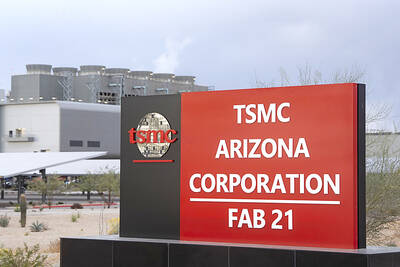
Taiwan Semiconductor Manufacturing Co (TSMC, 台積電), the world’s biggest contract chipmaker, booked its first-ever profit from its Arizona subsidiary in the first half of this year, four years after operations began, a company financial statement showed. Wholly owned by TSMC, the Arizona unit contributed NT$4.52 billion (US$150.1 million) in net profit, compared with a loss of NT$4.34 billion a year earlier, the statement showed. The company attributed the turnaround to strong market demand and high factory utilization. The Arizona unit counts Apple Inc, Nvidia Corp and Advanced Micro Devices Inc among its major customers. The firm’s first fab in Arizona began high-volume production

COLLABORATION: Softbank would supply manufacturing gear to the factory, and a joint venture would make AI data center equipment, Young Liu said Hon Hai Precision Industry Co (鴻海精密) would operate a US factory owned by Softbank Group Corp, setting up what is in the running to be the first manufacturing site in the Japanese company’s US$500 billion Stargate venture with OpenAI and Oracle Corp. Softbank is acquiring Hon Hai’s electric-vehicle plant in Ohio, but the Taiwanese company would continue to run the complex after turning it into an artificial intelligence (AI) server production plant, Hon Hai chairman Young Liu (劉揚偉) said yesterday. Softbank would supply manufacturing gear to the factory, and a joint venture between the two companies would make AI data
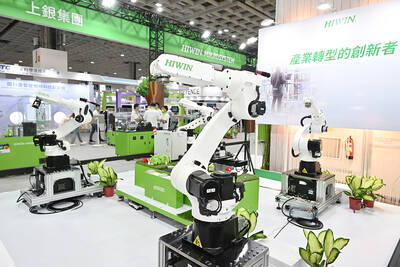
The Taiwan Automation Intelligence and Robot Show, which is to be held from Wednesday to Saturday at the Taipei Nangang Exhibition Center, would showcase the latest in artificial intelligence (AI)-driven robotics and automation technologies, the organizer said yesterday. The event would highlight applications in smart manufacturing, as well as information and communications technology, the Taiwan Automation Intelligence and Robotics Association said. More than 1,000 companies are to display innovations in semiconductors, electromechanics, industrial automation and intelligent manufacturing, it said in a news release. Visitors can explore automated guided vehicles, 3D machine vision systems and AI-powered applications at the show, along

AI SERVER DEMAND: ‘Overall industry demand continues to outpace supply and we are expanding capacity to meet it,’ the company’s chief executive officer said Hon Hai Precision Industry Co (鴻海精密) yesterday reported that net profit last quarter rose 27 percent from the same quarter last year on the back of demand for cloud services and high-performance computing products. Net profit surged to NT$44.36 billion (US$1.48 billion) from NT$35.04 billion a year earlier. On a quarterly basis, net profit grew 5 percent from NT$42.1 billion. Earnings per share expanded to NT$3.19 from NT$2.53 a year earlier and NT$3.03 in the first quarter. However, a sharp appreciation of the New Taiwan dollar since early May has weighed on the company’s performance, Hon Hai chief financial officer David Huang (黃德才)


 RSS
RSS