


Taiwan stocks yesterday rebounded, posting their best gains since March last year thanks to a broader rally among chipmakers.
Investors were buoyed by hopes that Taiwan might soon receive more COVID-19 vaccines and also by strong buying among foreign institutional investors on Monday, dealers said.
The TAIEX closed up 792.09 points, or 5.16 percent, at 16,145.98. The nearly 800-point gain was the biggest single-day rise in its history, smashing the previous high of 590.19 points on Nov. 29, 1989.
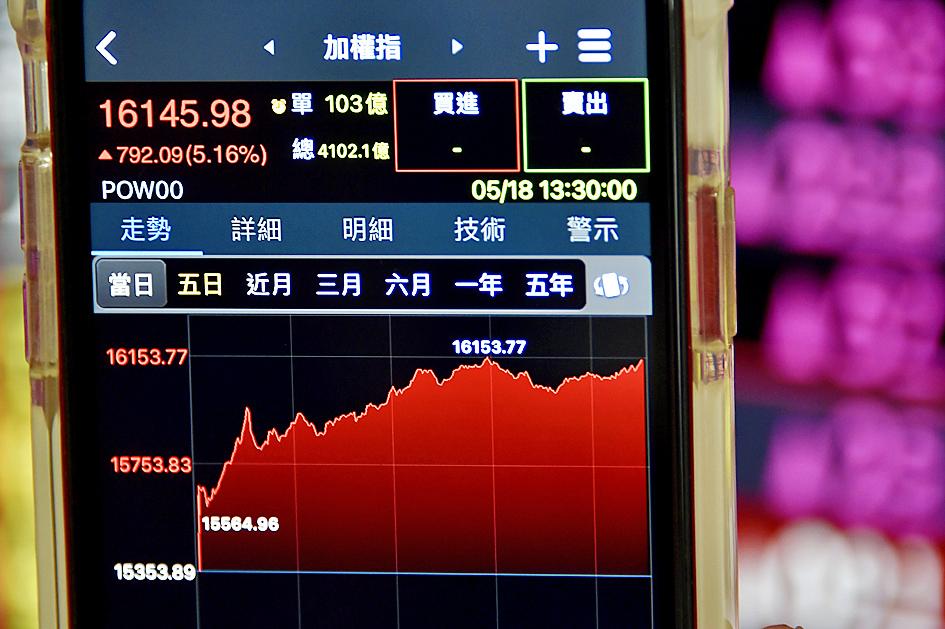
Photo: Tu Chien-jung, Taipei Times
Turnover totaled NT$410.207 billion (US$14.68 billion), as foreign institutional investors continued to pour money into the market, registering a net buy of NT$22.13 billion, the Taiwan Stock Exchange said.
“The dive in the TAIEX on Monday did not deter foreign institutional investors, which bolstered the confidence of many local investors, who seemed willing to chase prices today,” Concord Securities Co (康和證券) analyst Kerry Huang (黃志祺) said, referring to a net buy of NT$33.42 billion in shares by foreign institutional investors on Monday.
“More importantly, after the announcement of US President Joe Biden’s decision to send more COVID-19 vaccines to other countries, many investors became optimistic that Taiwan would receive some of them,” Huang said.
On Monday, a Reuters report quoted GAVI, the Vaccine Alliance — one of the WHO’s COVAX partners — as saying that it expects Taiwan to get its allocation of AstraZeneca COVID-19 vaccines by the end of next month.
Before yesterday’s rebound, the TAIEX had plunged 11.78 percent since the beginning of last week as Taiwan saw an escalation of locally transmitted COVID-19 cases.
Yesterday, Deputy Minister of Finance Frank Juan (阮清華) said that the state-run National Stabilization Fund was still monitoring the market.
Chipmaker Taiwan Semiconductor Manufacturing Co (台積電) jumped 4.19 percent, while chip designer MediaTek Inc (聯發科) climbed 8.75 percent. The two contributed the most to the benchmark’s gains. Steel, glass and shipping were among the top-performing sectors.
The TAIEX is by far the most volatile among major stock benchmarks tracked by Bloomberg, with a measure of 10-day swings the highest in more than a year.
Stock traders are preparing for more volatility ahead, loading up on options tracking the TAIEX.
The cost of hedging against swings in TAIEX rose to a 12-year high versus the S&P 500 on Monday, prices for one-month options compiled by Bloomberg showed.
“Investors should keep a close eye on the development of the local COVID-19 outbreak, which is likely to move the market,” Huang said, adding that there is strong technical resistance for the TAIEX at about 16,500, near the 60-day moving average.
Separately yesterday, the Financial Supervisory Commission said that financial companies should continue to maintain their operations and services even if the COVID-19 alert is raised to level 4.
The local stock and futures markets would open, while banks should at least maintain their online services and automatic-teller machines, and brokerage firms should operate their online trading platforms, it said.
Insurance companies should still review clients’ compensation claims and provide policies via online services, it said.
Additional reporting by Kao Shih-ching

The domestic unit of the Chinese-owned, Dutch-headquartered chipmaker Nexperia BV will soon be able to produce semiconductors locally within China, according to two company sources. Nexperia is at the center of a global tug-of-war over critical semiconductor technology, with a Dutch court in February ordering a probe into alleged mismanagement at the company. The geopolitical tussle has disrupted supply chains, with some carmakers reportedly forced to cut production due to chip shortages. Local production would allow Nexperia’s domestic arm, Nexperia Semiconductors (China) Ltd (安世半導體中國), to bypass restrictions in place since October on the supply of silicon wafers — etched with tiny components to

Singapore-based ride-hailing and delivery giant Grab Holdings Ltd has applied for regulatory approval to acquire the Taiwan operations of Germany-based Delivery Hero SE's Foodpanda in a deal valued at about US$600 million. Grab submitted the filing to the Fair Trade Commission on Friday last week, with the transaction subject to regulatory review and approval, the company said in a statement yesterday. Its independent governance structure would help foster a healthy and competitive market in Taiwan if the deal is approved, Grab said. Grab, which is listed on the NASDAQ, said in the filing that US-based Uber Technologies Inc holds about 13 percent of

Taiwan is open to joining a global liquefied natural gas (LNG) program if one is created, but on the condition that countries provide delivery even in a scenario where there is a conflict with China, an energy department official said yesterday. While Taiwan’s priority is to have enough LNG at home, the nation is open to exploring potential strategic reserves in other countries such as Japan or South Korea, Energy Administration Deputy Director-General Chen Chung-hsien (陳崇憲) said. While the LNG market does not have a global reserve for emergencies like that of oil, the concept has been raised a few times —

Taiwan Semiconductor Manufacturing Co (TSMC, 台積電) yesterday received government approval to deploy its advanced 3-nanometer (3nm) process at its second fab currently under construction in Japan, the Ministry of Economic Affairs said in a news release. The ministry green-lit the plan for the facility in Kumamoto, which is scheduled to start installing equipment and come online in 2028 with a monthly production capacity of 15,000 12-inch wafers, the ministry said. The Department of Investment Review in June 2024 authorized a US$5.26 billion investment for the facility, slated to manufacture 6- to 12nm chips, significantly less advanced than 3nm process. At a meeting with


 RSS
RSS